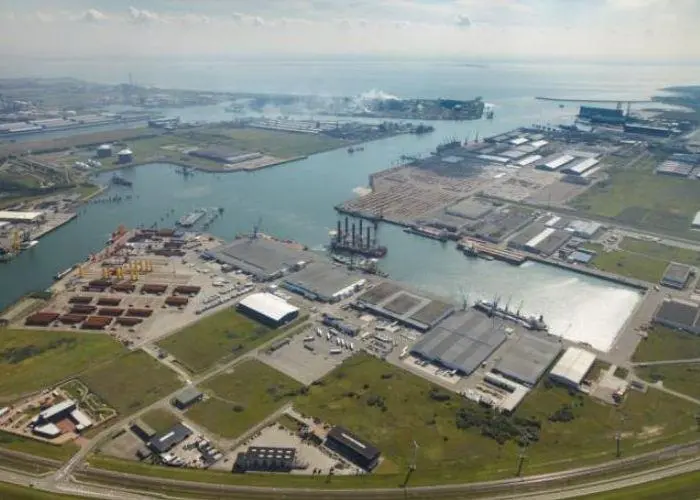
The new quay in the ‘Kaloothaven’ will be used by Ovet, resulting in the company having a deepwater quay of 650m in length plus another quay which is 310m long. Moreover, the deepwater quay is suitable for ships with a draught of up to 16.5m, with the potential for deepening to 17.5m.
Zeeland Seaports began preparations for construction in June 2011 and the project was completed in less than a year . The quay was designed for Zeeland Seaports by the consulting engineering company Lievense, which also took responsibility for project management and execution. It was built by main contractors Ballast Nedam.
The new quay wall has been placed in front of the original quay, and loading and unloading of the capesize vessels will be done by floating cranes. This reduces the required height of the retaining quay wall to 20m instead of 26m, thereby limiting construction costs.
Thanks to the new quay, Ovet can simultaneously handle two capesize ships and one panamax ship. In addition, Ovet has taken delivery of new premises covering approximately 1.5 hectares, giving the company additional storage and transhipment capacity.
Ovet has been an important customer for Zeeland Seaports from the outset, because company plays an important role in the transhipment of dry bulk such as minerals, ore and solid fuels and the handling of biomass in both East Vlissingen and Terneuzen.
Customers for these products include the electricity generation and steel industries. With around 35m tonnes transhipped annually, Zeeland Seaports is the Netherlands’ third largest port. At over 30%, dry bulk forms an important component of this operation.
The new quay means Ovet is able to meet the growing demand for imported coal from Germany as a result of the closure of the German nuclear power stations and coal mines (until 2018).