In 2005, Sharjah Container Terminal (SCT) and Khorfakkan Container Terminal handled 228,170 teu and 1.9m teu respectively, while 2006 volumes are “on par with expectations” at Khorfakkan and “above expectations” at SCT for the current year, according to Gulftainer commercial manager Keith Nuttall.
“The rapid rise in costs and the truly awful road congestion in this area mean that many consignees are increasingly re-locating to cheaper, more accessible areas, further away from the traditional centres. This does have an impact on us because such areas are often nearer to our terminal in Sharjah or the SICD, which services Khorfakkan,”he says.
Nevertheless, he stresses that he is not suggesting that Jebel Ali will fade away, but points out that cost and congestion in the Emirates, as anywhere else in the world, is making companies ‘spread out’ and that means that Gulftainer, as DP World’s only real domestic competitor, will be affected positively as, geographically, more companies will seek out more conveniently placed terminals,such as those run by the company.
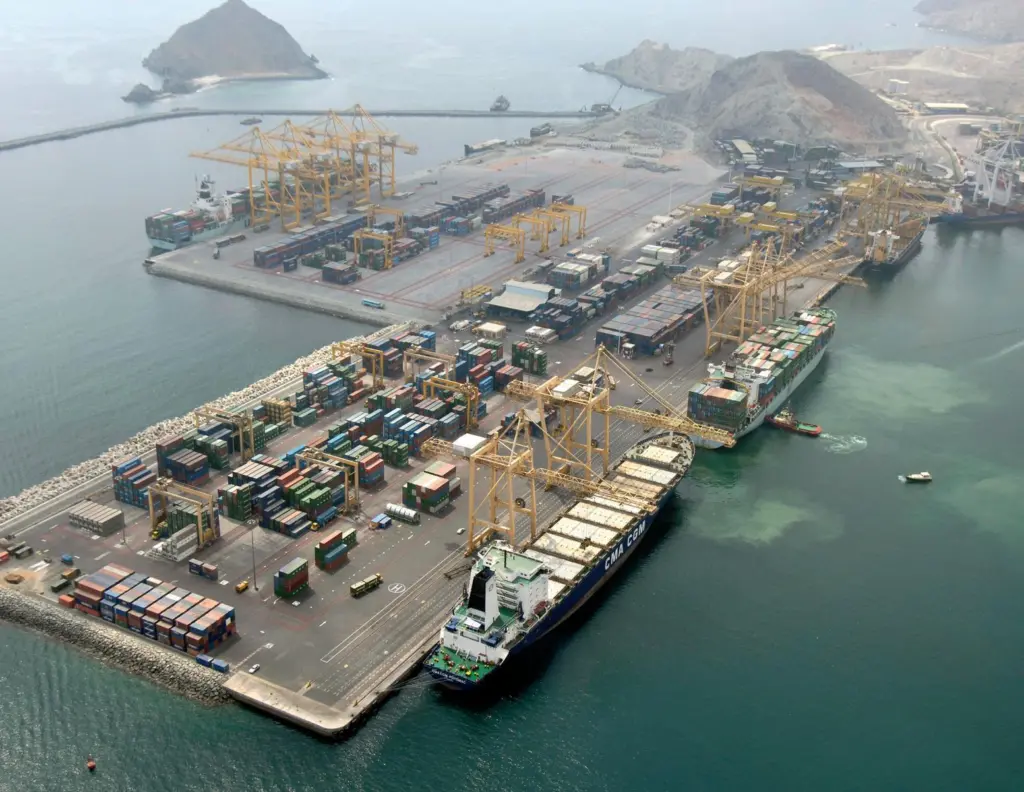
With this in mind, both Gulftainer’s terminals have been planning for the future. Earlier this year, Khorfakkan expanded its quay by 400m and added four new super post-panamax gantries, while 300,000 sq m of extra stacking and storage area was brought on line.Ships requiring 16m of draught can now also dock at low water.
SCT will also be expanded in 2006/2007. This will involve the use of an extra berth, as well as the acquisition of two post-panamax gantries and two mobile harbour cranes. The draught will also be deepened to 12.5m and up to 30,000 sq m of storage/stacking area will be brought into use. “In terms of productivity, this depends on a large number of factors. However on large, 8,500 teu ships with a 5,000 move exchange each week, we are achieving around 200 moves per hour with four super post-Panamax gantries at Khorfakkan,”says Mr Nuttall.
Another significant feature in recent years is the emergence of very large ships throughput the Gulf. Despite the fact that the region is replete with container terminals, he states that only Jebel Ali and Khorfakkan can handle the very largest ships.
“The cost environment for lines in the last year or so has worsened, so that all of them are looking at cutting costs and port calls (particularly with big ships) where possible. In this context, Khorfakkan and Jebel Ali are the two main hubs and Khorfakkan can save more time (and money) because it’s outside the Gulf.”
Challenged as to whether any business these days can be said to be ‘captive’, Mr Nuttall says it cannot. Nevertheless, he states that these days cargo bound wholly for the Emirate of Sharjah tends to move increasingly through the most accessible terminal available – this being a function of due costs/ congestion – again contributing to throughput figures at Sharjah.
At far as overseas opportunities are concerned, Mr Nuttall says that Gulftainer is considering options both in its surrounding region and beyond, of which a recently signed management contract for ports in the Comoros Islands is one particular example.