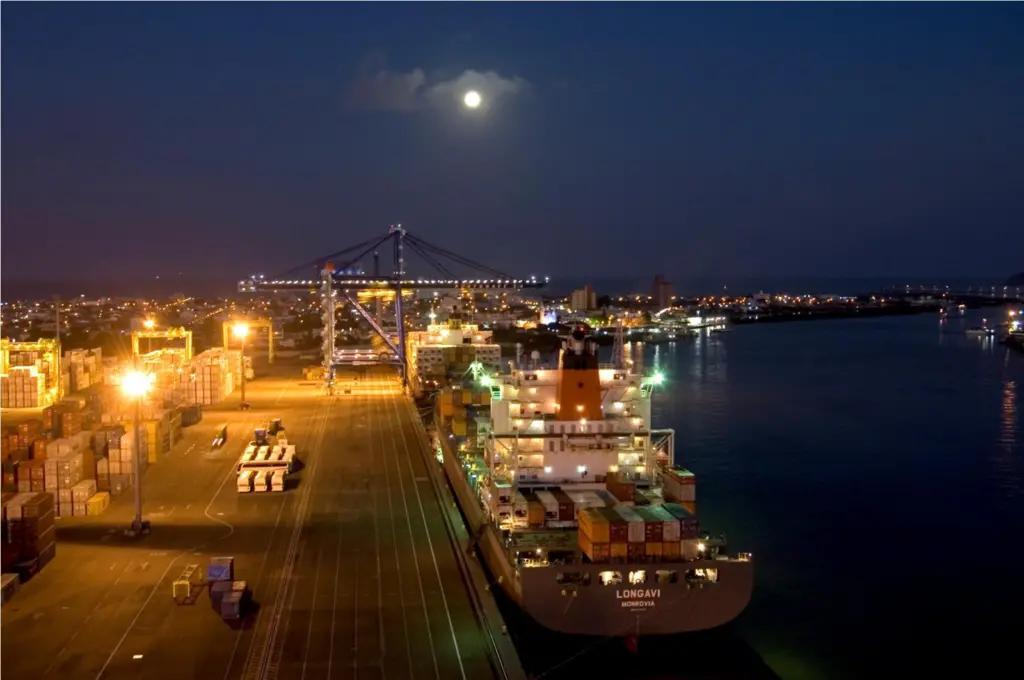
Led by regional powerhouse Brazil, ports on the East Coast of South America are enjoying the early years of what looks set to be a period of enviable prosperity.
The salient feature of the ports in three countries, Brazil, Uruguay and Argentina, are their plans to expand as their places in world trade secures themselves.
“All of them have expansion projects,” says Reynaldo Bench, the World Bank’s senior port specialist at Brazil’s Energy, Transport and Water Department. “They are expanding and they have foreseen the situation, especially Brazil. I don’t foresee any bottlenecks.”
What is also predicted – albeit more quietly – is an unevenness in this process. Brazil will power ahead, Uruguay will move along, but Argentina will struggle on the back of the legacy of a messy reform process and politics, making to choppy rather than dangerous going forward. However, that’s not to say that the latter has a lack of opportunity or investment interest – far from it.
Putting detail on all this is not difficult as good examples abound. Brazil’s Santos is a case in point.
Already the biggest container port in South America, but only the 39th in the world, and one of Brazil’s Big Three ports, Santos is a major operation with a 13,000m quay, 49 public berths, four container terminals, 24 for liquids, 14 for solids, and two ro-ro terminals.
Its grown massively from 34m tonnes in 1994, which doubled to 68m a decade later. Last year, it moved 83.2m tonnes and it kept a grip on increases in the wobbly years of 2007 and 2008 with 80.7m and 81.1m tonnes respectively.
Plans though are afoot to maintain this with the Embraport and BTP projects. The latter is a new terminal project of MSC for containers and liquid bulk while the former, a joint venture involving Coimex, Oderbrecht and DP World plans a multipurpose but mainly container terminal of nearly 1m m2.
Despite recent economic lulls both projects are still on the table. “Both areas should start the construction this year and the result will be the increase of the operational capacity of Santos Port,” confirms an official with the port.
Not to be outdone, Rio de Janeiro – another of Brazil’s Big Three ports – is also planning to expand its Caju quay and to provide new berths and additional quays.
Nor is this just a Brazilian thing as Uruguay, just across the border, will testify.
March 17 was the auction day for a thirty year concession to construct, administer, maintain and exploit (a word freely used throughout the region – so market friendly has it become) a new container terminal at the Port of Montevideo.
“The port of Montevideo has been growing rapidly and steadily at an average annual rate of 14% due to an increase in foreign trade,” said the Inter-American Development Bank at the end of 2009. “Its central location has played a crucial role in the growing importance of the port as a regional hub in the South Atlantic.”
However, despite these promising prjects, there remain two serious issues recurrent along that coast. One is the issue of dredging, the other location of ports and their connectivity to the rest of the infrastructure.
Of the River Plate ports, Buenos Aires and Montevideo are both city ports, as is Santos. This is, in the words of the World Bank’s Mr Bench, “sub optimal, (as the) absorption capacity of the surrounding infrastructure is not satisfying.” In short, their locations limit them and their expansion.
The decline of Brazil’s Porto Alegre – which became irrelevant because of its poor draught – barely gets a mention. But for ports on the River Plata this is a particular and ongoing concern especially as costs, which according to one source have doubled in ten years.
What worries the region’s port managers is that they might not be able to expand as they would like or need to in the future because of either surrounding cities or silted up ports.
“The big problem is involving the port access,” says a Santos official. “The port is currently building two new road access (avenidas perimetrais) and working on the deepening (to reach 15 metres) and widening of the port channel.”
The response to these restrictions has been twofold. One is to build deepwater megaports at greenfield coastal sites such as Brazil’s Superporto or those for a similar venture on the Uruguayan coast near Brazil.
The other is to look at boosting existing facilities such as Bahia Blanca, a collection of facilities spread out along 25 kms of the coastline of the northern part of the Estuary of the same name. However, while there is space to expand this port is 650 kilometres south of the capital Buenos Aires where most of the Argentinian population lives.
And the World Bank’s Mr Bench is skeptical about some new mega facilities pointing out the volumes don’t justify it yet – although maybe in twenty to thirty years the situation will be different. Until then they may be enough on the drawing board to satisfy demand in the medium term.