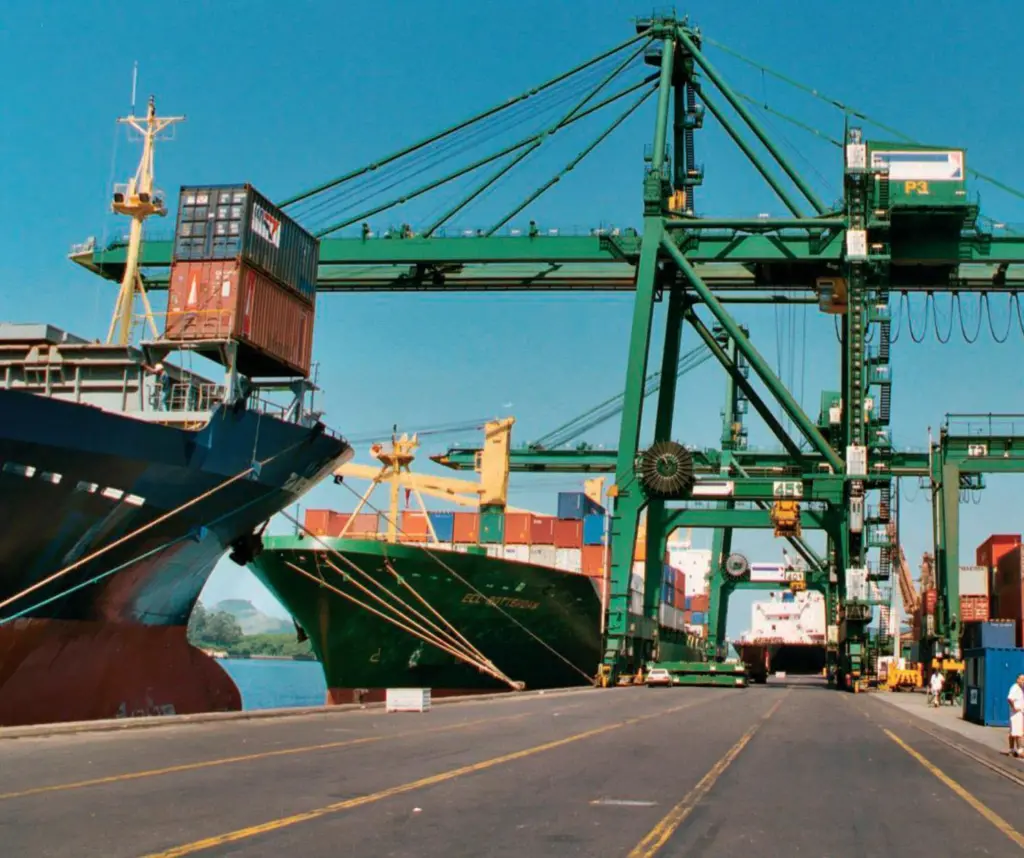
The main problems for the ports of Brazil during the past couple of years have been, in ascending order, congestion . . . congestion . . . and congestion again.
And the causes of the dreaded “gargalos” – congestion in Brazilian Portuguese – have been an acute lack of investment in port terminals, lack of investment in good rail and road links into the major ports of the South American country and, frankly, a terrible mess when it comes to arranging its dredging operations.
And deeper channel approaches and quays are desperately needed as bigger and bigger ships – such as the Hamburg Süd Monte class ships with 5,500 teu capacity and a 12.5 metre fully loaded draught – being deployed on the East Coast South America trades on a regular basis, many of them displaced by the huge juggernauts now entering the East-West container trades.
Spurred on by a very successful export boom,which began about four years ago, the Brazilian economy has registered gross domestic product growth of between 3% and 5% over the past five years and, even with a strengthening Real, the export push has continued, almost unabated.
During 2006 exports out of Brazil totalled $137.47bn, which was 16% up on the $118.31bn of 2005, and imports last year were $91.37bn, up on $73.55bn in 2005.
And now, with the strengthening of the Brazilian currency,imports are growing even faster than exports. This is leading to strong demand in both directions on trade routes, and also that “El Dorado” for container carriers: a balanced trade in many trading lanes.
The only problem for carriers is that fuel prices have gone through the roof and some trading lanes, particularly East Coast South America to US East Coast, are now Overall trade for Brazil has grown from $110.86bn per year in 2000 (around $55bn of imports and exports), up to last year’s $228.85bn, and that is expected to grow to $250bn by the end of 2007. For the 12-month period from March 2006 to February 2007 (the latest figures available) exports totalled $140.51bn, and imports totalled $94.68bn, giving a trade surplus of $45.84bn. All three are 12 month records and the trade and development ministry is forecasting $152bn exports for 2007.
So far, so good. But so far, so bad too, for the rapid increase in foreign trade and the increasing containerisation of general cargo – Brazil was a relatively late starter in this trend – has led to major logjams across the East Coast.Container movement through the country’s leading box port Santos increased from 832,000 moves in 2002 to 1.6m (2.45m teu) moves in 2006, almost double the number of moves.
Because of these sharp increases in movement transport logjams are occurring at times at the port terminals, especially owing to the unseasonably inclement weather experienced in Brazil during the last southern hemisphere winter, from July to September. There have also been major delays on the inland side, with the roads and the rail network.
Julian Thomas, the head of Hamburg Süd in the East Coast South America trades, says:”The rise in container movement at ports like Santos has been phenomenal and we are now paying the price for 20 years of Brazil not investing in its infrastructure.”
According to all sectors of the port and maritime community, what Brazil desperately needs now is more investment in its infrastructure, so that it can keep up with the flow of goods into and out of the country. And the recently re-elected government of President Luiz Inacio Lula da Silva has promised to deliver.
He announced a massive Reais504bn ($240.8bn) spending spree on Brazil’s infrastructure, known as the PAC initiative. Around Reais100bn ($47.8bn) will come from the government and the rest is supposed to come from Private Public Partnerships (PPPs),similar to those lauded by Tony Blair, the UK prime minister. Of that some $90bn is supposed to go purely on port and transport infrastructure – including rail links and port access roads, particularly for congested Santos, the country’s largest port by far.
Mauro Salgado, the president of Libra Terminais, which operates the second biggest container terminal in Brazil, Terminal 37, with close to 1m teu throughput forecast for this year,as well as smaller operations in Rio de Janeiro and Imbituba, says the PAC initiative was “heading in the right direction”.
Mr Salgado, who is also the president of the Santos Port Operators Association (Sopesp), says that those aspects linked to the second part of the PAC initiative – those aimed at cutting out red tape and bureaucracy – are possibly even more important than the cash injections. “We have been saying for years that Santos needs a plan as does Brazilian transport infrastructure,” he tells Port Strategy.”This has the makings of a planned way forward, so let’s now wait and see what is delivered.”
There are also clauses of the PAC regulations that will make it easier for the urgently needed emergency and deepening dredging to be carried out. Pressure will be exerted on federal and state environmental agencies (such as Ibama and Cetesb for Santos),which many blame for holding up the dredgers during the past two years, to loosen up their strict judgements and constant recourses to legal injunctions.
As one shipping agent for an Asian carrier expresses from his Sao Paulo office:”The country urgently needs Santos to be dredged and they have been holding it back because of a bunch of clam. It is an absolutely absurd situation.”
Another source says that the problem is also that Brazilian law makes the actual environmental officer personally liable if he gets it wrong, allowing development and dredging only to result in huge pollution. PAC is supposed to take away the individual responsibility for this, according to the Santos-based source, allowing the officers to make braver – in terms of development at least – decisions.
And there is certainly a feeling that deeper quays and deeper entrance channels will release some of the congestion pressures that Brazilian ports have been experiencing during the past two years. This is especially true for Santos which is the gateway for around 28% of all Brazil’s international trade (in value terms). The argument is that more draught means bigger ships, more economies of scale and better productivity. It also means that vessels are not waiting for high tide for departure, as they are at several ports right now, including Santos.
All shipping lines using Brazilian ports pay hefty light dues which should go towards dredging. But this dredging – an expensive exercise in Brazil owing to a duopoly between Bandeirantes and Dragaport, the Wilson Sons joint venture with the Serveng Civilsan construction company, and CBO, the offshore operator – never gets underway. Either the two named companies or a smaller third operator called Enterpa, query the transparency of the tender process or it gets blocked by the two main environmental agencies. PAC now aims to put a stop to that.
The initiative includes legislation to allow foreign dredging companies to come into Brazil without restrictions and also a curb on the environmental agencies being too zealous. It also includes Reais1bn ($477.8m) put aside, for this year alone, for dredging projects to be carried out, according to the Brazilian Transport Minister Paulo Passos. This will give port authorities, such as Codesp for Santos, more money for dredging but should also provide better value for it too.
Fabrizio Pierdomenico, the commercial and development director for Codesp and one of the more dynamic and young “politicos” to be found in Brazilian port authorities, tells Port Strategy: “PAC is definitely a step in the right direction and reducing the bureaucratic and environmental obstacles will greatly assist us in tying up dredging contracts and getting contractors to stick to timetables.”
Other solutions suggested by port terminal operators and shipping lines include getting bodies like Codesp out of the road and setting up private companies to charge a dredging toll and operate allyear round dredging.
However, the general consensus is that getting Codesp and President Lula to agree to that would be akin to turkeys voting for Christmas as Lula and the various political parties that appoint their cronies to positions on the port authorities gain political influence and, indeed, cash for the party coffers from their involvement in ports. But, never say never.
So with roads, rail and dredging all set to be tackled that will throw the onus back on the port terminals to keep improving productivity and upping capacity to satiate the growing demand of container movement into and out of the East Coast of South America.
The ports in the south and southeast have suffered the most from congestion and lack of capacity in recent years but several new projects will add more capacity in the very near future. And shipping lines – perhaps not wanting to leave their own fates in the hands of third party port operators in a lucrative trade like the East Coast of South America – are increasingly trying to diversify in shore-side operations, a trend that is sure to continue.