Consternation, jubilation or trepidation: two port calls from the CMA CGM Benjamin Franklin are seen as changing the nature and future of US West Coast ports. Adding to the mix is an industry perception that the Panama Canal will be sidelined during downturns and the only option for carriers is to cut rates, as they are doing now.
At the heart of debate are the concerns of overcapacity.
As consultant Dan Smith of The Tioga Group says: “Operators will get some relief from the Panama Canal, but the effect will be diluted by overcapacity. There are multiple layers at work here and the implications have not been thought through. Remember that the tolls on the canal are on ship size and not the number of containers, so operators are going to think hard about sending vessels through there when rates are already at basement levels and megaships are calling at West Coast ports.”
Economist and consultant Jock O’Connell notes that ports such as Los Angeles and Long Beach have “dug themselves out of the hole they were in” but new problems are on the way from cascading from the Asia-Europe routes, with the Benjamin Franklin a prime example. “This tends to displace the need for smaller vessels to go through the Panama Canal.”
Much as the ports want to pump up the Benjamin Franklin calls as the start of a definite service route schedule, the visit was an experiment and no future dates have been settled, although Long Beach and Seattle are possibilities. CMA CGM US chief executive Marc Bourdon tells Port Strategy: “At this point we are studying the feasibility of deploying such a vessel. We will assess potential deployment based on findings and market conditions.” He is cautious about future calls at West Coast ports, particularly Seattle, saying only “we will call at Seattle on a second trial.”
According to Paul Bingham, vice president of EDR Group, this was a publicity voyage put on by CMA CGM. “There is no justification from a cargo perspective for a vessel of that size sailing in that service at this time of year.”
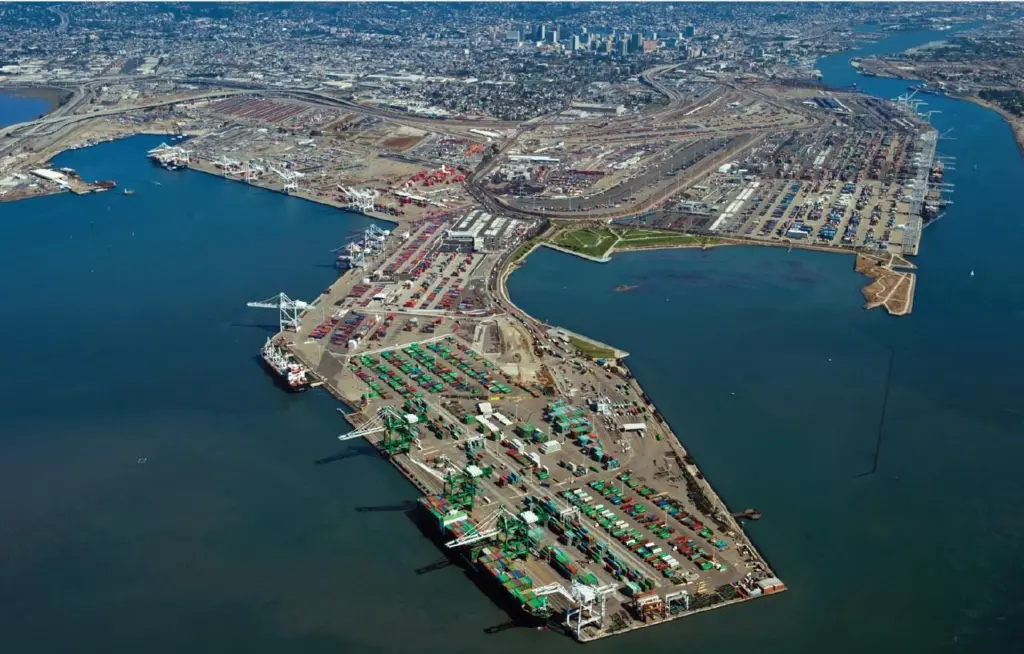
That is borne out by the actual volume of cargo unloaded: 6,000 boxes at Los Angeles and 2,000 at Oakland. Preparations took weeks at the two ports, not least of all involving the co-operation of the dockworker trade unions, a luxury that will be denied with a regular service.
And the capability of West Coast ports being able to handle the megaships is questionable. Mr Bourdon says the weaknesses CMA CGM has found are,” crane height, some maritime constraints in Oakland, cargo evacuation”, otherwise known as unloading.
Making a statement
Mr Bingham says the Benjamin Franklin call “makes a simple statement to decision-makers, planners and politicians that supporting improvements in associated land-side infrastructure are needed now, not at some distant point in the future.
“Whether that audience wants to bear the cost associated with building out the infrastructure to handle surges of cargo associated with the larger, lower-unit cost ships is another matter, especially if the benefits of the lower unit cost ocean transport are split between the carriers and shippers and don’t accrue to the terminal operators, infrastructure providers or land transportation services providers. “
Mr Smith says the downside of relying on calls by such ships is that handling costs increase. “Needing large numbers of dockworkers and cranes for one or two calls, which then sit around idle, increases the costs for terminal operators compared with several calls by smaller ships spread out during the week.”
Mr Bingham adds: “The labour work rules and the truck gate operating practices and even the beneficial cargo operators and third-party distribution centres and/or dray trucker marshalling/storage yards will have to adapt to handle more containers per ship call.”
The ‘lumpiness’ of the cargo then becomes a challenge, especially for the smaller-acreage terminals. “The vessel alliances with slot sharing and mixed control over the capacity utilisation of any one vessel call (although not stowage, which is still the Master’s ultimate responsibility) makes the planning for working ships each weekly call more difficult,” he says. “The 2M alliance of Maersk and MSC, has cited their two-member alliance as having a simplicity advantage over their rival alliances that have more members for just this reason.
Mr Smith cautions that a sudden switch to 18,000 teu vessels will be “a drastic change”. Customers, he says, will not be happy because they will have to schedule their deliveries to one service instead of two or three and port management will have to change its methods.”
Changing strategies
For Portland, viewed as the sickest and least viable on the West Coast, such concerns are in another world as the port has more practical problems. Beset by disruptions, racked by disputes with the ILWU trade union and with no regular container line service, the port has changed its operational strategy to keep involvement with the union to a minimum and to avoid having to pay what many see as the union’s exorbitant wages.
A barge-rail service for containerised farm produce collects goods from three states and stores them in a yard outside the port – and outside ILWU reach – for immediate delivery to the port’s sole remaining container carrier, Westwood.
“Ports are becoming multi-tiered businesses,” points out Mr Smith, “with different third parties operating different aspects of operations.”
Oakland is another port to have more to cheer about on the operations front after a lean spell. The biggest terminal, SSA’s International Container Terminal, is testing extended hours for empty container returns and pick-ups plus loaded container export drop-offs. Vehicle waiting times are said to have improved by as much as 20% at certain periods. The extended hours are planned to be adopted throughout the port by March.
Finances have improved: according to the latest figures, maritime operating income for the first quarter of the fiscal year (to the end of September) was up 5% to $36m. Capital spending rose 29% to $8m, largely because of construction at the former army base, which is being developed into the Seaport Logistics Complex.
Emitting fewer pollutants than earlier generations, megaships are better prospects for California, where the authorities want to bring in even tougher environmental regulations.
Recently, Los Angeles has taken a blow to its boast of being the world leader in environmental care, with a number of measures not implemented, such as converting all ships docking at the China Shipping terminal to cold ironing. There is also considerable public anger that a 40 nautical mile requirement for low sulphur fuel has not been followed by all vessels.
Yet the port has made huge strides in tackling pollution, with Sox and Nox down more than 50% since the program began.
Activist groups are said to be gearing up to launch lawsuits, which will take years and make the quest for cleaner water and air even more difficult. The port’s explaination that some measures have been technically infeasible have met with accusations that the authorities are covering up incompetence.
Diversification
Meanwhile, perils abound for Western Seaboard ports trying to diversify from traditional container and breakbulk operations. Longview in Washington has abruptly ditched its chief executive because of his support for a butane and propane gas export plant. The board of harbour commissioners says the $300m cost is too risky because of activist and community opposition, while too few jobs will be created.
Regardless of the type of cargo handled and the size of ship calling, for West Coast ports the ever-present challenge will be the high cost and attitude of labour. Mr O’Connell notes that pressure is being intensified for automation to handle the big ships, making the ILWU even more suspicious of employers’ strategies.
“And there is the effect of Obamacare policies on health insurance, which brings into play the question of who will pay the ‘Cadillac tax’ aspects of the new regulations – the employers or the union.”
The fact remains that the maximum size of ship the West Coast can handle is 14,000 teu – which is why the Benjamin Franklin was stacked seven high instead of the maximum 10 high.
The West Coast will continue to be bedeviled by its main bugbears for some years to come.