The vessel traffic management market is burgeoning. A report from ResearchAndMarkets.com says that the Global Vessel Traffic Management Market will grow from US$ 5.8 billion in 2022 to US$ 8.7 billion in 2027, at a CAGR of 8.4 per cent.
The report claims that increasing numbers of ports are using VTMS as a means of boosting efficiency and reliability, thus driving growth.
Activity at an industry level supports this view.
“The awareness is increasing that to ensure safe waters, you need more than binoculars and a radio,” says Huub van Roosmalen, Director Business Development, Saab Maritime Traffic Management. “With congestion in ports,” he elaborates, “the problem is not necessarily the ships themselves, but the containers on shore. Often, they are in the wrong place in the world, taking up space that is needed for other containers and impacting the planning of port calls.”
Efficiency is driven by managing congestion at sea, with fishing, wind farms and commercial shipping often competing for the same space. VTMS is essential to regulate this and with a similar level of challenge the approach to port facilities. “Other big market drivers,” notes Roosmalen, “are decarbonisation, Just In Time (JIT) operations, the need for better predictability in port operations and working around the lack of space that some ports experience. This forces them to efficiently use the space available; the quays, yard areas and of course access channels some of which are tide restricted. Autonomous shipping is also a market driver in terms of R&D.”
Having been active in the VTMS sector for over 30 years, Saab handles different types of contracts, with its systems in use in both large and smaller ports.
“We have been awarded several contracts in the last couple of years,” says van Roosmalen. “Recent ones that stand out are the Port of Tallinn, Estonia, Port of Shanghai, China, Port of Dampier, Australia, Port of Suva, Fiji and Port of Victoria. The contracts in Australia and Fiji have been won together with AMS Group with whom we have partnered.
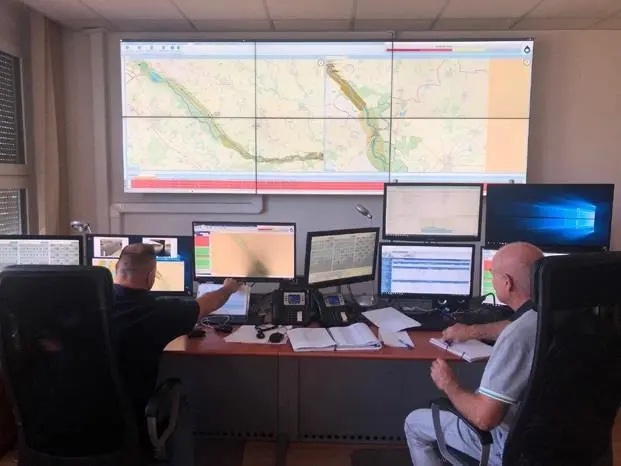
Founded in 2013, Horizonte AS has been active in the VTMS market from its early days. “The most important delivery we’ve had is the River Information System (RIS) for the Danube section in Hungary, considered to be one of the largest RIS in Europe, with over 100 sensors including AIS, radar, VHF, water level meters, visibility and meteorological sensors” explains Roberto Gonzalez, Founder & Managing Director, Horizonte AS.
“We are currently engaged in new VTS project delivery and plan to continue in VTMS for rivers, ports and coastal applications,” he adds.
One of the “world’s most advanced ocean space surveillance and VTMS systems,” as described by Håvard Odden, Vissim’s Senior Vice President for Maritime Awareness, has recently been developed. International energy company, Equinor contracted Norwegian tech company Vissim to produce a surveillance and marine co-ordination system that manages operational requirements and efficiency aims in the offshore energy field.
The new system includes subsea infrastructure monitoring, marine planning through weather forecasts and real-time monitoring and 3D situational awareness. Other elements include environmental surveillance, predictions of vessel routes, plus clear communication between control rooms, vessels and offshore workers.
REMOTE WORKING
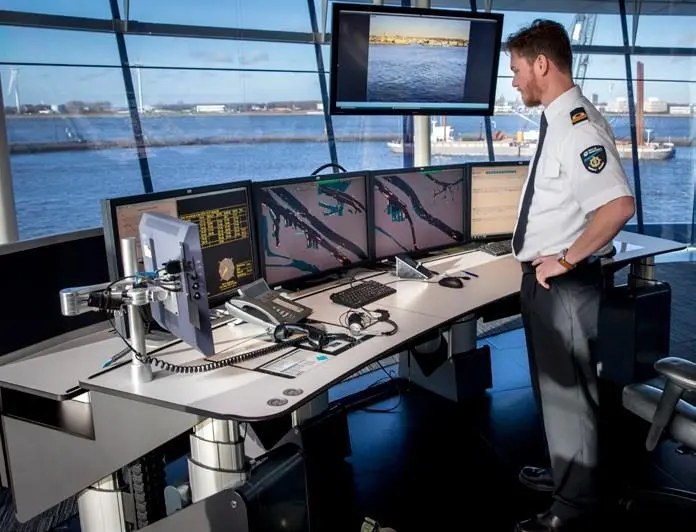
Installation of remote sensor sites has been beneficial to reduce costs, as well as usage of COTS, low energy consumption sensors, implementation of solar panels and other innovative ways to keep energy consumption low. “There is a wide variety of sensors and options available to reduce prices, but civil works and maintenance works and requests for 24 x 7 support, keep prices up” says Gonzalez. “Additionally, the scarcity of software developers and the man hours that are required to keep the implementation of new functionalities, continue research and development or to maintain systems have increased over time,” he elaborates.
Saab is implementing VTS within a Software-as-a-Service (SaaS) model, a cloud-based solution. “This,” the company points out, “has important implications for the cost model for the customer. It facilitates shifting from capital expenditure (CAPEX), i.e: large, one-time investments, to operational expenditure (OPEX) with a pay-as-you-go model. It reduces the hurdle of financing system investments, making VTS systems available to a larger market. Also, web-based user interfaces make deployment much faster and easier.”
Similarly, to enhance VTMS’ core surveillance and management features, Horizonte AS has made the use of VTMS intuitive with simplified functionality. “This is really important,” the company underlines and underlines, “It is about not offering too much functionality but instead the right functionality.”
“We have worked a lot on our software Aquacore, and a Graphical Use Interface (GUI) that is easy to use and operate, and which requires less time to train operators and dispatchers. Also, the modular design of the software allows for the implementation of functionalities that are required for a particular project or client and conversely provides the ability to leave out what is not needed.”
Saab says that it is strongly committed to AI to generate more operationally useful information from accumulated data. “We lead the way in VHF Data Exchange System (VDES), the next generation of AIS, for which we were the first supplier to have a commercial base station available,” highlights van Roosmalen. “With the added bandwidth and satellite communications, VDES enables new applications. An example of this is Sea Traffic Management (STM) for end-to-end management of vessel voyages,” he points out.
SECURITY FEATURES
Modern systems are required to interact with other satellite systems that cover the likes of finance and management.
The problem is, however, that interoperability can potentially result in cyber-attacks. To prevent this, systems like Kongsberg’s C-Scope are designed to the relevant quality assurance standards.
Saab’s VTMS system also plays an important role in a general security context. For example, the system alerts when an unidentified or blacklisted ship enters a port.
It also alerts for unauthorised access to restricted areas. Additionally, customers have the possibility to mark ships as suspect or hostile.
“Another security feature is the possibility to link with a Port Management Information System. This allows the VTS operator to look up information such as vessel ownership, history of violations, blacklisting and the nature of the cargo.”
When asked what makes a Horizonte VTMS system superior, Gonzalez explains that it is the response time on the system and easy to use GUI. “Also, the intuitive modular design of the software, and its wide possibilities of use for any applications such as in ports, rivers or in coastal surveillance.”
Because there are no one-size-fits-all requirements for ports, Kongsberg’s C-Scope can customise the operating environment. The operator can use the system to tailor requirements to the port’s specific needs. C-Scope also features decision support tools that provide configurable and pinpointed alert areas for safety and security.
Saab’s target tracking is the result of 30 years of development and significant time in operation under a wide range of circumstances. Van Roosmalen says that good tracker performance is essential for the reliability of alerts and situational awareness.
However, van Roosmalen stresses that VTS systems are more than technology alone:
“Our knowledge of implementation and system design give our customers the ‘most bang for the buck,’ he says. “Our expertise ranges from the selection of optimal sensor sites to ensuring uninterrupted operations during system replacements.”
Technology upgrading is a common trend. Lerwick Harbour selected Wärtsilä to upgrade its existing technology to deal with the high volume of traffic at the crossroads of the North Sea and North East Atlantic.
Facilities include CCTV, weather and tide sensors, positioned around the surrounding area allowing operators to track vessels and obtain data. Approaches to the port are covered by a double transmitter Jotron VHF system, providing VHF communication. A further system upgrade replaced Lerwick’s IT infrastructure with version 4.6, plus a radar processor upgrade using RPU5 interfaces.
NEW TECHNOLOGY
The biggest benefit of new generation technology is the use of AI and machine learning. This leads to a quality improvement in the traffic image and thus, traffic safety.
The ResearchAndMarkets.com report says that the Maritime and Port Authority of Singapore is engaged in extensive collaborations in conjunction with the introduction of new, top-of-the-range VTMS systems. Together with the Authority, Fujitsu Limited, Singapore Management University, and A*STAR’s Institute of High-Performance Computing are developing predictive technologies that use AI and big data analytics to deal with port trade and traffic. Real-world data can boost congestion predictions and eliminate the risk of potential sea accidents by detecting any possible risks at sea.
“IoT creates a more complete picture of what is going on in a port,” says van Roosmalen. “Various ports are pioneering the development of digital twins, for example, to predict energy consumption on the quay. Based on this data, ports can make better decision on infrastructure investments.”
Gonzalez says that VTMS can embrace new sensors technology (such as the IoT and predictive technologies) and take advantage of it. “I think it does have a good impact on the overall sensor information available for better situational awareness.”
While Gonzalez says that it is hard to predict the future of VTMS, surveillance in his view, is here to stay. “The evidence is that disruptions in the supply chain require more efficient ways to monitor not only vessels at ports, but expected arrival times.
“I do perceive,” he continues, “a blossom in utilisation of IoT based sensors and many other types of sensors that can be integrated into a VTMS, so do perceive that the broad use of VTMS can be beneficial not only for security and surveillance, but also for supply chain purposes.”