
With raised awareness and tighter regulatory standards, a change is needed. Depending on the source and ambient conditions, airborne dust can contribute to a number of concerns, including potential health or safety hazards, environmental issues, regulatory challenges, explosion risks, higher equipment maintenance costs, and poor community relations.
Some of the issues are fairly obvious: dust inhaled by workers or members of the surrounding community can irritate airways and exacerbate conditions such as asthma. From a purely financial perspective, when equipment air intake includes significant amounts of dust, it can lead to more frequent maintenance and faster wear, causing operating costs to rise. Fugitive dust can also generate complaints from local residents and businesses, affecting community relations and potentially creating obstacles to future operating permits.
What is ‘dust’?
Dust is a generic term for minute solid particles, typically less than 500 microns in diameter. In bulk material handling, these particles are often created in a wide range of sizes, with larger, heavier particles tending to settle out of the air, while smaller, lighter solids may hang indefinitely. For occupational health purposes, airborne solids are categorised by size as either respirableor inhalable.
The larger particles in the ‘inhalable dust’ classification are typically trapped in the nose, throat or upper respiratory tract. The US Environmental Protection Agency (EPA) describes this category as particles with a median diameter of about 10 microns.
In contrast, ‘respirable dust’ is small enough to penetrate deep into the lungs, usually identified as particles under 10 microns in size. These small particles that migrate deep into the respiratory system are generally beyond the body’s natural cleaning mechanisms (such as cilia and mucous membranes) and are likely to be retained. To put that in to perspective, a human hair typically ranges from 50-75 microns thick, so the most potentially hazardous dust particles are the ones too small to see.
Approaches to dust control
Basic spraying techniques such as sprinklers or hand-held hoses can help capture surface dust before it becomes airborne, but they have a tendency to saturate target surfaces, often resulting in standing water that can create additional hazards or damage sensitive cargo. The range of these techniques also tends to be quite limited, frequently requiring significant staff time to man the hoses or reposition sprinkler heads.
Their greatest drawback, however, is droplet size: water droplets produced from hoses and sprinklers are simply far too large to have any meaningful effect on airborne dust particles. A more effective option is an ‘atomised mist’, which relies on the principle of creating tiny droplets of a specific size and delivering them at relatively high velocity over a wide coverage area, inducing collisions with dust particles and driving them to the ground. The method has proven well suited for managing dust from coal, grain, fertilisers, cement and other bulk materials. It’s also one of the few technologies capable of delivering dust control via airborne capture AND surface wetting.
Even though new equipment designs are often compact in size, some atomisers are capable of reaching a very large surface area with powerful oscillating fans that can generate as much as 30,000 CFM (approximately 850cm3) of air flow. These high performance machines can have a throw of more than 200 ft (60m+), with fully oscillating models delivering a high-efficiency spray that can cover as much as 125,000 sq ft (2.87 acres or 1.16 hectares) from a single location. Manufacturers frequently offer a carriage mount that allows the equipment to be located wherever it may be needed on a given day. Units can also be tower mounted to increase the range and coverage area.
Selection criteria
The most obvious criteria is performance: How effectively does the equipment knock down solid particles that are suspended in the air and prevent ground level dust from becoming airborne? One way to judge equipment designs is to review their spec sheets and compare physical properties, including motor rating, air velocity, air and water volumes and water pressure, all of which directly affect the unit’s range and coverage area. In most situations, the higher the numbers in these categories, the better. The water source is also a factor: It’s very unlikely that a machine supplied by a garden hose will be able to equal the performance of equipment fed by a fire hose.
Not surprisingly, the equation is more complex than simply comparing statistics. As dust particles and water droplets approach each other, the best chance for a collision is created when they are roughly the same size, avoiding a slipstream effect that can carry them past one another. Unfortunately, there is a tradeoff – larger droplets will travel farther before losing their momentum, while smaller droplets are more effective at suppressing airborne dust.
Because all of the elements in dust control, equipment tend to have an effect on each other, each component must be designed to achieve an optimum balance, including pump, nozzles, barrel and fan. Changing any element can have consequences on droplet size, velocity, spray angle, pattern and range, and all of these must work together for maximum efficiency.
An age of specialisation
Like a physician, the most knowledgeable equipment supplier is likely to be the specialist. It stands to reason that a manufacturer who adopts dust control as one of many product lines must divide its resources to support all of those products, whether it be in R&D, technical service or repair parts. In contrast, a supplier whose sole business is dust control will have a very narrow focus, with every employee concentrating on functions related to that single purpose. Customers are likely to benefit from support personnel with extensive experience and daily contact with dust suppression issues.
Potential buyers of dust suppression equipment should also be sure to review the standard features and available options. Will the manufacturer deliver the unit on a carriage, providing ready mobility? Is it available with a skid mount, allowing easy transportation with a fork lift? Can it be ordered with a dosing pump to add surfactants for superior particle attraction or additives for odor control? Is there a filter system permitting the use of non-potable water sources?
In addition, particle attraction in atomised spray dust control is affected by the surface tension or contact angle of the water droplets. Among the options from industry leaders is an integrated dosing pump that allows users to carefully meter in surfactants to significantly lower surface tension. Even minute amounts of a surfactant can reduce the contact angle of pure water by more than 50%, producing greater numbers of smaller droplets and superior particle control.
Specialised designs
For specialised situations, some manufacturers offer designs with stainless steel or polymer nozzles and onboard filter systems. Larger designs will sometimes have booster pumps that can increase just 10 PSI (0.07 MPa) of water pressure by 150 PSI (1.03 MPa) or more, which has a direct impact on performance. If the equipment is well designed, the use of pressurised air should not be required to achieve efficient suppression, avoiding the need for compressors.
Beyond options and accessories, look for the ability to customise. Some equipment brands are sold with an established set of choices, with little room to accommodate specialised needs. For example, in some applications, the ability to tailor the droplets to suppress a very specific particle size can be a significant advantage. That kind of versatility typically means a change in nozzles and possibly other features, requiring a certain amount of flexibility that not all manufacturers will offer.
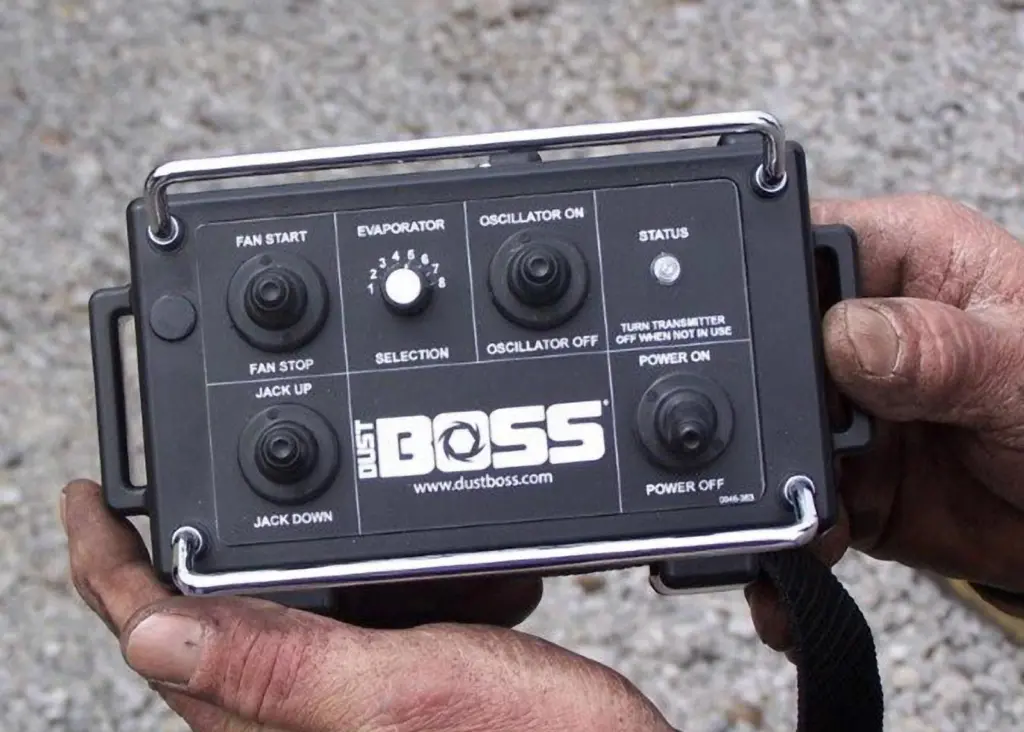
It may also be a good idea to find out if the equipment is suitable for automatic operation, even if that ability isn’t needed now. In the future, it may become desirable to incorporate remote control, solenoid activation or other automation, allowing users to operate suppression equipment only at specific times to conserve water and energy. Some of the latest equipment designs can be set up to operate via programmable logic control, which can accommodate changing weather conditions and even automatically start or stop machines when target airborne particulate levels are reached.
Demonstration is key
Before making a commitment to a particular dust suppression design, it’s a good idea to see the units close up and get a demonstration of the equipment in service. Don’t rely solely on specification sheets and videos. Renting a unit before buying can be a valuable experience, especially if the supplier will credit a portion of the rental fee toward the purchase.
Inspect the materials of construction: Is the unit built with heavy duty materials that are likely to withstand the rigors of everyday use, or does the manufacturer use thin sheet metal housings and light duty components? Does the supplier employ a durable frame and fasteners that lend themselves to removal and replacement, if a repair becomes necessary? Or is the unit assembled with light gauge rivets and sheet metal screws that are unlikely to survive many years of field service?
Safety has also become a key issue in dust control equipment, and specifiers can help avoid the risk of injury by looking for appropriate safety features on any design under consideration. Does the unit have any exposed moving parts that could cause accident or injury? Are fan blades and motors protected by heavy gauge housings or guards? What are the noise levels associated with the unit’s operation? While these considerations may seem minor compared to performance, just one job site injury could deliver more than adequate proof that the cost of ignoring potential safety risks can be extremely high.
As with many types of equipment, good indicators of overall quality are the supplier’s warranty and guarantee, not to be confused. The warranty is the manufacturer’s pledge to replace failed parts within a specified period of time, while the guarantee is that supplier’s assurance of a buyer’s satisfaction. A manufacturer willing to warranty its products for significantly longer than its competitors is demonstrating confidence that the equipment is durable and reliable. Likewise, if a supplier promises customer satisfaction with a money-back guarantee, it’s a good indication that the products have been field-proven to perform as advertised.