This is the view of the British Ports Association (BPA), which has stressed that ports are all very different in the UK with different levels of control over emissions.
Speaking at the recent BDB Pitmans ‘Decarbonising Ports: The Route to Net Zero’ webinar, Mark Simmonds, director of policy & external affairs at the BPA, said: “There is a level of uncertainty within ports about what the demand for zero-emission fuels might be.”
Huge costs are offputting
He explained it’s difficult to talk about decarbonising ports, without talking about decarbonising ships. There are also barriers in the market for decarbonising highly specialised port equipment, where electrification hasn’t necessarily progressed as much as much as the ports sector would like, or huge costs are involved.
“Where there are electric alternatives for much port equipment, there’s huge costs involved, and the cost and more broadly the business case is usually a barrier.”
Productivity is key, the equipment needs to be as productive as diesel counterparts, Mr Simmonds stressed.
He noted the industry will have to wait and see whether the government’s changes to the rebates for diesel will accelerate innovation and pace of adoption, but suspects this might not be the case. The BPA wants to see more support for the switch from diesel to lower carbon or zero carbon alternatives for port equipment.
Shore power challenge
Mr Simmonds referenced the BPA’s 2020 study examining the barriers to shore power in UK ports, which found the biggest barriers were huge capital costs, the price of electricity and a lack of consistent demand from port to port. Overall, there wasn’t enough demand to make the business case stack up in most ports.
The study also found no shore power project anywhere in the world has been undertaken without public support.
“A lot of ports are looking very carefully at shore power at the moment, but those capital costs probably remain a huge barrier to widespread adoption,” said Mr Simmonds.
Government responsibility
Electrification will be key to decarbonisation. The UK’s Department for Transport in its key maritime plan estimated that port demand for energy in 2050 will be somewhere between 10 and 200 times what it is now. “That’s obviously a huge spectrum. We’re concerned that this isn’t being properly accounted for in future planning scenarios,” Mr Simmonds said.
Decarbonisation is not going to be cheap and the BPA believes it is the UK Government’s responsibility to ensure the costs don’t fall too heavily on any one part of the supply chain, as well as helping with demonstrating new technologies and investing in innovation and research.
Mr Simmonds said the Government is starting to do this, for example with the Clean Maritime Demonstration Competition, but this needs to be scaled up. “We hope this becomes a template for a much bigger scheme,” he emphasised.
The BPA will be lobbying the government to properly recognise the future demand from the maritime sector and that ports have access to the power they need.
Mr Simmonds stressed that in any maritime decarbonisation work, the Government must recognise that moving freight by water is still by far the most efficient way to do it and shouldn’t disincentivise this and reverse modal shift freight back to rail and road. The government should look at transport emissions as a whole and recognise the maritime sector has a role in reducing emissions from other modes of transport as well.
The BPA conclude measures to overcome barriers to emissions reduction includes a green maritime fund, an energy system that supports maritime ambitions, a regulatory environment that provides certainty for low-carbon investment, a clear technology-neutral indication of direction for industry, and international leadership at the IMO and other multilateral organisations.
Other speakers at the webinar included Caroline Price, Director of Green Ports at Royal HaskoningDHV. Ms Price discussed landside operations and how diesel machinery is still playing an important part.
She pointed out a lot of focus in funding is on investment in innovative new technology, but new kit can take years to be delivered and physical space is an issue, especially if infrastructure needs to be changed.
“A fundamental part of decarbonisation is optimising energy you already use and need,” she said. “There’s lots of things that you can do within the context of what you already have that make the best use of the power that you need by directing it to where you need it, when you need it and focus on the amount that you need at any one time.”
Portsmouth tackling emissions
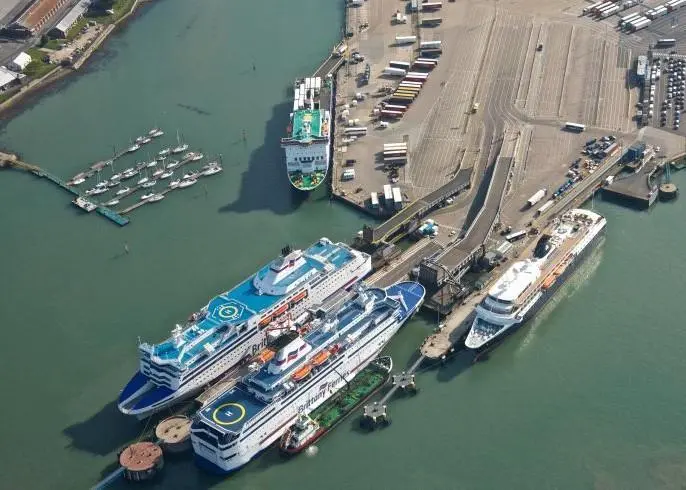
Jerry Clarke, pilot and assistant harbour master at the council-owned Portsmouth International Port (PIP) explained the port ensures it undertaking carbon audits (using DEFRA guidance) because “you cannot manage what you do not measure”. In 2018, PIP produced 50,000 tonnes of CO2 and 60,000 in 2019 with 844 more ships. PIP has installed air quality sensors utilising IOT to measure different polluting sources.
Mr Clarke matches environmental initiatives on the PIP’s capital expenditure programme with available funding to give the port the best chance of getting to the implementation stage.
The port secured GB£500,000 funding from the EU Interreg fund to implement eco-features in the Linkspan 4 and another GB£500,000 for a seawater heat transfer pump which serves to heat and cool the cruise and ferry passenger terminal, which also has seawater flushing toilets and air ducts on the roof utilising wind to cool the terminal.
It also secured £500,000 Innovate UK funding to work with Marine South East, Swanbarton and the Energy Catapult to install a dual fuel electric battery which uses machine learning and AI. “It uses port renewable energy and will control the distribution of energy around the port.”
In addition to installing a massive solar array, PIP has an Energy storage system in place and is looking into providing battery power for two ro-ro ferries for two hours alongside or a small cruise ship. He said that the use of split busbars on modern ships could facilitate the use of storage batteries for power in port.
PIP’s Solent Freeport bid will see it aim to secure funding to undertake a study/audit into the possibility of using large Energy Storage Systems in conjunction with intelligent energy management systems and grid supply to provide shore power, without massive capital infrastructure projects.
New Brittany Ferries LNG ferries coming to the port in 2022/3 also aim to plug-in to shore power. “It should take less than half a MW an hour and if it does we can do it from our energy storage systems,” said Mr Clarke.