Over the past year we have spent some time trying to analyse the flow of goods in the environment of the COVID-19 pandemic with its lockdowns and slow return to a new normal way of working. Economists are faced with major obstacles when trying to project the real volume of trade in all sectors of the maritime and port industry as demand has plunged and surged leaving us with, some would say, the happy situation of demand in excess of supply and a breakdown in the logistics supply chain resulting from the pandemic.
Economic forecasting has not done well in this new environment that saw countries shut down in various degrees for 18 months.
This was, and remains, an unprecedented situation.
An analysis of container volumes at the global level shows relatively mild changes, other than in a few individual months, comparing 2020 with 2019 at the annual level. This was likely due to reactions to tariffs which caused a surge of inventory building that went into early 2020.
In 2021 the consumer demand was strong enough to deplete most inventories which led to another boom in shipment volumes which is the background to the lack of capacity as COVID-19 impacted available labour and caused China to shut ports down. The end result was vessel queues resulting in congestion in China, North America, and Europe.
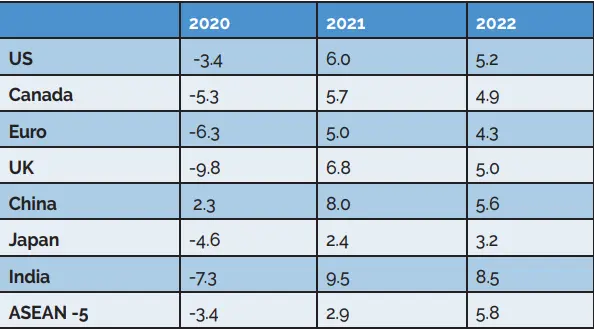
When we look at the IMF historical and projected growth projections in Table 1, we see a lack of connectivity between economic growth and trade volumes in 2020 but that comes back in 2021 and will most likely continue well into next year. This suggests that the pressures on available shipping capacity and the supply chain will also remain with us.
The impact on industrial production is most noticeable in China in 2020 and the Covid incentives of the U.S. and Europe in 2021. The UK recovery is particularly remarkable.