![GreenPort[PortStrategy]](https://www.portstrategy.com/greenport/wp-content/uploads/sites/4/2026/09/GreenPortPortStrategy.svg)
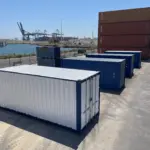



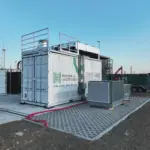
Passive cooling cuts container temperatures
Cooling Photonics’ passive film cut container temperatures by up to 22°C during a successful Valenciaport summer pilot
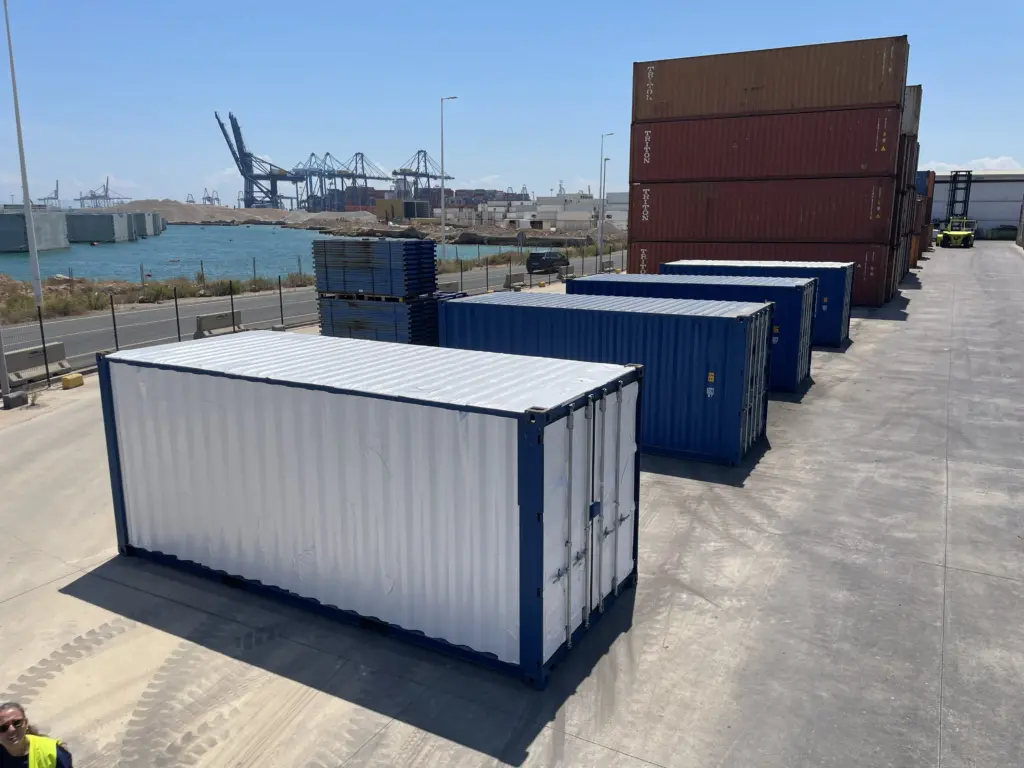
A new passive cooling material developed by deep-tech startup Cooling Photonics has reduced shipping container temperatures by up to 22°C during a pilot at the Valenciaport Sandbox in Spain, without consuming energy.
The trial was conducted over 15 consecutive summer days at the Transbase Soler depot, with support from Valenciaport’s open innovation hub Opentop, the Fundación Valenciaport and the wider port community.
“The Valenciaport Sandbox was created so that innovative ideas can prove their value in a real port operations environment, with data gathered on the ground,” said Juan Manuel Díez, head of innovation at the Port Authority of Valencia.
Four identical 20-foot containers with the same solar exposure were monitored. One remained untreated, another used a conventional internal thermal blanket, while the remaining two were coated with Cooling Photonics’ material on the roof, and on the roof and side walls respectively. Independent sensors recorded temperatures every 15 minutes, generating more than 5,600 readings.
The untreated container reached 53°C and spent more than one-third of the test period above 40°C. By contrast, the fully coated container remained below 34.2°C. Its daily peak temperature was reduced by an average of 17.5°C, with a maximum difference of 22°C on the hottest day.
The CoolPly material works by reflecting solar radiation before it penetrates the container’s steel shell, allowing the container to cool naturally at night rather than trapping heat through conventional insulation.
Salvador Furió, deputy director general and director of innovation and development of the Cluster at Fundación Valenciaport, said the pilot demonstrated its commitment to helping startups validate technologies in operational environments.
The technology could potentially protect cargo, reduce heat stress for workers and improve the reliability of electrical equipment. It could also provide ports and logistics operators with a passive tool for adapting to increasingly hot summers.
Alfredo Soler, chief executive of Transbase Soler, said the results showed the value of testing innovations in everyday operations.
Javier Achiaga, chief executive of Cooling Photonics, said the trial provided strong validation of the material under real Mediterranean summer conditions and highlighted opportunities to protect cargo and improve working conditions without additional energy consumption.
Related Articles
 ENERGY & TECHNOLOGY GREENPORT
 ENERGY & TECHNOLOGY GREENPORT
 NEWS GREENPORT