
Shoreline protection project
The challenge of erosion and associated coastal flooding have triggered long term investments in west Africa.
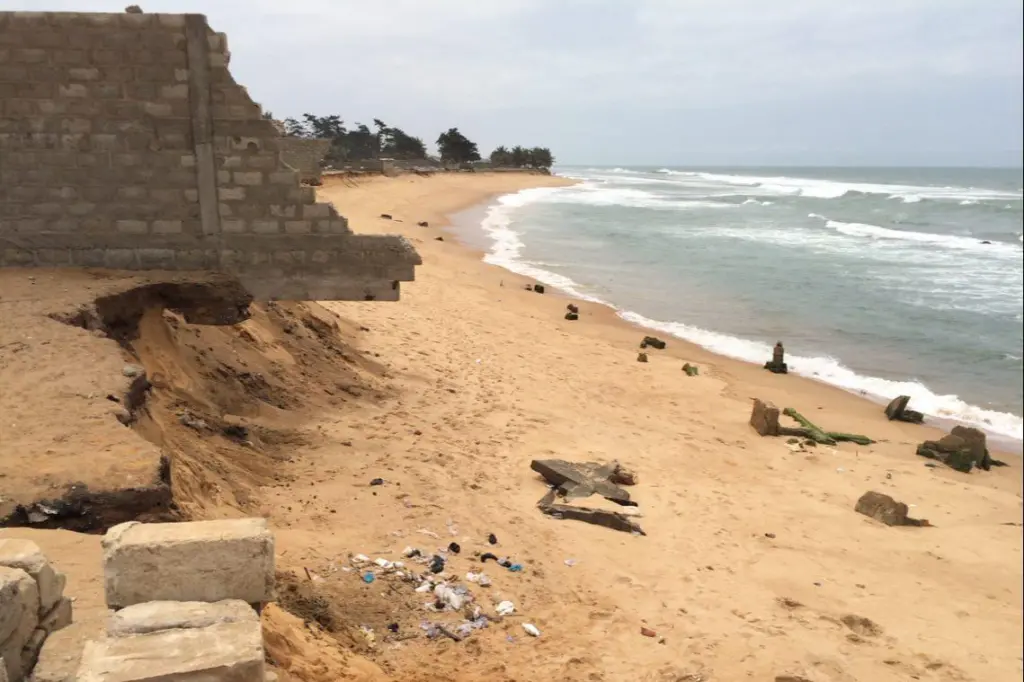
As governments and port developers invest in construction of new ports and expanding existing ones, the problem of erosion persists along the west Africa coastline that spans across 17 countries from Mauritania to Gabon.
The challenge of erosion and associated coastal flooding have triggered the unveiling of long term investments in environmental conservation measures particularly targeting the protection and replenishment of the troubled narrow low-lying west African coastline.
International partnerships
International partners, including financiers, marine engineering firms and environmental groups, have joined hands with governments of impacted countries, especially Togo, Benin, Senegal and Cote d’Ivoire and their respective port operators, to amplify the nexus of the region’s ports and the environment and how to leverage on such nexus for sustainable maritime infrastructure development.
Recently, Togo and Benin became the latest west African countries to unveil a new joint project to protect and replenish at least 40km of its coastline as part of the West African Coastal Areas (WACA) management programme.
The WACA programme is designed to build resilient coastal communities and areas through investing in seawalls, breakwaters, sand barriers, road protection, mangrove restoration, beach replenishment and pollution prevention according to the World Bank, one of the partners in the initiative.
Previous studies show port development and growth has had effects on the west African coastline contributing to the persisting leeside erosion, which in some instances extends as much as 50 kilometres along the environmentally troubled coastline.
But for Togo and Benin, the challenge of the current retreat of their coastlines could become a thing of the past with the unveiling of the new €55 million (US$57.9 million) project with the financing made available by the World Bank.
The two countries picked in March 2022 International Dutch dredging and heavy-lift company, Royal Boskalis Westminster N.V. as the preferred contractor for an ambitious project to protect and replenish a maritime area starting from eastern coastline of Togo and terminating at the western coastline of Benin. The project, which was set to commence immediately, is slated for completion in late 2023.
“The current coastline has suffered from significant erosion, resulting in coastal retreat that serves as a threat to vital infrastructure and the livelihoods of the local population,” said a statement by Boskalis.
The Dutch marine contractor will construct 15 new groins and refurbish six of the existing ones. Furthermore, it will carry out a beach replenishment programme using one million cubic metres of sand.
On the Benin side of the coastline, Boskalis will construct a 6.4 million cubic metre sand engine, a concept that the company was involved in co-developing and which has been successfully applied in the Netherlands for more than ten years.
With the sand engine concept, Boskalis explains, “a large volume of sand will be deposited at a strategic location and, over time, the natural motion of wind, waves and currents will spread it eastwards along the coastline.”
“This principle of building with nature will reinforce the coastline in a robust and natural way,” the company adds.
Once the project comes online, it would among other things reduce the average coastal retreat along coast of west Africa, a retreat estimated to be between one and two meters annually with some locations reporting up to ten metres.
It is estimated that the cost of environmental degradation for Togo and Benin, alongside Cote d’Ivoire and Senegal is about US$3.8 billion, an equivalent of 5.3% of the four countries’ gross domestic product as of 2017. Flooding and erosion account for up to 60% of the loss.
Several reports attribute huge coastal retreat in the coastline of west Africa to port infrastructure and sand extraction over time.
Both Togo, with Lome as the main port and Benin, where Port-Novo and Cotonou are the biggest ports, have joined four other countries in West Africa in the implementation of the West Africa Coastal Areas Resilience Investment Project with the aim of strengthening the region’s narrow and low-lying coastline.
For Togo and Benin, and indeed all the west African countries grappling with the problem of a retreating coastline, increasing investment in carefully designed shoreline projection structures will not only keep at bay the ferocity of floods and erosion but also reduce the coastal impacts around the region’s major ports.
Related Articles
 REGULATION & POLICY GREENPORT
 PROJECTS & INITIATIVES GREENPORT
 ALTERNATIVE FUELS GREENPORT