

A ready supply of batteries for inland vessels
The Port of Rotterdam Authority and inland shipping operator PortLiner are constructing a charging and storage pontoon for flow batteries in the Hartelkanaal.
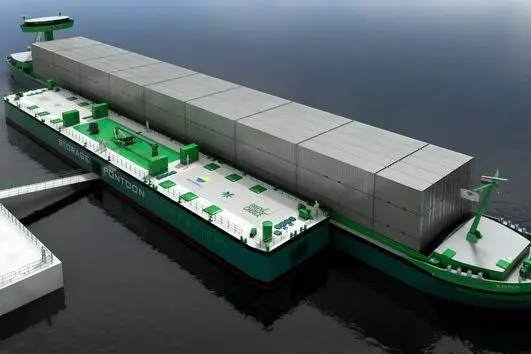
From this bunkering station, PortLiner will supply electrically powered inland vessels with flow batteries, allowing it to keep up with increased demand.
A spokesperson from the port said that the Port of Rotterdam Authority welcomes PortLiner’s innovative concept and continues to work with port businesses and the government towards a future-proof port.
Vessel demand
When completed, the pontoon will be supplied with green power (wind energy) from Greenchoice’s adjacent wind farm.
PortLiner is known for being a pioneer in emission-free transport solutions.
The company developed its innovative concept for zero-emission shipping based on flow batteries in cooperation with its partners Vattenfall and Greenchoice.
In flow batteries, electricity is charged in a liquid (electrolyte). Then once board a ship, the electricity is then extracted from the liquid and used for propulsion. The discharged electrolyte is then exchanged for charged electrolyte and the discharged electrolyte is recharged.
Within the Dutch transport sector, inland shipping is responsible for just 5% of carbon emissions. So by transitioning to electric power, PortLiner said that the inland shipping industry is making an important contribution to more sustainable shipping. This is not only in terms of a reduction in CO2, but also by lowering concentrations of nitrogen and particulate matter.
Construction of the pontoon is set to begin in the fourth quarter of this year, with completion of the Netherlands’ first electrolyte bunkering station expected in Q1 of 2024.
Related Articles
 PROJECTS & INITIATIVES GREENPORT
 PROJECTS & INITIATIVES GREENPORT
 ALTERNATIVE FUELS GREENPORT