


Growing as a region
Trade within the continent will spur growth at southeast Asias terminals in the coming years, suggests Wing Kah-goh from Singapore
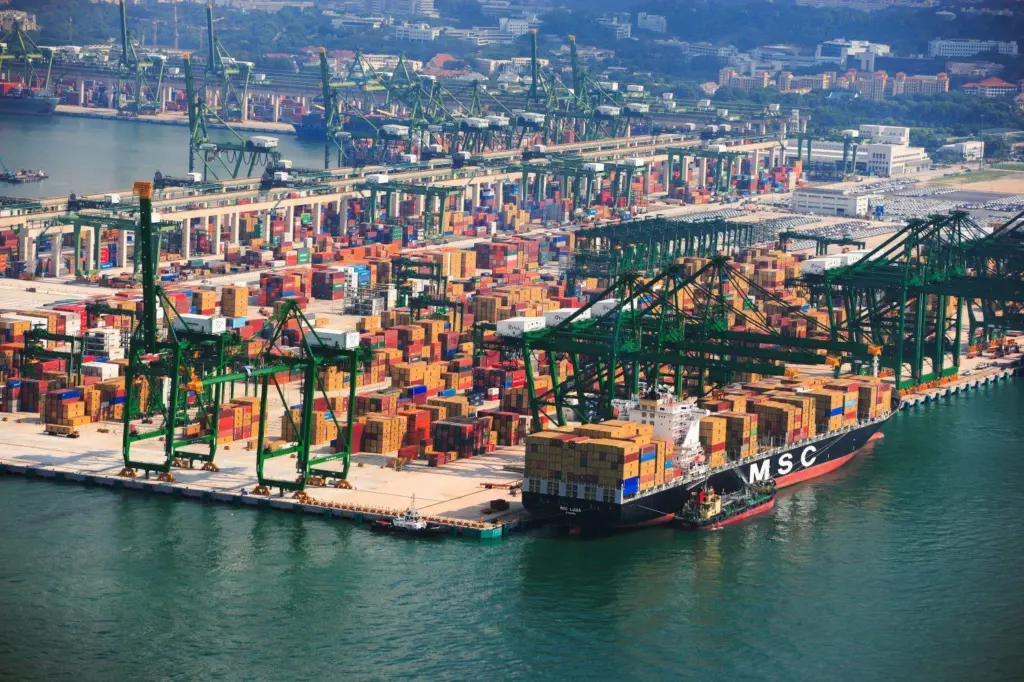
Southeast Asian ports now handle more than 60m teu a year and with projected terminal build-up it is not inconceivable that the region could grow by 50% by 2015.
While volumes on the transpacific look grim this year, booming trade between China and the 10 nation ASEAN region will keep boxes buoyant across southeast Asia. Latest statistics from the China-ASEAN Business Council show trade totalled $202.6bn in 2007, up 25.9%. China-ASEAN trade volume did not surpass $100bn until 2005, and it had not been projected to hit $200bn until 2010.
China and ASEAN recently agreed to complete a China-ASEAN Free Trade Area before 2010. This will serve 1.8bn consumers, nearly $2tr of gross domestic product and $1.2tr in trade volume.
Singapore leads the way with 27.9m teu shifted lastyear, up 12.7%. PSA Singapore Terminals is in the process of adding another 10 new container berths at Pasir Panjang Terminal (PPT). Collectively, PSA will have 54 berths and a total handling capacity of 35m teu at itsfour container terminals by 2009.
To equip its berths, PSA Singapore ordered more than 30 quay cranes from Shanghai Zhenhua Port Machinery Company last September and 79 rubber-tyred gantry cranes from Doosan Heavy Industries and Construction in April this year.
At the start of 2008, Pacific International Lines and PSA Singapore inked a joint venture to manage and operate a dedicated container terminal for PIL inSingapore. The PIL-PSA Singapore Terminal will operate three container berths at Keppel Terminal. It follows on from other dedicated terminal deals including with Cosco and MSC.
Work is also on schedule for the January 2009 opening of Singapore’s first dedicated car terminal. Japanese shipping lines Nippon Yusen Kabushiki Kaisha and Kawasaki Kisen Kaisha have teamed up with PSA to create Asia Automobile Terminal Singapore (AATS), a two-berth facility at PPT.
Over at Jurong Port, which accounted for 832,000 teu of Singapore’s throughput last year, vast infrastructure improvements are underway.In the past 12 months, it has completed the construction of two mechanical ramps capable of serving vessels/barges regardless of tide level. It has also extended berths J12 and J25 by a total length of 185 metres, while berths J12 and from J4 to J7 (total length of 873 metres) have been upgraded to handle vessels of up to 44,000 dwt.
Across the causeway, Malaysia’s Third Industrial Master Plan, a blueprint for growth from 2006 to 2020, earmarks a nation capable of handling 36m teu by 2020. This year, sources in Malaysia tell Port Strategy that the country as a whole should crack 15m teu.
The country’s Port of Tanjung Pelepas (PTP) managed to surpass the 5m teu barrier last year: strong Asia-Europe volumes saw business increase 15.3% to 5.5m teu.
After scratching around for a third large client – to add to Maersk and Evergreen – MISC, which already calls at PTP on its Halal Express Service, is going to drop by more often. The Malaysian flag carrier signed a memorandum of understanding in February with MMC, the 70% shareholders of PTP, to establish a joint venture terminal within the port.
MMC has also proposed shifting the container business from its other port, Johor, to PTP, though authorities have yet to sanction this move, nearly a year since it was first proposed.
Westports has the edge over Northport at Malaysia’s premier box facility, Port Klang. The former accounted for 61% of last year’s 7.12m teu at Klang. Transhipment accounted for 57.7% of Klang’s throughput.
This year, Port Klang Authority expects the port to handle 7.74m teu, a growth of 8.7%.
Westports has had a strong start to this year too, with volumes up 19% in the first quarter to a record 1.16m teu, well on the way to the 2008 target of 5m. Rapidly expanding French liner CMA CGM uses the facility as its regional box hub, as does China Shipping.
Westports, in which Hutchison has a 30% stake, is spending $253m on expansion including a fifth terminal to boost capacity by 30%. Phase one will be complete by year end.
On a sour note, Malaysia’s new Transport Minister, Ong Tee Keat, has vowed he will provide a full account of how Port Klang Free Trade Zone (PKFZ) managed to rack-up RM4.6bn ($1.5bn) in debts.
The crisis came last summer after Jebel Ali Free Zone pulled out of a 15-year management contract after just three years. In July 2007 it was revealed that costs had soared from an estimated RM1.1bn ($347m) to over RM4bn ($1.3bn).
Last August, the Transport Ministry gave PKFZ a RM4.6bn ($1.5bn) soft loan to rescue it from its debts.
In Indonesia, the main port Tanjung Priok, where Hutchison has a controlling interest, has outlined big expansion plans which the government is expected to release to tender soon. Construction of the first phase of Jakarta’s port expansion is expected to start this year and be completed in 2011, Sea Transport director general Effendy Batubara said in February.
Expansion will include the enlargement of a canal, deepening the port and the replacement of the breakwater in the West Gate of the port, Mr Batubara said.
With the expansion, the canal could accommodate two ships to keep pace with growing flows of cargoes in the port, he said.
Currently Tanjung Priok has the capacity to serve up to 80 ships per day and can shift up to 6,000 containers a day.
Based on a study by Japan International Corp Agency (JICA), Tanjung Priok needs a budget of Rp1tr ($108m) for expansion this year.
Elsewhere in Indonesia, the world’s most populous Muslim nation, French liner CMA CGM has confirmed it is very interested in developing a terminal just off Singapore at Batam island, a location due for a serious maritime upgrade with Dubai’s Drydocks World purchasing a 200 hectare site to build a giant shipyard there.
Moving to another archipelago to the north, the Philippines is garnering a fair amount of investment in the ports sector.
Manila International Container Terminal run by Philippine firm International Container Terminal Services Inc has an annual capacity of 1.5m teu, and it accounts for 62% of the capital’s box volumes. ICTSI has lately bagged two more concessions to bring its Philippine portfolio to six.
First off, it won the concession for the new container terminal at the Subic Bay Freeport Zone to the north of Manila in the middle of last year. The project, designed to make the Subic seaport a major container port in the country, is being funded by the Japan Bank for International Cooperation for $215m.
Then in April, ICTSI also won a 25-year lease for a terminal in the far south at Mindanao Container Terminal (MCT) inside the Phividec Industrial Estate in Tagoloan town, Misamis Oriental. The MCT is designed to accommodate an annual throughput of 270,000 teu. ICTSI also operates terminals in Poland, Brazil, Madagascar, Ecuador, China, Syria, Georgia and Colombia. The company had said that its capital expenditure this year might increase by 230% to PhPesos11.6bn ($278m), covering civil works, systems improvement and the purchase of major cargo handling equipment.
Meanwhile, China Ocean Shipping (Group) Co, China’s biggest shipping company, is shelling out a massive $3bn to develop a shipping complex at Sangley Point in Cavite.
The government is promoting the site as a transhipment hub for vessels carrying goods from Asia to Europe, the US and the rest of the world.
Sangley Point is 12.8km southwest of Manila, the capital. Cosco intimated that it might well invest further in the archipelago, in ventures such as shipyards and crewing centres.
In terms of transhipment hubs in the vicinity Cosco is already well served with dedicated berths with PSA in Singapore and a joint venture couple of berths with Hutchison in Hong Kong.
Laem Chabang, Thailand’s premier port, posted a very respectable 6.6m teu last year. What it needs now is a surge of new customers to fill in the raft of new berths that came onstream in 2007. The completion of a phase two expansion project which brought six new container terminals into play has ramped the port’s capacity to 11m teu. Perhaps more throughput might funnel down from landlocked Yunnan province in southwest China and landlocked Laos following the completion of a dramatic infrastructure project.
Further boosting Thailand’s prospects, the final link of the ”North-South economic corridor” linking Bangkok with southern China was opened on April 1.
The prime ministers of Cambodia, China, Laos, Burma, Thailand and Vietnam were on hand to officially inaugurate the former opium smuggling route as the final link of the ”North-South economic corridor,” a 1,850 kilometre network of roads linking the southern Chinese city of Kunming to Bangkok.
The area’s low-lying mountains – the foothills of the Himalayas – served for centuries as a natural defensive boundary between Southeast Asian civilisations and the giant empire to the north. The road rarely follows a straight line as it meanders through terraced rice fields and tea plantations.
With trade across these borders increasing by double digits every year, China has helped construct a series of roads inside the territory of its southern neighbours. The Chinese government is paying half the cost of a bridge over the Mekong river between Laos and Thailand, due for completion in 2011.
However, even before the completion of the road, trade between China and the upland Southeast Asian countries Cambodia, Laos, Burma, Thailand and Vietnam had risen impressively, to $53bn in 2007 from slightly more than $1bn a decade ago.
Intra-Asian trade really holds the key for future port demand parameters in the region.