


BIG CRANE BONANZA
The global demand for outsized ship-to-shore container gantry cranes is still growing apace, with another record delivery due in 2004 and substantial orders already placed for 2005 completion. Andrew Foxcroft reports.
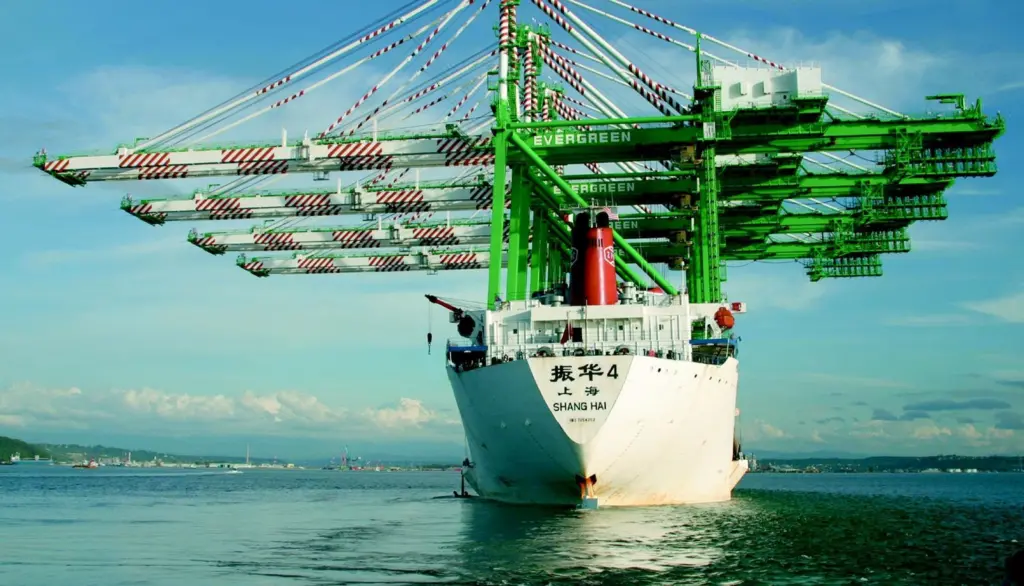
Production is being fuelled by the 10% plus annual expansion in container trade being handled by seaports worldwide and recent large additions being made to the world’s containership fleet. Moreover, a rising share of new tonnage is of 6,000TEU plus capacity, which requires handling by cranes of the largest post-Panamax dimension.
A glance at Table 1 gives the current picture. Over 400 new, dedicated container cranes are due for delivery in 2004-05 (according to data held at third quarter 2004), and these will add to an existing fleet of around 3,300 in service at end-2003. Over 220 cranes have been installed throughout 2004, and upwards of another 200 are already booked for arrival next year. This influx is steadily changing the composition of the world’s standing crane fleet, given that over 55% of all operational units, but just 15% of planned deliveries, are of Panamax outreach. By further contrast, only 6.5% of existing cranes have a ‘super’ or extra post-Panamax outreach, of 60 metres or greater, which comprise near a half of all current deliveries.
The global count of these larger cranes is set to almost double during 2004-05 when almost 200 are due for delivery overall. There will be a proportionally big rise in the number of cranes able to reach across 64 metres or greater, implying that the drive to push technical developments to their limit and build to an increasingly large dimensional capacity has not yet run its course. Over 30 cranes will reach further than 66 metres which is equivalent to traversing a width of 24 container rows, and the total includes some of the largest cranes ever to be built at 70 metres outreach.
The majority of cranes constructed to a 60 metre plus outreach are capable of handling current-generation ships of maximum 22 row width, and they are now being sought by all container terminals aspiring to hub status. To attain so large a reach the majority are constructed to a lift height (beneath the spreader) of at least 40 metres. They are also amongst the most technically advanced usually providing a trolley travel speed of up to 4metres/second and laden hoist speed of 1.5metres/second as standard requirement. Most are also rated to lift 60 tonnes or greater under the spreader with many featuring a twin-lift capability as well.
Cranes of the largest post-Panamax capacity are currently being supplied to ports the world over although a big share are heading for Northeast Asia and China in particular. As it is, the Northeast Asian region will account for the biggest proportion of all crane production in 2004-05, equivalent to 40% or 165 units. Ports in Europe are expected to receive almost 25% (91 cranes), with the Americas taking 15% (62). This leaves roughly 10% each for terminals in the Midle East (47) and Southeast Asia (38), and just a handful of cranes for other areas, including Africa (12) and Australasia (3). Most cranes of Panamax or more limited post-Panamax dimension are presently being built for ports in Europe, as well as for Central/South America, Japan, Vietnam, Thailand, the Indian Sub-Continent and Australia.
Many large cranes of 60 metres outreach or greater are being acquired by the big global terminal operators and are destined for brand new developments. The latter include the Suez Canal Container Terminal at Port Said which is to receive two units each of 62.5 metres outreach in 2005; Mawan Port in China taking delivery of eight units (65 metres outreach) during 2004-05; and Asia Container Terminals’ new site at Kwai Chung T9 in Hong Kong. This is also acquiring eight cranes of 65 metres outreach. However, one of the largest new development concerns Pusan Newport Corp, in South Korea which has ordered 18 cranes (again, all rated to 65 metres outreach) for delivery from 2005 onwards.
Some of the largest units ever to be built are being acquired for Singapore and Jebel Ali. The PSA has ordered 12 cranes of massive 67 metres outreach for its Pasir Panjang terminal. Dubai Ports Authority is taking a total of 18 cranes, all of 68 metres outreach in several batches during 2004-05. Yet other important purchases are being made by Eurogate at Hamburg (5 units), APM Terminals at Algeciras (3), Felixstowe (3), Evergreen in Los Angeles (5) and Virginia Port Authority (4), all of which have ordered cranes of around 62-63 metres outreach. Three cranes of this dimension are also under construction for the new, highly automated Tobishima Container Terminal at Nagoya.
Yet other orders for cranes of smaller 60-61 metres outreach have been placed by SETO at Le Havre (6), Kingston Port Authority in Jamaica (4) and HHLA for Container Terminal Alterwerden (6).
A sizeable run of 24 cranes, of smaller 55-56 metres outreach are meanwhile under construction for various sites in Antwerp. All such units provide a capability to span up to 20 container rows. They comprise 10 cranes destined for the MSC Home Terminal located at the Delwaide Dock extension and six for Antwerp Gateway Terminal under development within the Duerganckdok area. The latter is to be operated by a consortium led by P&O Ports Antwerp and options already exist for an additional three cranes of same capacity. A separate six cranes have meanwhile been contracted for the PSA/HNN (Hesse Noord Natie) project on the Scheldt Left Bank.
Another two are going to the Noordzeeterminal (Quay 913), also run by PSA/HNN, where they join six already in use there.
As suggested though, China has been the focus for many recent deliveries and 85 cranes of 60 metres outreach or greater are due for installation at ports there during 2004-05. Recipients include Shekou (5 units), Tianjin (6), Yantian (8), Ningbo-Beilun (8), Guangzhou (4) and Chiwan (8, including 4 of record 70 metres outreach). A total of 16 cranes are going to Hong Kong, including the nine destined for ACT. However, the biggest single delivery is being made to Shanghai.
A total of eight have just gone to the established Waigaoqiao Terminal, while 13 are destined for the new Yangshan Deepwater Terminal, which is due to open next year.
China’s need for additional crane capacity is paramount, as its seaports’ collective annual throughout is continuing to rise and is expected to top 75m TEUs in 2004. It has already surpassed the US as the world’s top container handling country and presently accounts for almost a quarter of world box traffic. However, this country is also home to the world’s largest manufacturer of ship-to-shore container cranes and so also benefits from a guaranteed local supply. Shanghai Zhenhua Port Machinery Co (ZPMC) has long gained from its proximity, as well as other competitive advantages, and today meets over 50% of world container crane demand.
This equated to an order book for over 220 cranes due for delivery in 2004-05 combined (Table 2), and no other supplier comes close to rivalling its position. The next biggest producer is the Italian Fantuzzi group which together with Noell Crane Systems, and its all-important Chinese fabricating subsidiary, is due to build around 35 cranes during 2004-05.
Another 30 are to come from the Paceco licencees, headed by Mitsui Engineering and Shipbuilding. Yet other important suppliers are Kalmar Industries Sweden, Mitsubishi Heavy Industries, Liebherr Container Cranes and IMPSA.
ZPMC is already meeting just about all business placed by terminals in China as well as a growing share from customers in Europe, the Americas and elsewhere. It is also responsible for producing a very high share of the largest capacity cranes and working on many of the largest and most prestigious projects. It has for example secured the DPA order, as well as those placed recently by SETO/Le Havre, Eurogate/Hamburg, Evergreen/Los Angeles, Virginia Port Authority, PSA/Pasir Panjang and Pusan Newport Corp.
Output from Fantuzzi/Noell is likewise globally focused, albeit on a much smaller scale. Sales have been made recently to ports in France, Italy, Egypt, US, Columbia, India, Thailand and Hong Kong.
Paceco licensees have, by contrast, tended to increasingly serve their more local market areas, based in Europe and Asia. Kalmar has similarly been targeting North Europe and, by virtue of its takeover of the former Dutch Nelcon business, has been responsible for meeting the entire run of orders placed by terminals in Antwerp.
Crane description Operating Due for delivery at end 2003 in 2004-05<$>Panamax outreach below 44m 1855 70<$>Post-Panamax outreach 44-48m 578 32<$>outreach 48-52m 391 51<$>outreach 52-56m 202 36<$>outreach 56-60m 60 31<$>outreach 60-62m 99 52<$>outreach 62-64m 66 34<$>outreach 64-66m 46 78<$>outreach over 66m 6 34<$>Grand total 3303 418
Table 1: World fleet of ship-to-shore container gantry cranes as of 3Q-2004 Note: outreach is measured from seaward rail . Source: Andrew Foxcroft
Data Manufacturer Due for delivery in 2004-05 ZPMC . . . . . . . . . . . . . . . . . . . . . . . . . . . . . . . . . . . . . . . . . . . . . . . . . . . . . . . . . . . . . . . . . . . . . . . . . . .221<$>Fantuzzi Group . . . . . . . . . . . . . . . . . . . . . . . . . . . . . . . . . . . . . . . . . . . . . . . . . . . . . . . . . . . . . . . .35<$>Paceco licensees . . . . . . . . . . . . . . . . . . . . . . . . . . . . . . . . . . . . . . . . . . . . . . . . . . . . . . . . . . . . .30<$>Kalmar Industries . . . . . . . . . . . . . . . . . . . . . . . . . . . . . . . . . . . . . . . . . . . . . . . . . . . . . . . . . . . .30<$>Mitsubishi Heavy Industries . . . . . . . . . . . . . . . . . . . . . . . . . . . . . . . . . . . . . . . . . . . . .24<$>Liebherr Container Crane . . . . . . . . . . . . . . . . . . . . . . . . . . . . . . . . . . . . . . . . . . . . . . . . .16<$>IMPSA Group . . . . . . . . . . . . . . . . . . . . . . . . . . . . . . . . . . . . . . . . . . . . . . . . . . . . . . . . . . . . . . . . . .10<$>Kocks Cranes . . . . . . . . . . . . . . . . . . . . . . . . . . . . . . . . . . . . . . . . . . . . . . . . . . . . . . . . . . . . . . . . . . . .9<$>Kranbau Eberswalde . . . . . . . . . . . . . . . . . . . . . . . . . . . . . . . . . . . . . . . . . . . . . . . . . . . . . . . . . .9<$>Konecranes . . . . . . . . . . . . . . . . . . . . . . . . . . . . . . . . . . . . . . . . . . . . . . . . . . . . . . . . . . . . . . . . . . . . . . .8<$>Other . . . . . . . . . . . . . . . . . . . . . . . . . . . . . . . . . . . . . . . . . . . . . . . . . . . . . . . . . . . . . . . . . . . . . . . . . . . . . .26<$>Grand total . . . . . . . . . . . . . . . . . . . . . . . . . . . . . . . . . . . . . . . . . . . . . . . . . . . . . . . . . . . . . . . .418
Table 2: World delivery of ship-to-shore container gantry cranes in 2004-05 by supplier (as of 3Q-2004) Source: Andrew Foxcroft Data
Related Articles
 CONTAINER & CARGO HANDLING
 CONTAINER & CARGO HANDLING