



Automate the Gate?
In the first of a two-part series Alex Hughes talks to terminal operators in Manila, Santos and Le Havre discovering that there is still at least one barrier to full automation.
Container terminal gate systems have traditionally been highly labour-intensive, capacity-challenged and not particularly secure. The leading developers of terminal management systems, such as Cosmos, Navis and Total Soft Bank, have all introduced gate modules aimed at increasing security, boosting throughput and enhancing traffic flow. While terminals around the globe are definitely upgrading their terrestrial interfaces, not all of them are doing it in exactly the same way.
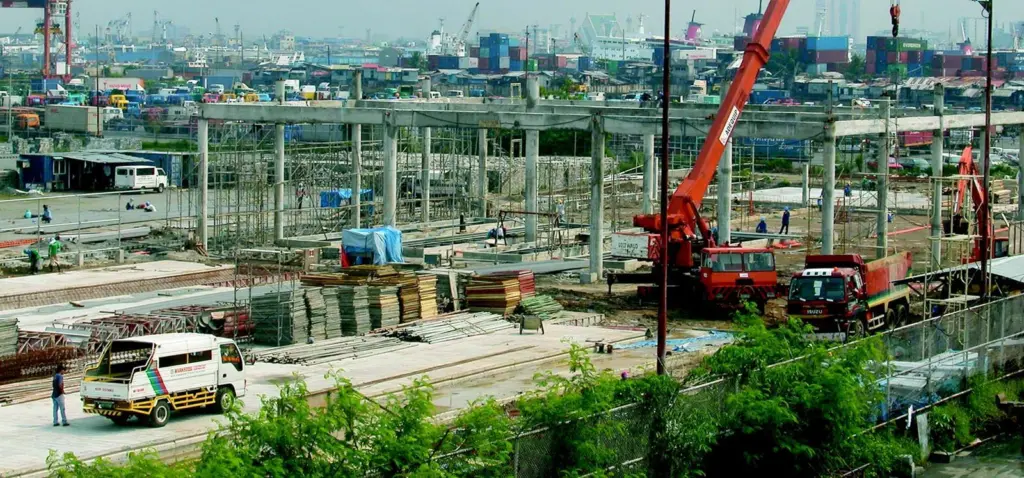
A brand new gate system is due to open early next year at Manila International Container Terminal (MICT), where Captain “Andy” Andrews is general manager. He points out that the terminal had probably gone as far as it could with its present set up which is heavily labour intensive. Furthermore, with grants available under the US government’s Megaports Initiative, MICT was able to source appropriate funding to put in what will be a wholly automated set-up for the future.
“At present, we contract out our gate management services. However, this is proving to be extremely expensive, contrary to what you might think, since somebody has to be available to note down a lot of detail about incoming containers to our terminal, ” notes Andrews.
In contrast, the new system will concentrate all inbound loads through a six-lane gate. Each container will pass through a radiation detecting portal which will also eventually incorporate some form of scanner to allow the interior of the box to be screened. All boxes will then be routinely scanned using an optical character recognition (OCR) system, obviating the need for somebody on hand to read the container number. However, because of ISPS regulations, the container seal number will continue to be manually read.
A series of up-and-down barriers will retard the progress of the container into the terminal until all formalities have been cleared. One of these will require every single box to be weighed, much to the delight of the shipping lines which claim that the weight revealed on some cargo manifests bears little relation to the actual weight of the loaded box.
“Throughout this entire procedure, truck drivers will remain in their cabs. There, they will be individually photographed along with the license plate of the vehicle. No physical contact will take place with communication undertaken via a microphone and display screen, ” explains Andrews adding that the physical condition of the container, including any faults or defects, will also be recorded.
The software controlling the gate is being written in-house but has a gateway allowing it to be fully integrated into MICT’s Cosmos terminal management system.
“We both like and trust Cosmos, but wanted to incorporate certain aspects into the gate software that were peculiar to our operation, so we wrote it ourselves, ” says Andrews, observing that this will also give the terminal’s technicians important local control.
“In the four years that I have been in charge at MICT, not one box has so far left the terminal without proper authorisation. We get about six misloaded boxes each year but every one has been picked up by our current gate system. However, because there is still a human element in the loading of trucks we don’t expect all anomalies to be totally eliminated even when the new automated gate system comes on stream, ” concedes Andrews.
Santos Brasil, the leading box handler in the port of Santos, has a gate system composed of 15 truck lanes of which ten handle inbound traffic and five, despatched boxes. Equipment on the gate is fairly sophisticated consisting of a PC and printer, an infrared scanner and cameras for recording an image of the truck. Antonio Carlos Sepulveda, terminal director, reveals that an OCR system is being installed on the exit gates to read truck number plates and also log the container number.
“For containers entering the terminal by road we don’t apply either barcoding or tags. Instead we simply log the container number which is then keyed into radio data transmitters when the position of that box is changed in any way, ” he notes.
On outbound movements, the truck driver is given an authorisation sheet with a three-dimensional barcode which is impossible to copy.
At the gate this barcode is passed through an infrared scanner and must be validated before the truck is allowed to proceed. A second security gate has also been installed as part of ISPS code compliance, which once again checks the authenticity of the document conveyed by the driver.
“We very seldom encounter any anomalies on the gate. However, if a container does slip through the system, the truck is pulled over and the container and documentation rigorously checked to prevent this happening again in the future, ” explains Sepulveda.
FULLY INTEGRATED The gate system in place at Santos Brasil is fully integrated into the terminal management system. To minimise disruption following a power-out, a back-up generator is retained. Sepulveda reveals that internal targets insist on a 15-minute maximum acceptable stoppage. If it then proves impossible to restore the system within that period, a manual back-up procedure is put in place.
Asked what future developments he would like to see implemented at the terminal, Sepulveda emphasises that the shift to OCR at the gate will eventually make the whole procedure automatic, with an employee presence no longer necessary. He stresses that at Santos Brasil software is being developed in-house and that the eventual aim is to integrate everything into a single package. While not overly aware of the external market for such system, Sepulveda nevertheless believes that the provision of gate IT equipment is not extensive and that competition for supply is minimal.
Le Havre’s most important box-handling operator, Terminaux de Normandie (TN), has a ten-lane gate system in place at the port.
According to commercial director Didier Chapsal, TN’s gate system links directly to a port platform database. So all information regarding inbound and outbound containers is held centrally which means that any container exiting the terminal must have relevant Customs clearance and have paid any outstanding port fees and charges before its release is allowed. Interestingly, the driver does not necessarily need to handle any paperwork: the container number and/or the booking number alone is sufficient. “At the gate, one of TN’s employees simply keys either the container or booking number into the computer, which will then confirm its status, ” notes Chapsal.
Asked whether the gate system ever picks up any anomalous boxes he points out that misidentification of containers is extremely rare speculating that only one or two a year are turned back at the gate. “There is more potential for mistakes to occur with empty rather than full containers, simply because the shipping lines and forwarding agents take more care with the latter. In fact, the central database does not track the movement of empty containers in the same way and cannot therefore give release information as such to the man on the gate, ” explains Chapsal.
In respect of potential hardware problems, he points out that a mirror system kicks in if the main computer crashes, while a back-up generator is also available if the mains electricity supply fails. Manual processing of containers is only used as a last resort.
As to automation of the gate, Chapsal observes that no plans yet exist to introduce this at the company’s existing facilities in Le Havre, although the Port 2000 development may well. He nevertheless reiterates Andy Andrews’ point that the ISPS code actually makes it impossible to introduce wholly automated operations simply because the seal number on the container must be physically read if terminals want to continue to do business with the US.
Related Articles
 CONTAINER & CARGO HANDLING
 CONTAINER & CARGO HANDLING