

Home, sweet home
DP World has captured headlines around the world for its tenacious port purchasing power.Alex Hughes heads back to where it all began
Although Dubai Ports World (DPW) is nowadays better known as an international container terminal operator, with interests across the globe, it has not neglected its home base of Jebel Ali/Port Rashid in Dubai.
Here, throughput continues to grow at a rapid pace, thanks to both increasing import/export traffic and a significant trade in boxes rotated in and out by sea. According to a spokesperson for the company, strong growth is expected to continue for some years to come.
When Jebel Ali first opened in 1979,it was the largest manmade harbour in the world. Nowadays, it has 4,700m of berthing line and alongside draught of 17m. Last year, traffic amounted to 6.39m teu, making it the ninth leading container port in the world and the largest to be found between Singapore and Rotterdam.
However, an upward capacity constraint of 9m teu has prompted discussion on where future containers will be handled. This burgeoning traffic has therefore resulted in the decision to undertake a two-phase development of Jebel Ali, which will allow capacity to be added in line with demand. “We will continue to invest in Jebel Ali to ensure we can provide the services our customers value today and in the future,” the company tells Port Strategy.
In fact, DPW claims that throughput at the port is rising at 20% annually, which has already prompted the company to add extra quayside lift to accommodate the growing number of ships.
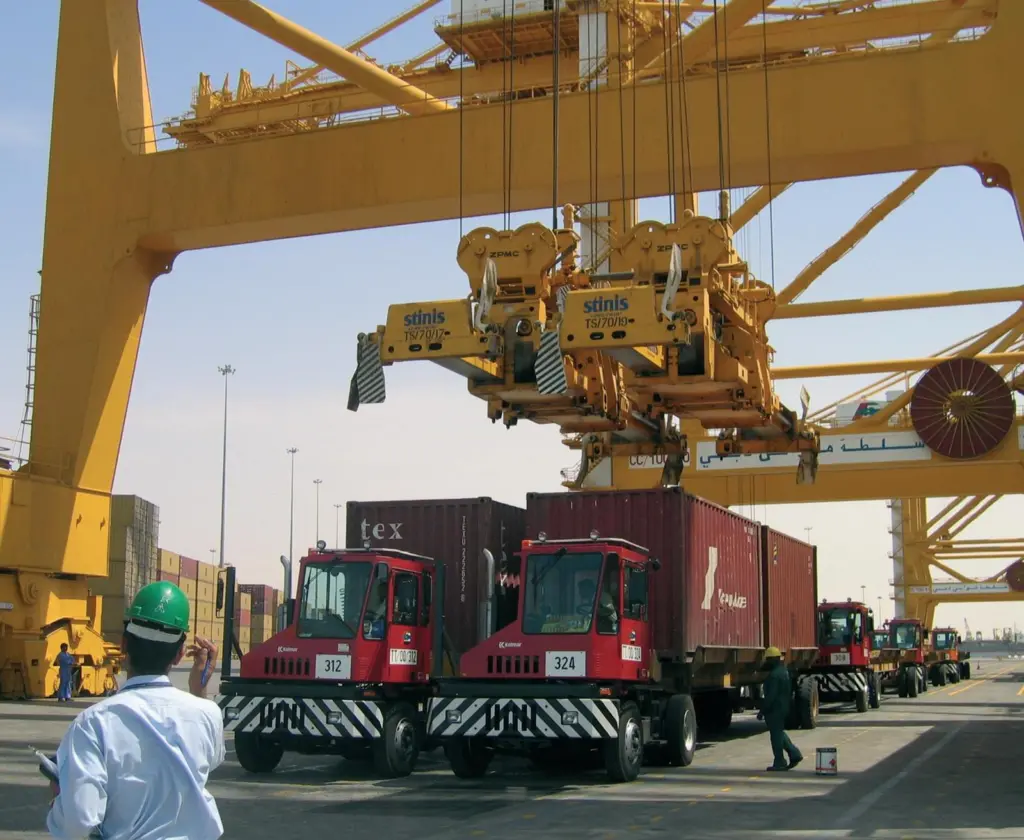
Currently, Jebel Ali container terminal can call upon no fewer than 146 RTGs and 45 quayside gantry cranes, of which 10 are quad-container ship-to-shore units. These have undoubtedly been a big help in boosting productivity, which is now in the region of 32 moves per crane per hour.
“Our prime objective in bringing in quadcontainer cranes was to meet the needs of our customers, who were looking for faster vessel turnaround even as cargo volumes were increasing,” says the company. Such has been the success of the equipment in adding flexibility to quayside handling operations that the new Jebel Ali 2 terminal will also be outfitted with these, although of a slightly modified design. Asked to explain how easy it is to keep a continuous feed of yard vehicles beneath quad-cranes to ensure that there is no break in productivity or efficiency and that congestion is kept to an absolute minimum,DPW concedes it has to work hard to avoid congestion.
“We operate 24 hours a day,7 days a week and plan carefully to make sure we maximise efficiency and keep cargo and vessels moving,”the company says. In addition, DPW is at pains to point out that every port operation depends on vessels arriving on time,the depth of water drawn by those vessels, harbour traffic in general and so on. Having said that, the company insists that average anchorage at Jebel Ali is only about 1.5 hours to 2 hours.
In fact,relief for existing installations is in sight.Phase I development of Jebel Ali 2 is due to come on stream in 2007,allowing the whole DPW complex to handle up to 12m teu.This will involve the construction of 2,475m of quay and also result in a concomitant expansion of the adjacent Free Zone, which is expected to continue expanding up to a size of 130 sq km.
Once the second phase expansion of the new terminal is completed, Jebel Ali 2 will add up to 5m teu of available capacity. With investment in this new complex totalling ¢322m, it is perhaps understandable that DPW is somewhat shy about releasing details on how long it thinks it will take to get back a return.
While container handling operations in Dubai have become synonymous with Jebel Ali Port, it is sometimes forgotten that the first box facility in the Emirate did not open until 1972, when Port Rashid commenced operations. At that time, it had two quayside gantry cranes,while throughput was less than 10,000 teu. Since then, it has expanded considerably, handling 1.229m teu last year.
Current capacity is limited to 1.5m teu, given that the terminal has just 1,400m of quay and alongside water depth of 13m. Quayside lift consists of nine quayside gantry cranes, while take-away and stacking capability is in the hands of 37 straddle carriers.
Related Articles
 CONTAINER & CARGO HANDLING
 CONTAINER & CARGO HANDLING