


Building Frenzy
A record orderbook and increasing pressure to produce more green tugs proves there’ s a future for these waterborne powerhouses, as Jack Gaston explains
At no time in its 170-year history has the towage industry worldwide experienced a demand for new tonnage to match that currently being experienced by tug owners and builders alike. This unprecedented demand, dubbed by one insider as “a feeding frenzy for new vessels”, has resulted in a total of well over 550 tugs under construction around the world as this article goes to press.
There is no single reason for this massive demand, which is placing a noticeable strain on the resources of owners, specialist shipbuilders and component manufacturers. Some pundits quote a recurrent building cycle, where many vessels in service are over 25-30 years old, and there was indeed a large increase in tug building in the mid 1970s.
Others point to demands generated by increasing numbers of very large container vessels, tankers and a new influx of liquified natural gas carriers. The predominant cause however is the tug owners reaction to constant pressure from shipowners to reduce towage rates while at the same time providing ever more powerful and efficient tugs.
Asked for his views on this bulging orderbook, towage industry guru Michiel Wijsmuller, head of design consultants Worldwise and newly-formed Offshore Ship Designers, comments: “I am sure the huge influx of new harbour and terminal towage capacity will certainly be absorbed. Think about the number of ports in the world, the annual increase of seaborne traffic of around 10% and the fact that many harbour tugs are 25 or more years old. Many of them are no longer fit for their tasks, or the tasks to come such as handling LNG vessels.
“Future challenges for tug naval architects will be the development of more environmental friendly tugs, which often have to work in relatively densely populated areas.There still is a future for us.”
In many ports around the globe the use of tugs is unavoidable. For the foreseeable future there will always be ports that can only be accessed by certain types of ship with the aid of tugs and equally there will always be ships that can only be berthed/unberthed safely with tug assistance, due to their size or handling characteristics.The tug will therefore remain an integral part of a ports infrastructure and continue to be seen in many cases as an ‘insurance policy’with an unwelcome but inevitable premium.
It is against that background that the tug owner must currently operate. Thanks to the continuing effects of globalisation that tug owner is increasingly likely to be a large national or multinational company.
During the most recent round of takeovers and mergers,just a few weeks ago,SvitzerWijsmuller,part of the AP Moller Group,grew to become the largest single tug owner in the world and Smit International took over one British fleet and formed a working alliance with a major Italian operator. Companies operating on a national or global scale frequently have the ability to deploy tonnage to its best advantage, extracting maximum utilisation from tugs of various types, and sheer purchasing power when new vessels are procured.
A very high proportion of the tugs presently under construction are of the shiphandling type designed to provide assistance to large ships frequenting ports large and small.The designs themselves are, in the vast majority of cases, those intended for series production in substantial numbers to a given standard incorporating considerable commonality.This principle has been in place for several decades with specialist shipyards in the Netherlands, Spain,Turkey, the US and the Far East.
Dutch tug builder Damen Shipyards alone reports approximately 170 tugs under construction, to a dozen or so designs, some of which are for specified clients, some to be completed for immediate sale and others to be held as stock hulls. Spanish yards are at full stretch, with many vessels being built to established designers such as Cintranaval. Well known, Vancouver-based, naval architect and designer Robert Allan estimates well over 150 tugs being built to designs from his company Robert Allan Ltd in yards worldwide.Many of the latter are high-tech terminal tugs of various types.
Shiphandling tugs for the modern market place, attending container ships,bulk carriers,car transporters and the like, are invariably expected to have a bollard pull of between 50 and 70 tonnes. They may well be rather smaller than their predecessors at anywhere between 24 and 30 metres in length.The title ‘compact’ tug has become fashionable with whole ranges of vessel on offer to standard designs. They are powerful and highly agile vessels of around 25m in length with a beam of about 11m with engines and propulsion systems designed to generate bollard pulls of up to 70 tonnes.Compact tugs are optimised for operation by a crew of two or three and in keeping with most modern shiphandling vessels are used in a ‘push-pull’mode of operation.
Their size and agility enables them to exert power exactly where it is required and one or two tugs of this type are frequently carrying out berthing operations that previously required three or four.
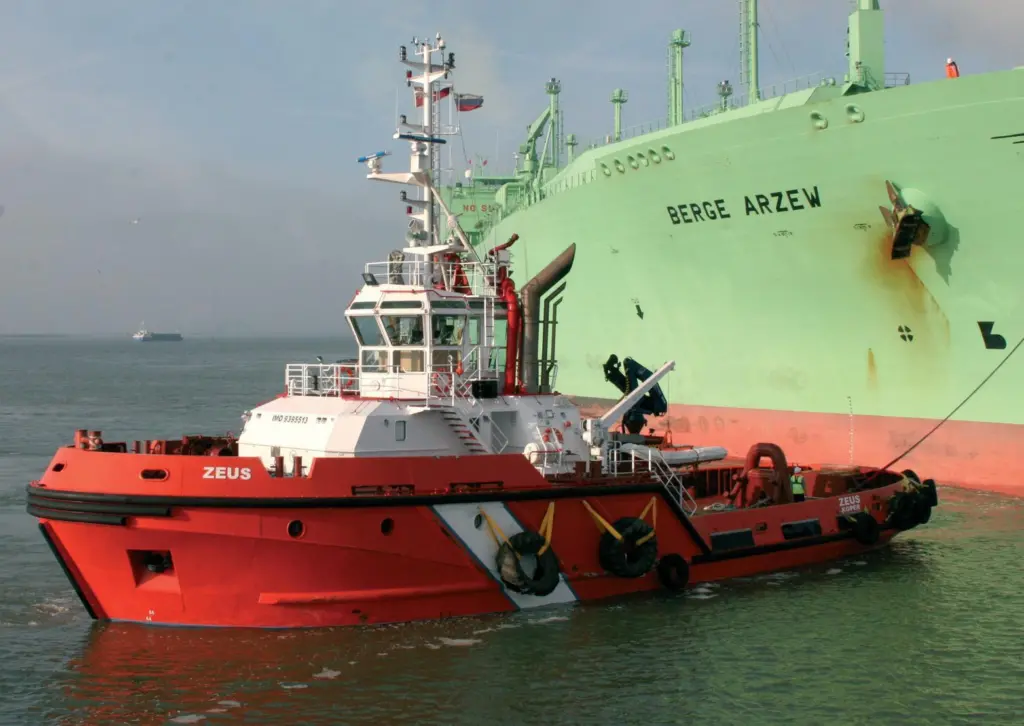
In the present economic climate there is also an almost endless demand for larger and more sophisticated tugs to attend oil and gas terminals.This sector is probably where the majority of research and development has taken place and where building costs are at their highest. Escalating concerns for environmental issues, from environmentalists, politicians, the general public and terminal operators themselves, have resulted in a second generation of highly specified tanker handling tugs capable not only of shiphandling but also escort duties, fire fighting, pollution control and emergency response operations.
Such tugs are increasingly expected to operate in relative isolation at remote oil and gas terminals where weather and sea conditions create particular problems and at the same time there are serious environmental conditions to be met.Tugs designed for terminal duties, whether at oil or gas installations have to meet stringent performance criteria not only in terms of static bollard pull but also in dynamic line pull while underway with a ship in the escort mode of operation.
Requirements for static bollard pull figures of over 100 tonnes are not uncommon and while operating in the indirect (escort) mode dynamic steering and braking forces exceeding 160 tonnes, at speeds of 10 knots are specified.
Whole fleets of terminal tugs are contained within the total worldwide order book for tugs and demand shows no signs of abating. Tugs ordered for the new gas terminals in the UK at Milford Haven are a good example. With two terminals due to come on stream towards the end of 2007 a fleet of nine tugs has been ordered by SvitzerWijsmuller to service not only two separate 25-year contracts with the terminal operators but also the existing oil terminal work in the port. The fleet, when complete, will be one of the most powerful and technologically advanced in the world with the largest escort tug having a static bollard pull of 115 tonnes.
Related Articles
 EQUIPMENT