


Hinterland headaches in North Europe
A number of studies have been completed, and most likely some are still in progress, that have addressed the issue of the origin and destination of cargo from the natural hinterland of the major European ports. In theory this should not be a hard task to achieve, but in practice there are many obstacles in place that obfuscate the reality.
Research has been done using demographic “gravity” models; network models using shortest or most cost effective highway/rail movements, again linked to population and business demographics. Other studies have focused on direct market research. Perhaps surprisingly, ports often do not know the extent of their hinterlands.Much of this movement is in the hands of private carriers, who generally carry only a small part of a port’s hinterland traffic. The carriers that bring cargoes to and from ports often view their trade data as a commercial secret. This is particularly true of cargo moving by truck.Much of the cargo is controlled by forwarders.
A recent study by Global Insight of the six major European North Continent ports was completed to establish a more accurate picture of the origins and destinations of the containerised cargo transiting to and from the hinterland. The ports studied are in the Le Havre-Hamburg range.
The key to the success of this study has been the combination of relatively reliable world trade data with port data and direct market research related to mode of transportation and inland origins and destinations. Port traffic statistics were matched with foreign trade and transport statistics in order to run an integrated regional model. Transhipments and short sea traffic were identified as part of a separate effort by ISL.
The combination of the three elements of port traffic has been solved successfully for the first time to both identify container movements as well as to eliminate double and treble counting.
For the six major ports in the North Range, the two leaders are Hamburg and Rotterdam. Excluding transhipments, Rotterdam marginally leads Hamburg in the combined import and export trade on non-European Union trade lanes. A full 74% of the deepsea import traffic for the ports is direct to the Hinterland. But this gives a misleading picture.
The Port of Rotterdam is surrounded by distribution centres. It is estimated that nearly 60% of all distribution centres in terms of volume, are located in the Netherlands. Therefore we see a very large proportion of cargo being discharged for customs clearance in the Netherlands, but the large majority of this is further re-distributed inland, primarily to Germany (Nordrhein Westfalen).
A similar picture is true for Hamburg which acts as the distribution point for the Bremen- Hamburg range as well as Austria, Poland and Russia (primarily via Finland by means of shortsea transhipment).Antwerp equally serves northern France.
Hamburg is the largest transhipment port of deepsea containers while Rotterdam is the larger for shortsea activities. These differing activities,which were not very clear to the ports before, can generate significantly different marketing and business planning strategies. Le Havre on the other hand is primarily a French port that during periods of congestion in other ports benefits from transhipments, mostly intra-line activities across differing strings of services.
Nearly 75% of the ports deepsea traffic is either destined or originates in the Hinterland,with just over a quarter transhipped. These numbers exclude the direct call shipments to ports that are primarily served by feeder vessels.
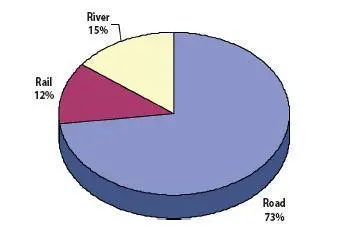
The much vaunted rail services out of Rotterdam and to some extent Bremen,with destinations to the south, are only very small service providers in terms of volumes. Road haulage remains king.
Related Articles
 THE ECONOMIST
 THE ECONOMIST
 THE ECONOMIST