



Building sustainability at Stockholm Norvik
Constructing a new port is a major infrastructure challenge. But in Stockholm, it is alsoan opportunity to address environmental and climate challenges, says Chloé Farand
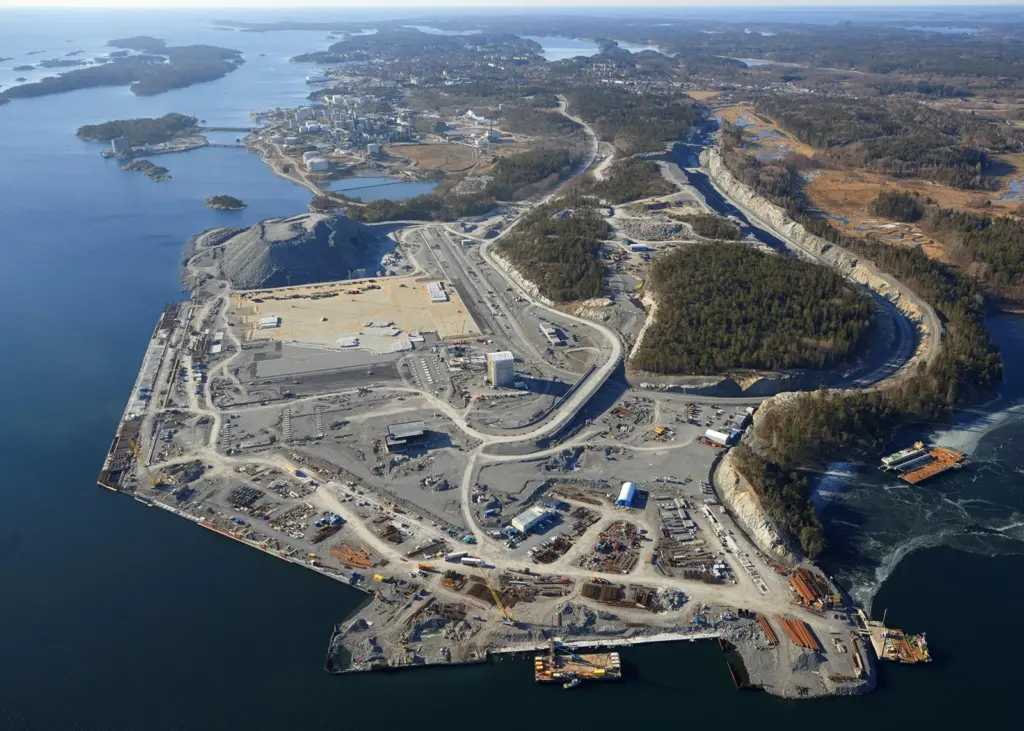
Located 50 kilometres south of Stockholm, Stockholm Norvik Port is due to receive its first vessels in May 2020. The Municipality of Stockholm, which owns the Ports of Stockholm, is confident the new deep-water port will be “a game-changer in the Baltic region”.
The Baltic Sea is one of the busiest seas in the world, accounting for up to 15 per cent of global cargo transportation, according to the Baltic Ports Organisation. The increase in
maritime traffic and associated pollution has progressively degraded the sea’s natural environment and biodiversity and left the sector in great need of reducing its impact in the region.
Camilla Strümpel, director of communications at the Ports of Stockholm, explains that a key reason for building the new port is “to be able to transport goods in a sustainable way to the growing Stockholm region”. According to the Stockholm Chamber of Commerce, the Swedish capital is growing more rapidly than any other European city, with its population expected to expand by 11 per cent between 2015 and 2020.
“Right now, most of the goods in the Stockholm area are transported by truck or train. Using sea transport to get as close as possible to the end consumer is the most resource-efficient way to get the goods to the user while reducing their carbon footprint,” says Strümpel.
The Stockholm Norvik Port has a natural depth of 16.5 metres and the quay lengths and terminal area are designed to be able to handle the largest vessels in the Baltic Sea, creating a transport hub that needs to be both efficient and sustainable.
The port authority has invested in a four-kilometre shuttle railway to connect the port with the state-owned network. The introduction of a barge shuttle service from Stockholm Norvik Port into lake Mälaren is also under discussion.
The new port will aim to mitigate some of its environmental and climate impacts with onshore power supply using “ecolabelled electricity” instead of fossil fuels at every berth. It will also boast black and grey wastewater, or sewage, reception facilities and waste-sorting facilities.
Energy-efficient buildings fitted with geothermal heating, solar panels and environmentally-approved materials will also help the port minimise its carbon footprint.
Smart green ports
But efforts to reduce the port’s environmental impact will also occur in everyday operations with efficient logistics. That is the idea behind the ’smart port’ concept, which is being promoted by the Baltic Ports Organisation, of which Ports of Stockholm is a member.
Ellen Kaasik, chair of the organisation’s environmental working group and environmental manager at the Port of Tallinn, says that smart solutions help ports use resources in a
more efficient and environmentally friendly way.
“In practice, this is about creating an environment where certain processes are simplified by various security and automated devices and thus accelerated. The goal is to
minimise the time [ships] spend in the harbour,” she explains.
The faster loading and unloading, and mooring and unmooring of ships, for instance, reduces engine running time and greenhouse gas emissions. In Tallinn, the Old City Harbour
also uses smart traffic flow management to automatically guide vehicles to the right check-in booth and lane, reducing waiting time.
Smart solutions have become key to running ports more efficiently and sustainably. The popularity of automated systems and data tracking is partly due to the fact that every
port, new and old, can explore its own solutions.
Related Articles
 EUROPE GREENPORT
 ALTERNATIVE FUELS GREENPORT
 ALTERNATIVE FUELS GREENPORT