




Customer capture
In the hinterland chase, Europe goes international while the US sees a demography shift, as Martin Rushmere explains
Stark differences in conditions and circumstances define Europe and America’s different approaches to hinterland development and management. A major reason for this of course is size: 3m vs. 9m square kilometres, which leads to contrasts in challenges and problems.
In Europe, competition for the same hinterland is more intense, with national pride and methods figuring prominently. While in the US, demographic shifts are affecting development, as the growing centres of population move away from the traditional areas.
“The Mountain States and the South West are the new focus of activity,” says Paul Bingham, head of the economics division at CDM Smith consultancy. “There has been a drift away from the traditional hubs in the Mid West and North East. This has led to the big distributors such as Wal-Mart decentralising (two centres on the East Coast and one each in Texas and the West Coast) and setting up regional distribution centres.
“The bottom line is that if you are shipping only one container, go to a port such as Long Beach and destuff there. But if you are shipping 1,000 containers go to different points and use different modes. It also makes sense from the risk mitigation point of view.”
In Europe, the Marco Polo programmed funded by the EU (two Euro per tonne per 500 kilometres) is pushing hard via the Hinterport scheme to get the loads off the roads and on to rail and short sea. Angelo Aulicino at Interporto Bologna, which is co-ordinating the scheme, says that the initial forecast was for 8%-12% of cargo to be shifted from road to rail. “The final outcome will be 10%-11%.”
Some of the main ports participating have been Antwerp, Kober in Slovenia, Naples, Valencia and Talin in Estonia.
Hinterport is taking development a step further by linking corridors between ports. Barcelona is extending inter-modal efficiency and investing in Lyons, Antwerp is investing directly in an inland terminal and Bologna is involved with La Spezia.
Mr Aulicino says the bigger plan is to go international, which has recently been discussed at the Interport Alliance conference in Poland. Eleven European countries are involved, along with Australia, China and the US. “At this stage the emphasis is on promotion, dissemination and explanation of the processes needed for seamless corridors and inland terminals.
“One of the difficulties is in establishing integrated KPIs for the corridor. The agencies involved such as the railways and ports probably have different sets of indicators.”
Another difficulty could well be national commercial rivalry, with countries vying to get as much control as possible over decision making.
A technical consideration to be thrashed out is increasing the standard length of trains beyond 700 metres. “Remember too that Europe uses single stacking,” says Mr Aulicino.
He acknowledges that harbour depths could also put a brake on growing volumes of cargo as dredging is not covered by the Marco Polo funds.
For the US, political rivalry is much less of a consideration, as is competition between ports for interlocking hinterland. “There is some, such as Los Angeles/Long Beach and Seattle/Tacoma,” says Mr Bingham, “but it’s healthy tension and leads to greater efficiency.”
Environmental issues are playing a much greater role and are a fact of life. “Companies such as Wal-Mart have said outright that they will choose suppliers and distribution areas that are doing the most to reduce their carbon footprint. This will play a big part, even in a recession,” says Mr Bingham.
He notes that the US has a historical advantage in rail freight over Europe because the system was built for freight while Europe has concentrated on passengers. And the US continues to benefit from private ownership as compared with state-owned systems in Europe. The result has been quicker and more efficient investment.
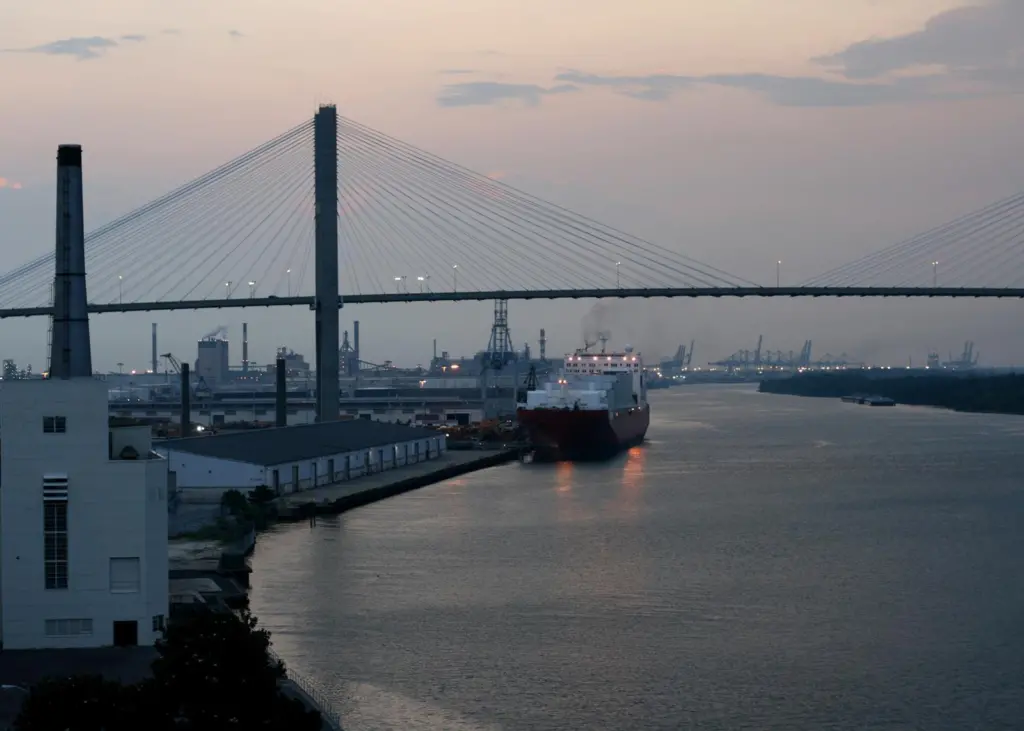
In fact, deeper harbour depths are causing more tension between US ports than hinterland rivalry. South Carolina and Georgia have been bickering over dredging the Savannah River, which would allow Georgia to expand Savannah port at the expense of Charleston. Both states have to agree if the work is to go ahead.
“Market penetration will change if ports are deepened to take the new post-panamax ships,” says Mr Bingham. Baltimore is a case in point, with shippers having to decide whether to sail slower through the Chesapeake Bay to get to the port, which claims to serve two-thirds of the national population.
Tom O’Brien, director of research, Center for International Trade and Transportation, California State University, Long Beach says that environmental and regulatory requirements can be a hindrance to ports such as Los Angeles/Long Beach.
“Because of the environmental landscape in Southern California, Canada’s Prince Rupert and Vancouver are more competitive. They don’t have hinterlands and the associated issues to deal with.” He sees the increasing traffic and cargo in Southern California as riding in tandem with stricter regulations.
Complicating US hinterland development is the scattered placement of import and export distribution networks. Often in different areas, particularly so in the Midwest, they have led to less efficient transport networks.
Hinterland locations and links can make a huge difference to costs. According to research by Jean-Paul Rodrigue and Theo Notteboom: “Globally, inland access costs account for 18% of the total logistics costs, and could be reduced by one third with appropriate regionalisation strategies. On the crucial China-US trade link, bringing a container from inland China to a gateway port such as Shanghai alone accounts for more than 60% of the total transport costs.”
Related Articles
 CONTAINER & CARGO HANDLING
 CONTAINER & CARGO HANDLING