![GreenPort[PortStrategy]](https://www.portstrategy.com/greenport/wp-content/uploads/sites/4/2026/09/GreenPortPortStrategy.svg)


Automation boost in Angola
Angola’s Port of Luanda is stepping up investment in automation at the port’s concessioned container terminal so to achieve a safer, greener and more productive performance in the long-term.
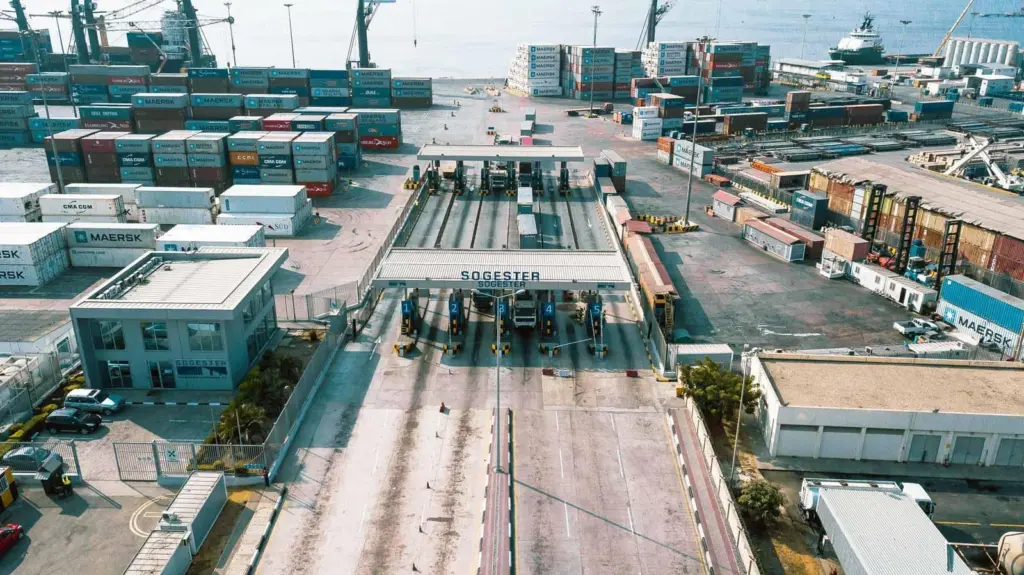
Sogester, one of the five public and private companies operating a container terminal at the port, has announced major strides in its automation and digitalisation of operations at its 800,000 teu/year facility leading providing a solution to what it calls the twin challenge of diminishing space for future terminal expansion and high labour costs.
Digital solutions
As of February 2022, it is marching forward with implementation of digital solutions including the installation of new automatic gate software to optimise vehicle flow into and out of the terminal in order to reduce idling time for waiting trucks. This could translate into a cutback in emissions at the facility.
“Gate automation is a major milestone in reducing queues at gates, allowing truckers to save time and our customers to better plan their cargo flows,” said Frans Jol, managing director at Sogester in a statement.
Gate automation is expected to ease the checking of both the containers and trucks entering and leaving the facility with the process of identification, checking and transmission of information (including container number, type, size, condition, weight, owner and voyage-related data) becoming much faster.
“In addition, a new customer portal will be implemented in the first quarter of 2022, allowing customers to manage all payments, container releases or other transactions directly from their computers, without having to come to the terminal in person,” the statement said.
The company, however, did not specify whether it is deploying Radio-frequency identification (RFID) systems or Optical Character Recognition (OCR) technology at the container terminal.
Separately, Sogester’s drive towards achieving green status continues with an investment to upgrade its equipment at the Luanda port container terminal in December 2021.
The arrival of two new Liebherr mobile harbour cranes (MHC 800 series), the largest terminal cranes available in the region, means that the operation will be able to reach 23 rows of containers, compared to 15 or 16 rows reachable by cranes available at other facilities elsewhere in Angola. The Liebherr mobile harbour cranes are equipped with the latest generation of diesel engines certified to EU stage IV or EPA Tier 4 reducing harmful emissions, especially of particulate matter and nitrogen oxides, to minimal levels.
Mr Jol says the additional cranes will enable the company to “perform double cycling, which means loading and discharging the same container bay on the vessel at the same time.”
“Higher productivity will also mean that we will be able to perform twin lift on both empty and full containers, which was not possible in the past,” he adds.
Furthermore, Sogester, the only terminal operator with permanent International Ship and Port Facility Security (ISPS) approval in Angola, is now set to accommodate large vessels unhindered with the additional container handling equipment.
Despite the disruption of the Covid-19 pandemic in early 2020, Sogester has invested an estimated US$25 million in new equipment such as terminal trailers and tractors, empty handling equipment and Ram twin lift spreaders; an indication of the container terminal operator’s commitment to modernise and comply with its long-term sustainability goals.
Sogester is a joint venture of APM Terminals and Angola’s Gestão de Fundos, which won a 20-year concession from the port’s operator, Empresa Portuária de Luanda, E.P back in 2007.
Related Articles
 REGULATION & POLICY GREENPORT
 PROJECTS & INITIATIVES GREENPORT
 ALTERNATIVE FUELS GREENPORT