![GreenPort[PortStrategy]](https://www.portstrategy.com/greenport/wp-content/uploads/sites/4/2026/09/GreenPortPortStrategy.svg)
A Swedish logistics hub for captured carbon
By establishing a logistics node for captured carbon dioxide at Stockholm Norvik Port, a sustainable transport chain for the gas can be established for East Sweden.
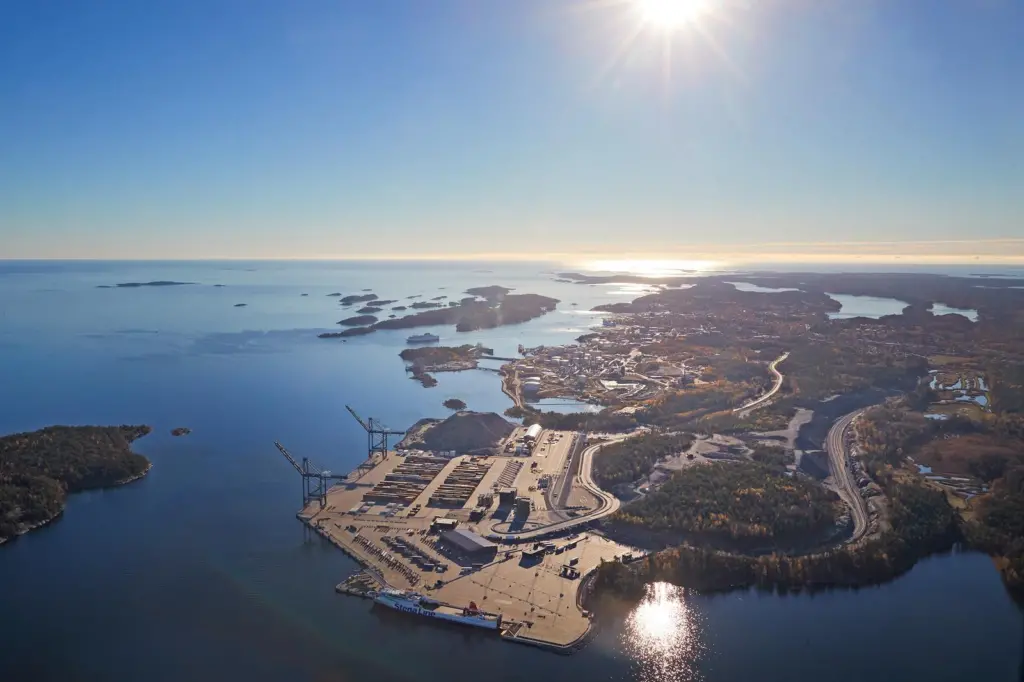
That’s according to the final report of the feasibility study of the NICE project – Norvik Infrastructure Carbon Capture and Storage (CCS) East Sweden.
”It is extremely pleasing that Stockholm Norvik Port has the potential to be an important part of the solution to achieve national, regional and the City of Stockholm’s own climate goals,” said says Jens Holm, chairman of the board, Ports of Stockholm.
”We are now continuing to work on the goal of establishing a hub for an efficient logistics chain and enabling CCS on a large scale in East Mid-Sweden.”
Central logistics node
The final report of the feasibility study shows that conditions are favourable from a logistical, technical and operational point of view to successfully establish a central logistics node for carbon dioxide in East Sweden at Stockholm Norvik Port.
The port’s infrastructure is efficient and there are good development opportunities in terms of infrastructure, quays and areas in and around the port. Regardless of which operation generates the emissions, the carbon dioxide can be transported to the new node for intermediate storage before being transported by large ships to its final destination.
CCS sites that are leading the way and are considered to have the greatest near-term potential are located in the North Sea. Therefore, a functioning and efficient logistics chain is required to enable large scale CCS in East Mid-Sweden.
The NICE project is led by Ports of Stockholm and a feasibility study was conducted in collaboration with Stockholm Exergi, Mälarenergi, Söderenergi, Vattenfall, Heidelberg Materials, Nordkalk and Plagazi. The logistics infrastructure will not only be open to participants in the NICE project, but also to other third-party carbon emitters.
Further work will focus on the detailed design of the node in close dialogue with suppliers and project participants. The aim of further work is to facilitate investment decisions for all stakeholders in the value chain.
The City of Stockholm’s goal is for a climate-positive Stockholm by 2030 and a fossil-free city by 2040.
Related Articles
 ALTERNATIVE FUELS GREENPORT
 ALTERNATIVE FUELS GREENPORT
 ALTERNATIVE FUELS GREENPORT