![GreenPort[PortStrategy]](https://www.portstrategy.com/greenport/wp-content/uploads/sites/4/2026/09/GreenPortPortStrategy.svg)
A victory for transitioning port infrastructure
The IMO has approved a landmark shipping carbon levy, marking a major milestone in maritime decarbonisation which should help spur on port infrastructure development.
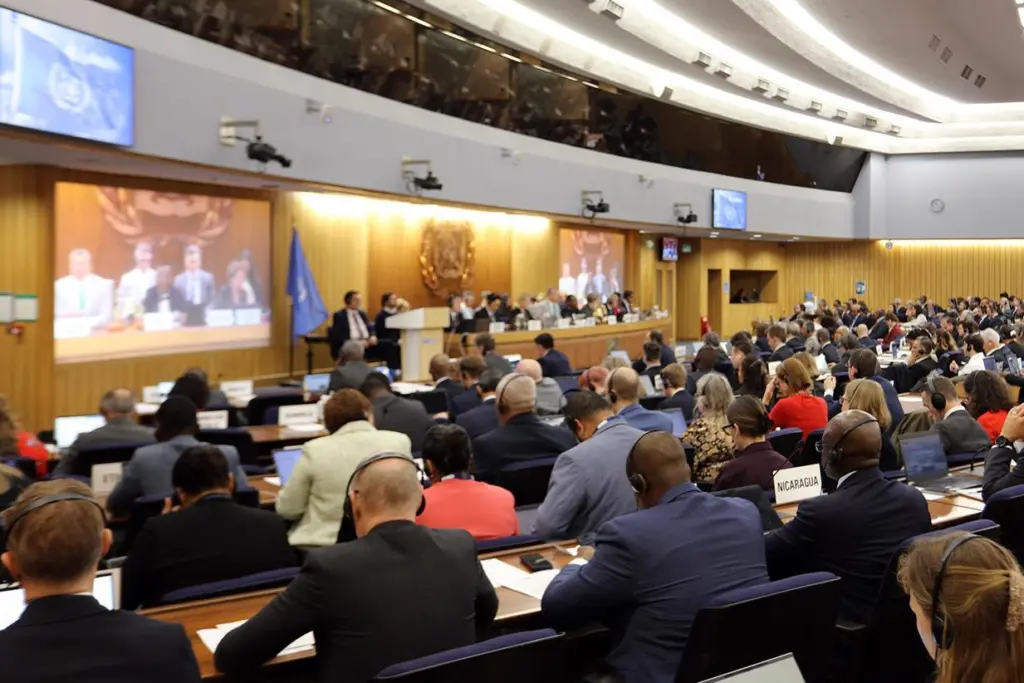
This decision, made at the MEPC 83 meeting, establishes a global framework to slash greenhouse gas (GHG) emissions from international shipping.
The levy, set to be implemented in 2027, will drive investment in alternative fuels and port infrastructure, while also funding research into zero-carbon technologies.
“Ports require regulatory certainty on a global level. They also require a global standard to prepare themselves for receiving vessels under propulsion from new zero and near-zero carbon fuels,” said Patrick Verhoeven, managing director, International Association of Ports and Harbors (IAPH).
“IAPH will continue to support the sterling efforts of the IMO, which is uniquely placed to ensure a level playing field globally to achieve a just and equitable energy transition in the maritime sector for all countries.”
Key victory
A key victory for the International Association of Ports and Harbors (IAPH) was the inclusion of port-related infrastructure and equipment.
Revenues from the shipping carbon levy will now support infrastructure and equipment upgrades, particularly in developing countries, to enable safe bunkering and cargo handling of low-carbon fuels.
This is a key victory for IAPH, which had previously cautioned that any levy needs to ensure port and terminal readiness for safe bunkering operations, as well as preparing masterplans for putting infrastructure in place for loading and unloading operations of alternative fuels as cargo.
The IMO’s new shipping regulation forms the cornerstone of its broader net-zero strategy adopted in 2023.
IAPH said it will also align its own IMO recognised Environmental Ship Index with the new framework to incentivise compliance and innovation through reduced port fees.
In parallel, by using initiatives like Clean Marine Fuels and the CEM-HUBS collaboration with ICS, it will continue to work towards fostering more cross-sectoral action on scalable low-carbon energy solutions.
Related Articles
 ALTERNATIVE FUELS GREENPORT
 ALTERNATIVE FUELS GREENPORT
 ALTERNATIVE FUELS GREENPORT