![GreenPort[PortStrategy]](https://www.portstrategy.com/greenport/wp-content/uploads/sites/4/2026/09/GreenPortPortStrategy.svg)


Backing for German LNG terminal project
An LNG terminal project in Germany is being backed by a German port authority keen to progress LNG provision in the country.
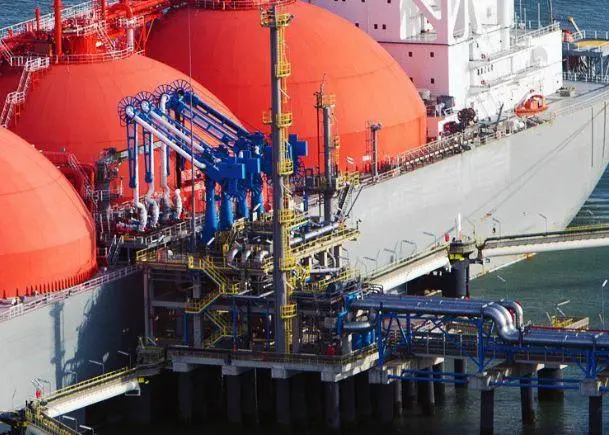
Rolf Brouwer, managing director of German LNG Terminal GmbH, met with Jens Meier, CEO of Hamburg Port Authority (HPA) to discuss the proposed import and distribution terminal project at Brunsbüttel, which offers potential for the nearby Port of Hamburg. Germany currently has no LNG terminal of its own.
“LNG is playing an increasingly important role as a low-emission fuel in the cruise industry, as well as for container ships. That’s also becoming increasingly tangible at the port of Hamburg,” said Mr Meier. “The ports of Hamburg and Brunsbüttel are linked by a longstanding and close partnership. As the supply of LNG at the port of Brunsbüttel should be possible without any complications, we are following the development of a modern terminal on the outskirts of Hamburg with great interest.”
Hamburg has been open to the use of LNG technology for several years. For example, the cruise ship AIDAprima was regularly supplied with LNG to generate on-board power during its layover at the Steinwerder Cruise Centre.
“LNG is a building block for even greater sustainability at the port. We are delighted that the project will soon be entering the decisive phase,” said Mr Meier.
German LNG Terminal GmbH, which recently announced it is now ready to sign Heads of Agreement, is a joint venture between Dutch companies Gasunie LNG Holding B.V., Vopak LNG Holding B.V. and Oiltanking GmbH, a subsidiary of Marquard & Bahls AG, Hamburg, Germany.
“We can be an important addition for ship owners and the port industry in the switch to alternative fuels,” said Mr Brouwer.“The terminal being planned at Brunsbüttel will be a practical support for introducing LNG as a more sustainable alternative fuel, especially for shipping traffic.”
The terminal will also provide a wide range of services including the loading and unloading of LNG carriers, the temporary storage of LNG, regasification, feeding natural gas into the German natural gas network, and distribution of LNG via tank trucks and LNG tank cars.
Related Articles
 ALTERNATIVE FUELS GREENPORT
 ALTERNATIVE FUELS GREENPORT
 ALTERNATIVE FUELS GREENPORT