![GreenPort[PortStrategy]](https://www.portstrategy.com/greenport/wp-content/uploads/sites/4/2026/09/GreenPortPortStrategy.svg)
Decarbonising Hamburg’s vessel fleet
Despite its primary focus on electrification, Hamburg is looking at other ways to decarbonise its fleet where that’s just not possible.
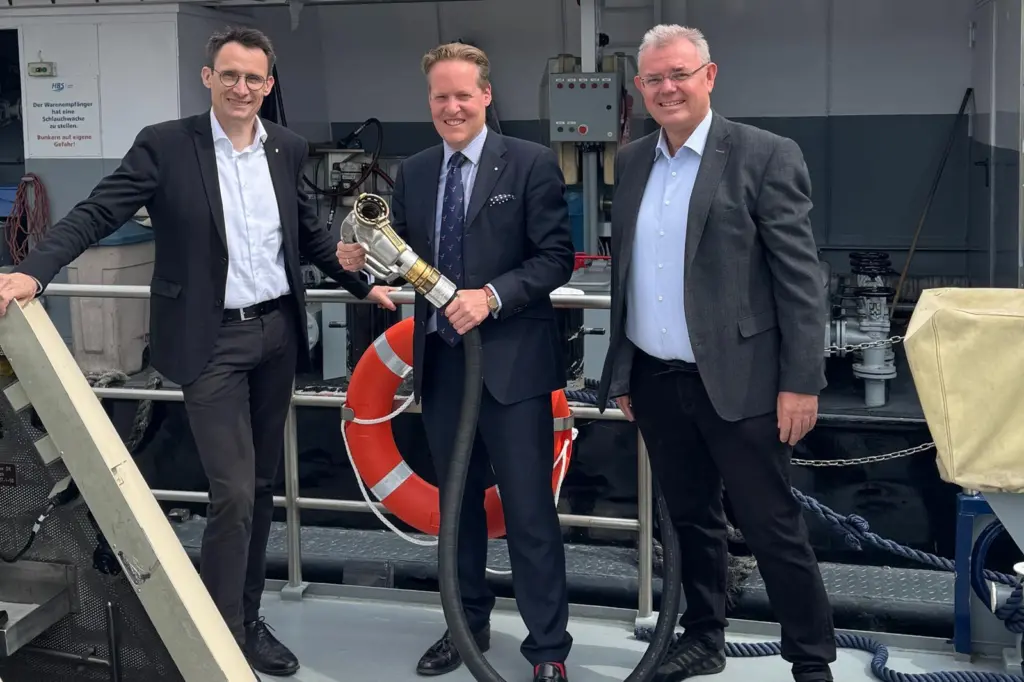
Not all vessels can be electrified with current technology and so in order to continue pursuing its zero-emissions strategy even with its existing fleet, Hamburg Fleet is trialling the use of Hydrotreated Vegetable Oil (HVO 100), produced by Shell.
“While Hamburg Fleet remains focused on electrification and innovative propulsion systems, we will only achieve our ambitious greenhouse gas reduction targets by complementing these efforts with innovative fuels such as HVO 100,” said Karsten Schönewald, managing director of Hamburg Fleet.
“For inland vessels, HVO 100 currently represents the most pragmatic interim solution. We are proud to help establish HVO 100 as a fuel in Hamburg and to be one of the pioneers in the Port of Hamburg.”
GHG reduction
The trial, being undertaken in cooperation with its long-standing supplier Friedrich G. Frommann GmbH & Co. KG, will involve three of its vessels.
HVO 100 used by Hamburg Fleet is made from food waste and is entirely free of palm oil. It meets the sustainability criteria set out in the EU’s RED II directive.
The declared emissions intensity of this fuel suggests that a reduction in greenhouse gases of at least 80% can be achieved. If the trials prove successful, the fuel could be rolled out across the entire Hamburg Fleet.
Hafenkapitän will be the first non-electric vessel to operate in an almost CO₂-neutral manner under the auspices of the trial. Other vessels taking part include the survey and sounding vessel Deepenschriewer III and the transport and inspection vessel Neßsand.
Decarbonising its fleet is just one facet of Hamburg’s multi-faceted approach to decarbonisation.
Also this month, the Port of Hamburg announced a major expansion which represents a vital investment in its long-term competitiveness. It also lays the groundwork for the next steps towards climate-neutrality.
Related Articles
 ALTERNATIVE FUELS GREENPORT
 ALTERNATIVE FUELS GREENPORT
 ALTERNATIVE FUELS GREENPORT