![GreenPort[PortStrategy]](https://www.portstrategy.com/greenport/wp-content/uploads/sites/4/2026/09/GreenPortPortStrategy.svg)
DNV throws its weight behind methanol bunkering
DNV has joined a working group which is developing a Technical Reference (TR) for methanol bunkering for Singapore, the world’s largest bunkering hub.
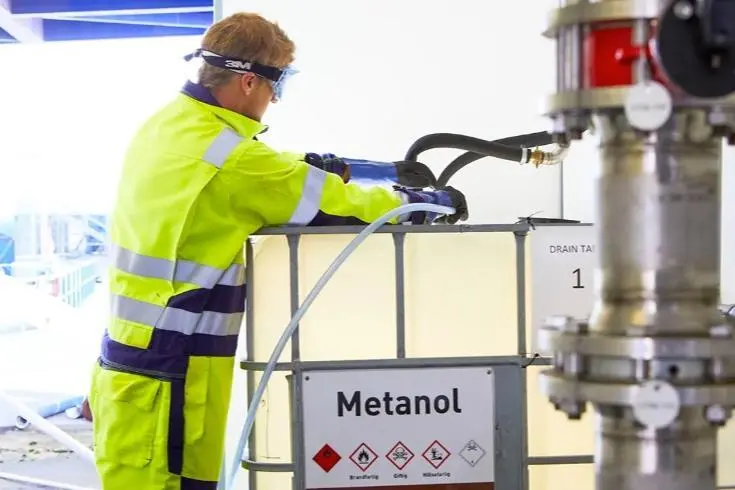
The group, managed by the Standards Development Organisation at Singapore Chemical Industry Council (SCIC-SDO), was formed in consultation with the Maritime and Port Authority of Singapore (MPA).
“Initiatives like the Working Group established by SCIC-SDO, are essential as the energy transition accelerates and the maritime industry moves towards a multi-fuel future,” said Cristina Saenz de Santa Maria, regional manager South East Asia, Pacific & India at DNV Maritime.
“For methanol and other alternative fuels to continue to build traction within shipping, we need to build confidence and encourage a wider uptake. This can only be accomplished through standards that enhance safety while providing a comprehensive and practical framework for all stakeholders.”
In depth guidance
The working group includes government agencies, bunker suppliers, bunker craft operators, engine manufacturers, testing and certification bodies, shipowners and operators, terminal operators, as well as classification societies like DNV.
Its TR will cover custody transfer requirements (quantity and quality) for the delivery of methanol as a bunker fuel. It will examine all aspects of bunkering, from the bunker tanker to the receiving vessels, examining the operational and safety requirements for methanol bunkering, as well as crew training and competency.
This announcement of the development of the TR comes alongside record-breaking orders for vessels capable of using alternative fuels. DNV’s Alternative Fuels Insight (AFI) platform, which tracks orders and bunkering locations for alternative fuels, logged orders for 35 methanol-fuelled vessels in 2022 – more than the 26 vessels currently in operation.
Likewise for LNG, the most popular alternative fuel to date, the newbuilding orders in 2021 and 2022 will more than double the fleet in service upon delivery.
DNV was the first classification society to release a notation covering every aspect of using low flashpoint fuels, including safe design, fire safety, control and monitoring. It has regularly built on these recommendations, including the Alternative Fuels for Containerships document, which was recently updated with a new chapter covering methanol.
Related Articles
 ALTERNATIVE FUELS GREENPORT
 ALTERNATIVE FUELS GREENPORT
 ALTERNATIVE FUELS GREENPORT