![GreenPort[PortStrategy]](https://www.portstrategy.com/greenport/wp-content/uploads/sites/4/2026/09/GreenPortPortStrategy.svg)





EXCLUSIVE: Clean power: coming to a port near you
Alternative powered port equipment can support sustainability goals without compromising on performance, writes Jan Willem van den Brand, director global market development Big Trucks, Hyster Company
Across the globe, port terminal operations are putting an increasingly watchful eye on their environmental impact. The motivation for this emphasis varies, but among the most common forces are the drive to be a good corporate citizen and increasing pressure from governments.
In recent years, many companies have been establishing more aggressive emissions reduction goals and governments have been considering or passing legislation to tamp down greenhouse gas emissions (GHGs). For instance, a few of the current targets for the year 2030 include a 50% reduction from 2005 levels of GHG pollution for the United States, the conversion of 42.5% of energy to renewable sources within the European Union and a 43% emission reduction for Paris Agreement signees.
Supply chains, including ports, present themselves as an obvious place to look for opportunities to make progress against these emission reduction ambitions. After all, supply chains contribute to about 90% of an organisation’s GHG emissions and about 60% of all carbon emissions globally.
While material handling equipment like heavy-duty forklifts, container handlers and reachstackers have traditionally been powered by internal combustion engines, ports are turning to electric-powered alternatives to reduce emissions.
So, let’s take a look at the alternative power landscape for port equipment and how various options can support sustainability goals without compromising on the performance these operations rely on.
Different options
Ports exploring clean power sources have choices. Several advancements and new options have emerged in recent years, including solutions that leverage lithium-ion batteries, hydrogen fuel cells (HFC) and hydrotreated vegetable oil (HVO).
For instance, lithium-ion has become a more prevalent power solution for high-capacity forklift trucks within the last couple of years and now there are even container handlers and reachstackers in development that are to be partially or even fully powered by lithium-ion.
Lithium-ion has become an attractive power option for some ports because these batteries produce zero harmful emissions and are capable of delivering the ICE-like performance that high-intensity operations count on – a major step forward from lead-acid battery technology.
This capability is possible because lithium-ion batteries can tolerate a high energy draw without overheating or dropping in efficiency. Lithium-ion technology also provides far greater energy density, power transfer and service life than lead-acid batteries.
Combining power
Using electricity sourced from solar panels on site, lithium-ion batteries can also work in tandem with another power source – hydrogen fuel cells.
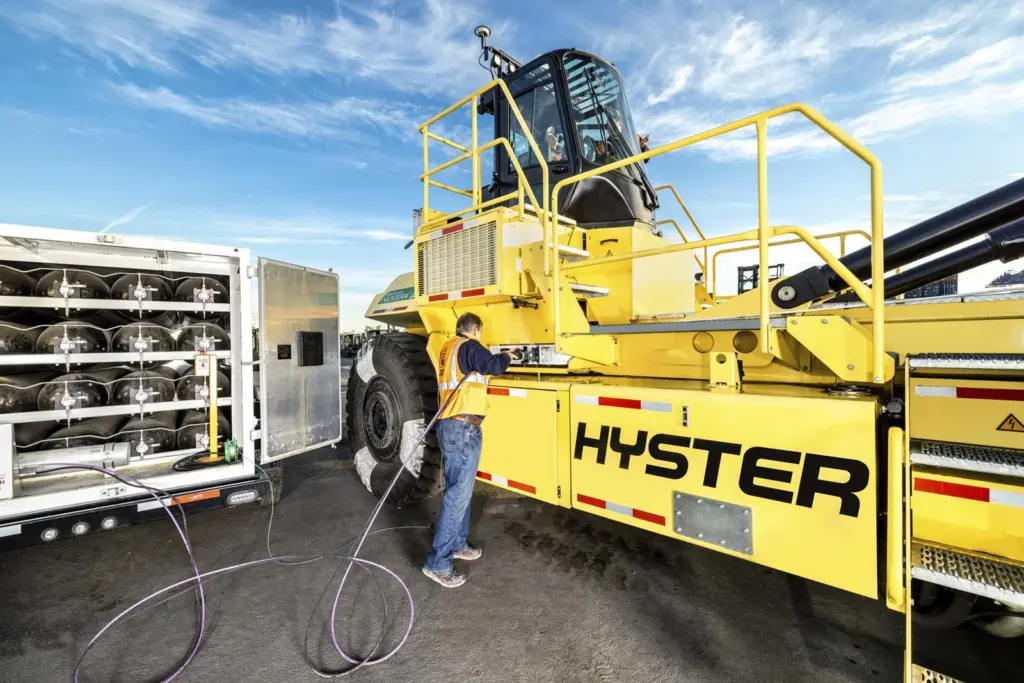
A notable example of this approach can be seen in a pilot programme of a hydrogen fuel cell-powered top pick container handler Hyster has underway with Fenix Marine Services at the Port of Los Angeles. This truck is powered by two hydrogen fuel cells working in tandem with an on-board lithium-ion battery, with the fuel cells able to power the equipment directly or charge the battery.
Like lithium-ion, hydrogen fuel cells produce zero harmful emissions, emitting only water vapour and heat and they consistently deliver power until full depletion. As a result, the top pick container handler, which is the first of its kind and was recognised earlier this year by Fast Company, is expected to provide emissions savings of 127 tonnes of carbon dioxide and almost half a tonne of criteria pollution per year.
Unlike lithium-ion batteries, fuel cells do not need to be recharged. Instead, operators refuel a tank of hydrogen, a process similar to that of refueling internal combustion engines. For large hydrogen fuel cell-powered equipment with big tanks, it takes about 15 minutes to fill an empty tank – enough for up to 8-10 hours of continuous runtime.
Another alternative that’s becoming a tool to help ports reduce emissions is hydrotreated vegetable oil (HVO). This renewable fuel source is produced from materials like vegetable oils and animal fats, which undergo a hydrotreatment process that makes the resulting HVO 100 almost chemically identical to conventional diesel.
Because of its similarity to mineral diesel fuel, few equipment modifications are required to benefit from HVO. A switch to HVO power can help operations eliminate up to 90% of net GHG emissions, making it a particularly useful diesel alternative for ports that are making a more gradual shift and that might benefit from an interim step before replacing equipment with zero emissions trucks.
Careful consideration
The most important thing to keep in mind is that just because one power source is the right fit for another operation does not mean it will be the right fit for your business. The answer depends on so many factors like duty cycle, utility grid capacity and fuel availability, so don’t try and make a square peg fit a round hole.
Determining your best-fit motive power solution requires a comprehensive look at your specific application and goals for emissions reduction and performance.
For example, your throughput demands are an important consideration. Although the pressure to reduce emissions in the short and long-term is growing, productivity typically cannot be compromised. While all three clean power options offer consistent power delivery until depletion, each has unique charging or refueling times, as well as varying intervals between charges and refuels. Consider how much continuous operational time you need from your equipment.
Another thing to evaluate is the reliability and capacity of the local electric grid. Battery-powered electric equipment relies heavily on the electrical grid – charging a single container handler with a 260 Kilowatt-hours (kWh) battery pack consumes significantly more electricity than the average household or even business uses per day.
On the flip side, although hydrogen fuel cells are becoming a more viable form of motive power for port equipment, not all areas have easy access to hydrogen. Your location, fleet size and equipment runtime will be important factors in deciding whether battery electric, or something like HFC or HVO, is most appropriate.
Future landscape
Hyster has shipped or announced equipment for a number of pilots within the last two years. Recently, we shipped an electric ReachStacker to the Port of Valencia in Spain for a pilot at one of Europe’s largest container terminals.
This truck uses hydrogen fuel cells to charge batteries, which power the electric motors and hydraulic systems enabling the ReachStacker to lift laden containers with similar performance to a diesel-powered alternative.
We have also announced that we will provide two electric container handling vehicles to Hamburger Hafen und Logistik AG, including the first-ever hydrogen fuel cell-powered empty container handler in a real-world application. The other vehicle will be a hydrogen fuel cell-powered terminal tractor – the first Hyster terminal tractor supplied in Europe.
While it’s important to note that these clean power options remain emerging technologies for port applications, real-world pilots are cropping up around the world. That’s not the only sign of forward momentum either – government authorities and private entities are taking steps to prepare for and advance electrification.
For example, major companies are joining forces to build a regional hydrogen network to produce and distribute hydrogen fuel at scale and the U.S. Department of Energy recently announced a US$3.5 billion investment in battery manufacturing to support domestic battery materials processing as well as battery production.
As your port weighs electrification, and whether the path there involves a strong interim step or a longer-term transition, consider speaking with an expert who has the experience to help you navigate the decision based on the particulars of your unique port and application.
Related Articles
 ALTERNATIVE FUELS GREENPORT
 ALTERNATIVE FUELS GREENPORT
 ALTERNATIVE FUELS GREENPORT