![GreenPort[PortStrategy]](https://www.portstrategy.com/greenport/wp-content/uploads/sites/4/2026/09/GreenPortPortStrategy.svg)
EXCLUSIVE: Decarbonising the inland waterways with hydrogen
In this Q&A we sit down with Sara Ravazza, managing director, Future Proof Shipping, to talk hydrogen and the future of the inland waterways.
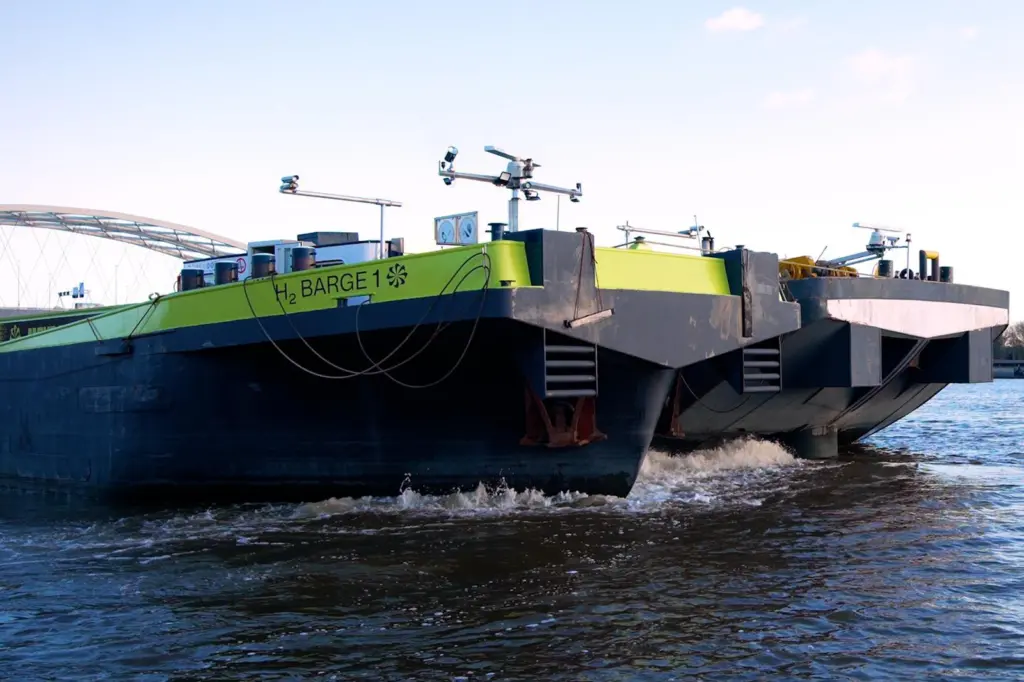
Netherlands based Future Proof Shipping offers marine transportation services to enable players across the value chain to make the transition to zero emissions.
Q What is the FPS zero emissions philosophy with regards to the inland waterways?
A Zero means zero! With regards to the sailing and fuelling of our ships, zero emissions means zero ghg emissions. All our vessels will be equipped with zero emissions propulsion systems.
Our founder Huib van de Grijspaarde is a visionary who wants to accelerate the green transformation of shipping and he decided to start Future Proof Shipping with that objective.
There was a lot of research and studies involved and it was decided to start with H2 and inland. An important part of this journey has been Nike. They really want to improve the Co2 footprint of their logistics and were prepared to take the leap and work with us on H2 Barge 1.
We set out to prove that zero emissions could be achieved in inland shipping and set the standard for the entire shipping industry.
Q Why is hydrogen so well suited to inland waterways vessels?
A It provides clean power. Hydrogen offers the required power density and ease of operation in combination with a large hydrogen production, storage and distribution network which is being worked on throughout the Benelux and Germany; especially in the areas in which inland shipping plays a big role (Antwerp, Rotterdam, Amsterdam & Duisburg region).
The beauty of H2 is that it allows us to reach zero emissions while other fuels offer only an improvement.
We see that our vessels are almost silent and clean and this is very much appreciated by the crew members. As the European Commission pointed out in one of their videos about us, H2 is part of a silent revolution.
To secure our energy supply, we signed a long-term contract with green hydrogen supplier, Air Liquide.
As part of the agreement, Air Liquide will supply carbon-free hydrogen through specially designed multi-modal hydrogen storage suited for inland barges. The newly designed storage will be homologated with the support of notified bodies and will pave the way to make this new market a reality.
Q Please explain the background to the H2 barge projects, with a particular focus on refuelling infrastructure needed
A In some ways, we could consider the journey to H2 Barge 1 almost a journey of four years, our engineers and experts have worked intensively in the concept design, testing, data analysis. We have developed unique expertise and we are now in a perfect position to help others with our consultants.
Being the first meant we had to overcome quite some difficulties. Lack of suitable parts and easily available materials, no proper legislation in place etc. we had to develop everything in close cooperation with the main partners involved in the project (i.e. Holland Shipyards, Koedood, Oechies and Air Liquide)
Refueling has been proven to be very easy and has not caused any issues or incidents since the vessels are sailing. It requires some proper planning with the H2 supplier, but nothing that is really complicated.
Our partner Air Liquide has been very cooperative and supportive, even when the planning of the vessel is sometimes a challenge due to external factors (strike at the locks etc).
Q What new projects are on the horizon for FPS?
A H2 Barge 1 and H2 Barge 2 are sailing fully zero emissions. We currently own two more diesel barges that we will retrofit, and the next phases will be planned later this year. Based on the experience gained, we are discussing the various components and processes to continuously improve.
This is important not just for us, but for all players that want to retrofit their vessels and ask us for support. We have the DNA of a company that wants to continuously learn and optimise, and we often go back to our desks and perform analysis of our data: we are now in a unique position because of this approach and want to develop this further.
FPS is truly in a scale-up phase: we are stabilising our internal processes and operating systems and reflecting on all the learnings we have so far to accelerate moving forward.
We are now active as consultants where we see our expertise is also requested in short sea projects, we still have to plan for the coming inland vessels, and we are investigating how we can leverage our unique data position to support others.
Q What is/are your take home message(s) for our readers?
A The challenge of the green transformation of shipping is not only technological. We want to have a cooperative approach with all actors in the supply chain, from shipping lines to terminal operators, forwarders and other logistic solution providers. It is our belief that working together we can really accelerate such an important transition.
One of the key factors is mobilising demand: a client like Nike has been instrumental in the change, and we need others to follow with the same ambition for our planet and passion for sustainability.
Our dream is to see an industry that moves forward all together with determination and pace. For our planets and our kids we would hope to see quite a few more H2 vessels, both owned by FPS, but also vessels that we helped others to develop.
But to get there, we believe it is extremely important that all of us as consumers start asking for green transportation solutions, maybe being prepared to pay a little more to support the new technologies, but valuing the impact that these steps can have on the society as a whole.
What is special about H2 Barge 1?
The HS Barge 1 is the first inland container vessel in the world to run 100% on green hydrogen.
Since the hydrogen is created using clean energy (making it green/zero carbon hydrogen), the H₂ Barge ” will have zero Carbon Dioxide (CO₂) emissions.
There is no diesel on-board nor any back-up generators that run on diesel. Batteries are used as back-up.
H2 Barge 1 is the first inland vessel of its kind to have 875 kW of installed fuel cell capacity on board and nearly one tonne of hydrogen on board, operating commercially, and crossing national borders.
The vessel is now propelled by an 800kW electric motor, which is one of the world’s largest electric motors installed on an inland vessel. The old engine was donated to the STC Naval School for future students and sailors to learn from.
It is also the first vessel to receive the A-Zero (A0) label. This is the Dutch label system for inland waterway vessels and is the environmental label for the vessels that meet certain emission limits.
The Label system for inland vessels is based on classification for air pollutant emission performance expressed in average gram per kWh for the vessel: (NOx, PM) ranging between 0 and 5, linked to emission limits from CCNR II and different Stage V options.
Classification for greenhouse gas emission performance is expressed in average gram per kWh for the vessel (CO2, CH4) with a linear range between A and E The classification is therefore a 2-dimensional table. Where A is zero climate emissions and 0 means no air pollutants are emitted by the vessel.
H2 Barge 1 was the first to reach this performance using FC technology in combination with green hydrogen. H2 Barge 2 also has the A0 label.
Its design enables H2 Barge 1 to reduce CO2 emissions by nearly 2,000 tonnes of CO2e per year. This removes the need for 22 trucks going 24/7 from the road.
The amount of hydrogen used is equal to the use of hydrogen of 80 city buses. To compensate this amount of CO2 we would have to plant 80,000 trees.
Related Articles
 ALTERNATIVE FUELS GREENPORT
 ALTERNATIVE FUELS GREENPORT
 ALTERNATIVE FUELS GREENPORT