![GreenPort[PortStrategy]](https://www.portstrategy.com/greenport/wp-content/uploads/sites/4/2026/09/GreenPortPortStrategy.svg)


EXCLUSIVE: Drop-in decarbonisation for port fleets
Wilson Sons’ biofuel trials at the Port of Açu are demonstrating how existing port vessels can reduce emissions without costly engine or infrastructure changes.
As ports worldwide search for commercially viable alternative fuels, the Brazilian maritime operator is using HVO and second-generation biodiesel to test whether drop-in fuels can accelerate decarbonisation across tug fleets and wider port infrastructure.
The trials, carried out at the Port of Açu in Rio de Janeiro State, are focused on maintaining operational reliability, controlling costs and leveraging existing fuel storage and bunkering systems while cutting greenhouse gas emissions.
“We are constantly seeking new technologies that contribute to the safety, efficiency, and sustainability of the port sector,” says Gustavo Machado, chief operating officer of Wilson Sons.
Immediate benefits
For ports and terminals evaluating their own decarbonisation strategies, the company’s trials provide a detailed case study in balancing sustainability targets with operational realities.
Rather than focusing solely on future fuels that require new propulsion systems and extensive infrastructure investment, Wilson Sons has concentrated on fuels capable of immediate integration into existing port vessels and bunkering systems.
The approach reflects growing industry recognition that the path to net-zero emissions will depend not only on long-term breakthroughs such as hydrogen, ammonia and methanol, but also on transitional fuels that can deliver immediate carbon reductions across existing fleets.
Wilson Sons conducted the Brazilian maritime sector’s first HVO trials in 2025 using five tugboats operating at the Port of Açu. The renewable diesel fuel replaced conventional marine diesel oil during operations at the Açu Liquid Terminal operated by Vast Infraestrutura.
According to Mr Machado, the results demonstrated one of HVO’s strongest advantages: compatibility with existing engines and fuel systems.
“As a ‘drop-in’ fuel, HVO does not require any modifications to the engines of our tugboats,” he explains. “All engine performance parameters remained within acceptable levels, with no loss of efficiency and with the vessels’ bollard pull maintained.”
The trials also revealed operational advantages extending beyond emissions reduction. Wilson Sons found that the fuel generated fewer engine residues while maintaining vessel availability, manoeuvrability and maintenance routines at standard operating levels.
Benefits vs challenges
From a port infrastructure perspective, these findings are significant. Ports seeking to reduce emissions from harbour craft and port vessels often face the challenge of balancing decarbonisation with the need to maintain uninterrupted operations.
Tugboats, pilot vessels and other essential marine assets operate under demanding schedules where downtime and technical uncertainty carry commercial risks.
Drop-in fuels offer a pathway that avoids many of those operational disruptions.
Wilson Sons reports that HVO has enabled an 83% reduction in carbon intensity compared with conventional marine diesel. The fuel used in the tests was produced from used cooking oil, aligning the project with broader circular economy principles increasingly valued within global supply chains.
However, the trials also exposed a critical challenge confronting many emerging alternative fuels markets – supply availability and economic competitiveness.
“Importing HVO presents significant challenges, resulting in high operating costs,” says Mr Machado.
The absence of domestic HVO production in Brazil currently limits large-scale deployment. While some Brazilian refineries are exploring future production capability, Wilson Sons concluded that imported HVO remains commercially difficult to justify under current market conditions.
A broader fuel strategy
This economic reality has shaped the company’s broader fuel strategy.
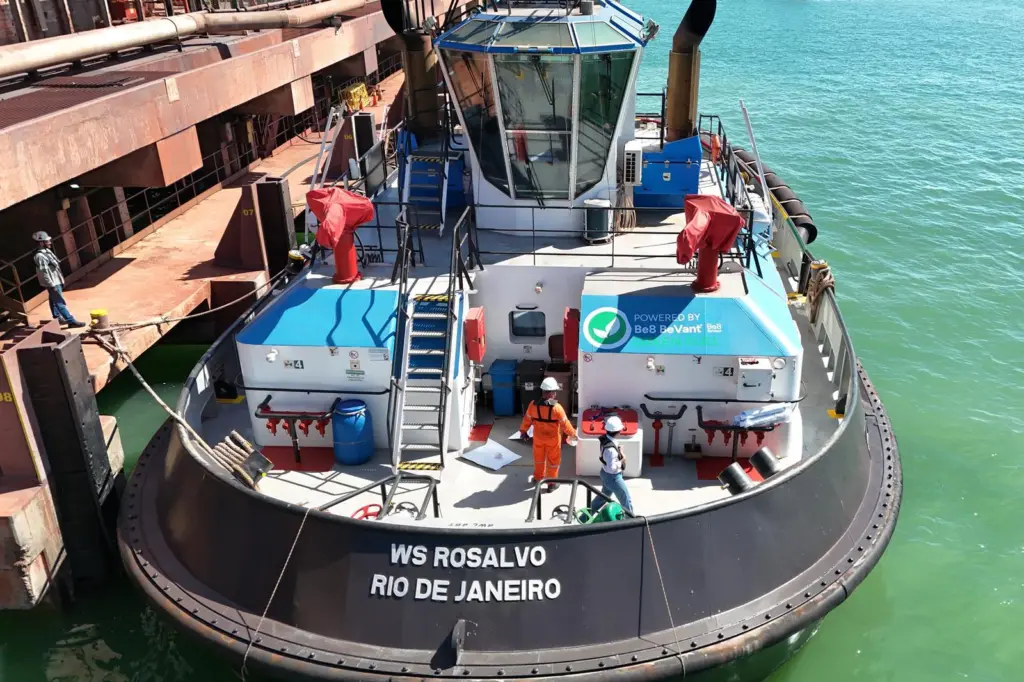
In April 2026, Wilson Sons launched a new series of trials using Be8 BeVant®, a second-generation biodiesel developed in Brazil using soybean oil, animal fat and used cooking oil. The tests involve the tugboat WS Rosalvo operating at Ferroport’s iron ore export terminal at the Port of Açu.
The move reflects what may become a defining lesson for ports globally: successful alternative fuels strategies will likely depend heavily on regional fuel availability and local industrial ecosystems.
“This biofuel is an alternative to HVO, effectively addressing the two main challenges we faced: first, domestic availability in Brazil, and second, the high cost associated with imported HVO,” says Mr Machado.
The company expects the fuel to deliver a carbon intensity reduction of more than 70% compared with conventional marine diesel oil.
For port operators, the importance of local production capability cannot be overstated. While many future marine fuels remain dependent on international supply chains still under development, Brazil’s established biofuels sector provides an existing industrial foundation capable of supporting maritime decarbonisation.
Mr Machado repeatedly emphasises Brazil’s position as a major agribusiness and biofuel producer as a strategic advantage.
“The country has a highly competitive position in terms of carbon intensity in biofuel production,” he says. “Brazilian biodiesel is highly competitive compared to other solutions.”
Ready-made infrastructure
This local production capability also supports one of the most commercially attractive aspects of biodiesel and HVO adoption: The ability to leverage existing port infrastructure and fuel distribution networks.
“Regarding infrastructure, this is another advantage of biodiesel, as it can make use of existing storage and distribution systems already available in Brazil for the road transport sector,” says Mr Machado.
That compatibility is becoming increasingly important as ports evaluate how to phase decarbonisation investments. Fuels requiring cryogenic storage, pressurised handling systems or entirely new bunkering facilities present substantial capital requirements and operational complexity. By contrast, drop-in fuels offer ports an opportunity to begin emissions reduction programmes while preserving existing fuel infrastructure.
Wilson Sons also highlights safety considerations as a key differentiator when comparing biodiesel with fuels such as hydrogen, ammonia and methanol.
“We have observed that safety standards are maintained, as it is a fuel handled and stored at ambient temperature and atmospheric pressure,” Mr Machado explains. “It has a range of advantages that do not increase risk to crew safety, vessels, or terminals.”
This point carries considerable weight within port environments, where safety regulations, operational continuity and risk management remain central to infrastructure planning decisions.
The company’s operational findings also address one of the maritime sector’s longstanding concerns regarding biodiesel which is fuel degradation and sludge formation.
According to Mr Machado, conventional biodiesel can create operational issues through oxidation and sludge accumulation affecting filters and injectors. Wilson Sons’ ongoing trials suggest second-generation biodiesel may overcome many of those technical barriers.
“The Be8 biodiesel does not present this problem, as we are confirming in tests on the tugboat WS Rosalvo,” he says.
For ports considering alternative fuels adoption across tug fleets or harbour craft, this operational reliability may prove decisive. Technical compatibility alone is insufficient if fuels introduce additional maintenance burdens or reduce asset availability.
Biofuel adoption
Wilson Sons’ broader decarbonisation strategy demonstrates how biofuel adoption can form part of a wider sustainability programme rather than a standalone initiative.
The company has monitored greenhouse gas emissions since 2013 and maintains a Gold Seal-certified emissions inventory. Alongside fuel trials, Wilson Sons is investing in shore power deployment, renewable electricity procurement and equipment electrification across its operations.
Among its infrastructure measures, the company has expanded shore power use across its tug fleet, with 71 of its 82 tugboats currently using shore power at berthing locations. It is also investing in electrified container terminal equipment including rubber-tyred gantry cranes, yard tractors and container handlers.
Meanwhile, at its Guarujá shipyard within the Port of Santos complex, Wilson Sons is constructing new tugboat designs focused on efficiency improvements and reduced emissions.
The company’s new RSD 2513 tug class combines hydrodynamic hull efficiency with engine optimisation to achieve an estimated 14% reduction in fuel consumption.
Collectively, these initiatives illustrate a central message emerging from Wilson Sons’ experience: maritime decarbonisation will likely require layered solutions rather than dependence on a single technology pathway.
For many ports and terminals, particularly in emerging economies, this incremental approach may prove more achievable than rapid transition toward entirely new fuel systems.
Mr Machado also stresses the importance of policy support in accelerating adoption.
“In Brazil, we consider it important to evaluate initial incentive policies to enable the broader use of this product, as was done in California ports,” he says.
He points to California’s regulatory framework as an example of how public policy can help bridge the cost gap between conventional marine fuels and renewable alternatives. In that market, local production combined with carbon intensity incentives has helped minimise price differences between HVO and marine diesel.
Testing ground
The implication for port authorities and regulators is clear. Infrastructure readiness alone may not be sufficient to drive adoption if fuel economics remain uncompetitive.
For the Port of Açu specifically, the development of domestic biofuel production could support ambitions to evolve into a broader green fuels hub serving both shipping and industrial customers.
Wilson Sons and the Port of Açu continue collaborating on lower-carbon fuel initiatives, positioning the port as a testing ground for scalable maritime decarbonisation technologies.
The lessons emerging from these projects resonate beyond Brazil. Across the global ports and terminals sector, operators are grappling with the challenge of reducing emissions from existing vessel fleets while maintaining commercial viability and operational resilience.
Wilson Sons’ experience suggests that drop-in biofuels may offer one of the most practical near-term pathways available today.
Rather than waiting for the large-scale arrival of future fuels infrastructure, ports can begin reducing emissions immediately through fuels compatible with existing engines, existing bunkering systems and established operational practices.
For an industry under increasing pressure to decarbonise without compromising efficiency, that practicality may ultimately become the decisive advantage.
Related Articles
 ALTERNATIVE FUELS GREENPORT
 ALTERNATIVE FUELS GREENPORT
 ALTERNATIVE FUELS GREENPORT