![GreenPort[PortStrategy]](https://www.portstrategy.com/greenport/wp-content/uploads/sites/4/2026/09/GreenPortPortStrategy.svg)
EXCLUSIVE: Scaling green methanol up with minimal cost
David Surplus OBE, co-founder of B9 Energy Storage and member of the Maritime Power-to-X project team, explains how port infrastructure can be transformed at minimal costs to cater for the zero emission fuels of the future.
The global maritime industry has set the goal of net zero emissions by 2050 and if this ambitious target is to be met, renewable fuels need to be developed and onboarded as a matter of urgency.
In the near term, the IMO’s ambition is for scalable zero emission fuels to make up 5 to 10% of all shipping fuels by 2030. Evidence suggest that the shipping industry is currently off track on these targets.
From conversations we have had with leaders across the sector at global conferences in the past year, price, critical infrastructure and commercial readiness are key factors in determining the pace of development for decarbonisation, as is competition with other sectors like road and aviation which are also on their own energy transition journeys.
At B9 Energy and with the wider Maritime Power-to-X team, we are addressing these challenges through determined innovation and creative collaboration, exploring how fully scalable green methanol can be used as a zero-emission fuel for the global maritime industry.
This Maritime Power-to-X project is part of the Clean Maritime Demonstration Competition Round 4 (CMDC4), funded by the UK Department for Transport (DfT) and delivered by Innovate UK.
CMDC4 is part of the Department’s UK Shipping Office for Reducing Emissions (UK SHORE) programme, a GB£206m initiative focused on developing the technology necessary to decarbonise the UK domestic maritime sector.
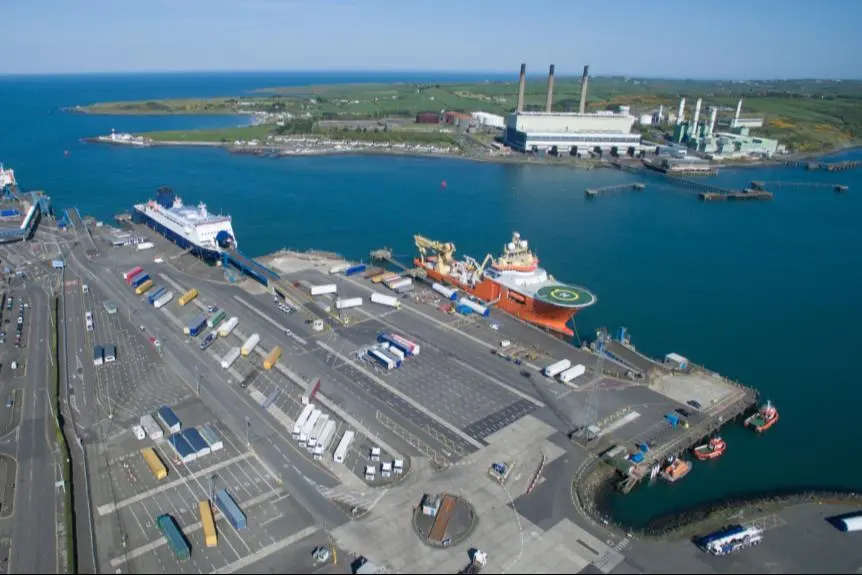
The project team, which also includes DFDS Seaways, DFDS Logistics, JG Maritime Solutions, Larne Harbour and Mutual Energy, is investigating the feasibility of a Green Shipping Corridor between Northern Ireland and the Northwest of England for which pre-deployment trials will take place in the weeks ahead.
The idea is straightforward. Our goal is to power freight ferries with green methanol, incorporating a carbon capture loop.
This fuel would be synthesised onshore using green hydrogen generated from excess wind power and carbon dioxide captured and returned from an onboard reformer. The carbon is conveniently returned to the methanol synthesis plant in the same tank containers that delivered the methanol. Loading and unloading the tank containers is achieved by using existing ro-ro cargo handling ramps or lo-lo cargo cranes.
By re-using the CO2 in the synthesis of the methanol, we are closing the carbon loop, meaning freight ferries can be powered by fuel with ‘true zero’ emissions.
Equipping ports and ferries
Incorporating this technology into older freight ferries will be key to expediting the industry’s journey to net zero.
According to Lloyd’s Register data, many ships originally designed to be powered by fossil fuels are likely to remain in service by 2050, representing around 20% of the global fleet. Decarbonising these vessels is therefore a crucial element of the maritime energy transition. Tens of thousands of ships could potentially benefit from such a retrofit and the techno-economic appraisal of how a vessel would be retrofitted is a major part of the current CMDC4 project scope of work.
A major benefit of our system is that port and harbour infrastructure does not need to be altered or expanded to cater for the new fuel supply chain. Upgrading of port infrastructure represents a major challenge to the pace of development when it comes to decarbonising the industry.
The duplication of tanks, pumps, pipelines and bunkering stations associated with the alternative fuels costs money, takes time and adds to the scale of already complex project development requirements. For this reason, Maritime Power-to-X has proposed a system that uses conventional cargo handling infrastructure to refuel the ships.
As it uses ro-ro ramps our system places no additional requirement for the port to invest in any e-methanol or liquid CO2 handling apparatus. With standard design ISO tank containers on skeleton trailers, e-methanol is delivered across the ramp to an on-board bunkering position located at an open-air location on the upper trailer deck.
E-methanol is withdrawn from the ISO tanks as the vessel is under way and when empty the ISO tanks are filled with captured liquid CO2. On return to the home port the liquid CO2 tanks are unloaded across the ro-ro ramp for return to the e-methanol synthesis plant, located in the port hinterland or within a suitable economic radius from the port.
In addition, the ship propulsion system that uses reformed hydrogen in fuel cells will be kept operational when the vessel is in port in order to charge traction batteries for use during peak electrical load conditions such as thrusting out of and into harbour.
This means there is no requirement to connect the vessel to shore power – a major challenge for port infrastructure to accommodate especially with regard to grid connection capacity and the requirement for temporal correlation with green power generation.
Our project provides considerable relief for ports that are struggling to design, specify and deliver refuelling infrastructure upgrades to accommodate new alternative fuels that need to be bunkered in a conventional manner.
This duplication of infrastructure can be avoided but there may be a requirement to assist with peripheral development of offshore power cable landfalls, substation and switch yard areas, electrolysers and e-methanol plants in the port hinterlands or surrounding areas.
Looking to the future
The purpose of our project is to demonstrate that green methanol is an ideal solution for meeting industry net zero targets – that it can be scaled up and seen as the go-to zero emission marine fuel.
Through Maritime-Power-X we are showing that scalability can be achieved. Our carbon loop technology enables recycling of captured CO2 into e-methanol synthesis, avoiding the severe future constraints (and associated high prices) of biogenic and direct air captured CO2.
If the capital and operating costs of the carbon loop system are accounted for as a means to deliver fuel to the ships, then the additional costs of returning liquid CO2 to the e-methanol synthesis plant is a marginal cost. Thus, essentially zero priced circular CO2 makes the e-methanol price much lower than the linear CO2 model can deliver.
We are in the process of delivering our first pre-deployment demonstrations at Larne Harbour, Northern Ireland, initially demonstrating the conversion of methanol to electricity using a Whitecell methanol fuel cell.
This efficient solution converts green methanol into electricity all within a single unit – avoiding the need for a separate methanol reformer and a hydrogen fuel cell.
We will use this technology to charge battery electric vehicles such as cars and light vans, providing a smaller scale demonstration of how this technology can ultimately be used to power a ro-ro freight ferry.
The beauty of the power-to-x process is that it can be applied to other industries and indeed this pre-deployment trial will also demonstrate a larger reformer / fuel cell unit that can charge more powerful battery electric HGV tractor units and show how truly green methanol can support road haulage on the journey to decarbonisation.
Benefits of green methanol are obvious and the key is to make the fuel scalable while recycling captured carbon.
Through Maritime Power-to-X and our Carbon Loop we are demonstrating that scalable, recyclable, truly net-zero fuel can be a reality for an industry that has hitherto struggled to make significant progress on decarbonisation.
We’re excited for the future and the next steps for a project that has the potential to deliver a sea change on the industry’s journey to net zero.
For more information on Maritime Power-to-X visit: https://b9energy.co.uk/cmdc-4/
Related Articles
 ALTERNATIVE FUELS GREENPORT
 ALTERNATIVE FUELS GREENPORT
 ALTERNATIVE FUELS GREENPORT