![GreenPort[PortStrategy]](https://www.portstrategy.com/greenport/wp-content/uploads/sites/4/2026/09/GreenPortPortStrategy.svg)




Fuel celled trucks
A new whitepaper discusses hydrogen trucks as the only zero emissions solution in certain applications.
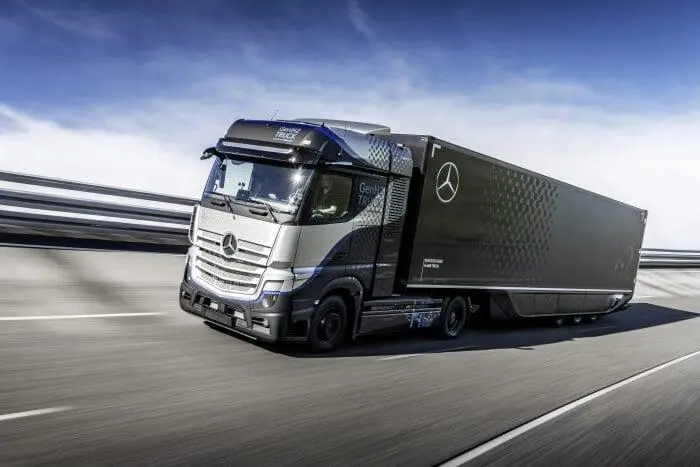
The H2Accelerate collaboration’s whitepaper is based on focus group discussions with truck end-users and logistics providers, including Amazon, Nestle Waters, DB Schenker, and Kuehne-Nagel, who all have the potential to drive significant market demand for hydrogen trucks and the growth of the sector.
“The findings of this study confirm what we have been hearing from industry partners and customers for the past year or so, the heavy-duty transportation sector is on board with using hydrogen to effectively replace fossil fuels,” said David Burns, VP Clean Energy Development at Linde, a H2Accelerate member.
“We know that the technology is there – we have delivered over 200 fuelling stations around the world and successfully fuelled more than 1.5 million vehicles. Together with the H2Accelerate members, we are now working on scaling up the technology and building a robust infrastructure to enable the heavy-duty transport sector to operate with zero emissions, reliably and at a competitive cost.”
Sector needs
In the paper, the H2Accelerate collaboration sets out the needs and expectations of trucking end users and logistics providers as these organisations look to decarbonise their operations. It also outlines how hydrogen can enable end users to achieve their decarbonisation targets while maintaining operations, especially amidst mounting regulatory pressure.
The whitepaper found that the organisations, which have public-facing decarbonisation targets, understand that hydrogen freight will be a required complement to battery vehicles in order to achieve full decarbonisation of their operations.
This is particularly true not only for long-haul applications, where the advantage of fast refuelling over battery electric alternatives was stressed, but also for transport in grid constrained areas or in applications where vehicles are double shifted.
With regards to the cost and operation of the vehicles, end users were willing to accept that in the early stages of roll out, vehicles are likely to be more expensive and infrastructure more limited that the incumbent diesel trucking system.
Several end users stated that while they would be happy to pay more in the short term to trial a small number of fuel cell trucks, their business model requires that in the long term, scale improvements and supportive policy allow hydrogen trucks to achieve parity with diesel. Similarly, it is expected that in the long term, network design, station availability, and vehicle maintenance develop to allow end users to achieve similar operational convenience and flexibility to diesel.
The H2Accelerate collaboration was formed by truck manufacturers Daimler Truck, IVECO and Volvo Group and hydrogen infrastructure providers Linde, OMV, Shell and TotalEnergies. Its central objective is to enable a commercially viable, pan-European hydrogen trucking system in the post-2030 period.
The full whitepaper can be downloaded from the H2Accelerate website.
Related Articles
 ALTERNATIVE FUELS GREENPORT
 ALTERNATIVE FUELS GREENPORT
 ALTERNATIVE FUELS GREENPORT