![GreenPort[PortStrategy]](https://www.portstrategy.com/greenport/wp-content/uploads/sites/4/2026/09/GreenPortPortStrategy.svg)
Gothenburg hydrogen generator project
The Port of Gothenburg has entered into a hydrogen collaboration with Hitachi Energy and Skanska which aims to expedite its transition to alternative fuels.
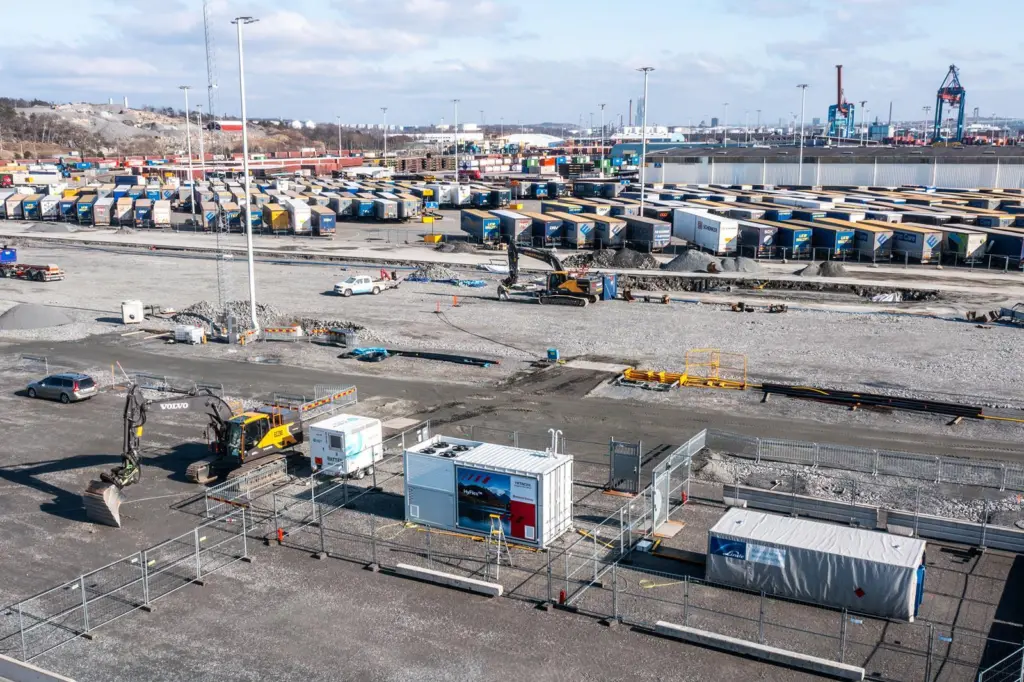
In recent weeks, emission-free excavation work has been carried out in one of the Port of Gothenburg’s largest infrastructure projects ever, using a hydrogen generator with completely new technology piloted in the project.
“In a diverse and energy-intensive operation like a port, there are many areas of use [for hydrogen]. It can be used as fuel for trucks, trains, or handling equipment in terminals, for propulsion of ships, or to support the power grid when a ship is connected to shore power,” said Viktor Allgurén, innovation manager at the Gothenburg Port Authority.
”So the use of hydrogen fits perfectly into the port context.”
Pioneering technology
The generator is a scalable and portable plug-and-play solution that can be easily moved and used on the go. It includes fuel cell modules, power electronics, cooling, auxiliary systems and an intelligent control system.
Hitachi Energy’s technology partner, PowerCell Group, provides the power modules and expertise in fuel cell integration.
Pilot tests at the new terminal area, Arendal 2 in the Port of Gothenburg mark the first field test of Hitachi Energy’s hydrogen generator.
The generator has been in operation for the last two weeks using green hydrogen from Linde Gas to generate electricity for a charging station on-site.
In turn, the charging station supplies electricity to an electric excavator from Volvo, which is used in one of the port’s major infrastructure projects where 140,000 square metres of new terminal area is being created in the outer areas of the Port of Gothenburg.
Arendal 2 is the largest terminal development project in the Port of Gothenburg the 1970s. The terminal area rests on a foundation of blasted stone and contaminated dredged material reused as fill material.
The Port of Gothenburg aims to reduce port-related CO2e emissions by 70% from Vinga out to sea, to the entire Gothenburg area on land.
There is a strong focus on creating conditions for the transition of maritime and land traffic through fossil-free infrastructure and accessibility to a mix of alternative fuels.
”Hydrogen has greenhouse gas reduction potential in all these areas,” added Mr Allgurén.
Related Articles
 ALTERNATIVE FUELS GREENPORT
 ALTERNATIVE FUELS GREENPORT
 ALTERNATIVE FUELS GREENPORT