![GreenPort[PortStrategy]](https://www.portstrategy.com/greenport/wp-content/uploads/sites/4/2026/09/GreenPortPortStrategy.svg)


‘Hydrogenising’ the fleet to reduce emissions
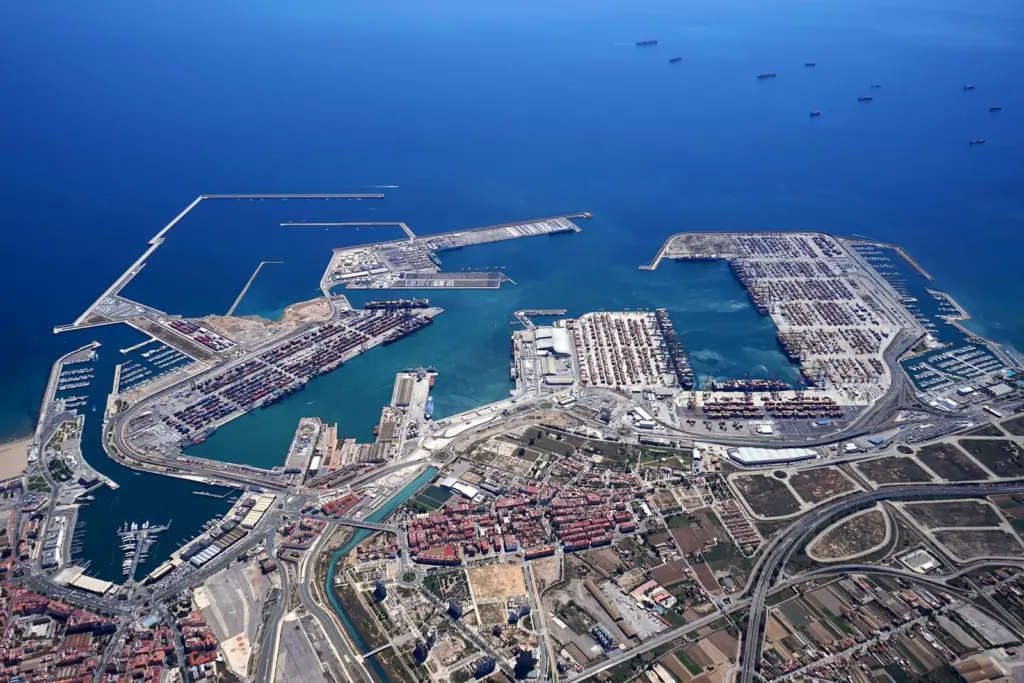
Port of Valencia is making a name for itself as a European pioneer in alternative fuel technology with its first hydrogen powered container stacker.
The benchmark piece of technology is reputedly the world’s first hydrogen powered reach stacker and has been developed by Hyster.
“The arrival of this new container terminal yard machine at the Port of Valencia reaffirms our European leadership in decarbonisation and the use of hydrogen as an alternative energy to fossil fuels,” said Joan Calabuig, president of the APV.
“It is a success for the Valenciaport Foundation, the Valencia Port Authority and all the companies and institutions collaborating in the H2PORTS project, which we celebrate with the entire port community of Valencia. The community that can be proud of its competitiveness, professionalism and willingness to innovate.”
Green reach stacker
The reach stacker prototype joins the hydrogen-powered tractor unit and the mobile hydrogen supply station (HRS) being tested in real operating conditions in the Port of Valencia from September 2023 until December 2024.
Having been manufactured and supplied by Hyster, the machine was transported to on three trucks and arrived at the port disassembled, ready for assembly.
The fuel cell powered Hyster ReachStacker is an innovative zero-emission solution that uses a Nuvera Fuel Cell Engine to convert hydrogen into electricity.
It is expected to offer comparable performance to a diesel reach stacker in terms of capacity and lift and drive speeds.
The design includes four hydrogen tanks as a standard option to store hydrogen inside the reach stacker. When combined with the right application and operating intensity, Hyster says the reach stacker will provide up to two shifts of operation before a hydrogen refuelling is required.
For convenience and flexibility, the reach stacker is designed to comply with the standard hydrogen filling station connection (SAE standard), allowing global use.
Going forward, refuelling and operational tests will be supervised by the technical team of Hyster, MSC Terminal Valencia, Centro Nacional del Hidrógeno, Carburos Metálicos and the Valenciaport Foundation, as coordinator of the H2PORTS project.
The port explains that its motive for choosing hydrogen as an alternative fuel is because it’s a clean energy carrier with the advantages of easy storage and, when used, produces no emissions other than heat and water.
The reach stacker’s hydrogen fuel cell converts H2 into electricity, resulting in zero-emission equipment that, when combined with the use of environmentally friendly hydrogen, is also carbon neutral. This technology has advantages compared to other zero-emission technologies and has a good range, a short run time, short and low fuel consumption.
Pilot project
Since January, also as part of the H2PORTS programme, the Port of Valencia has set up a hydrogen supply station (HRS).
This hydrogen supply station includes a fixed part dedicated to the reception, storage and compression of hydrogen up to delivery pressure and a mobile part that stores the compressed hydrogen and has a dispenser for refuelling the port machinery.
April saw a 4×4 truck tractor unit powered by green hydrogen, developed by ATENA, supported by ENEA and Parthenope University of Naples, also going into operation at the port under the auspices of the H2PORTS project.
The terminal tractor has a fuel cell/battery hybrid powertrain which allows the vehicle to perform all the intensive tasks that are required during roll-on/roll-off operations.
Its hydrogen storage system, made of four Type 3 cylinders (350 bar), has an overall capacity of around 12 kg, which guarantees a continuous operation of at least six hours before refuelling, corresponding to the average duration of a working shift. The electric motor is fed by a high-performance LiFePO4 battery, with 25 kWh energy capacity, and a 70 kW Ballard fuel cell module.
In particular, the electric motor can receive power for traction from the fuel cell and battery simultaneously or charge the battery during braking or decelerations. At the same time, the fuel cell can provide power both to the electric motor and the battery, if needed. The hybrid powertrain shows high operational efficiency, since it takes advantage of a significant share of kinetic energy recovery, up to 25%.
Both the reach stacker and the tractor are being tested at the MSC terminal.
Hydrogen commitment
Valencia says it’s the “first port in Europe” to incorporate hydrogen technologies to reduce the environmental impact of its operations.
The delivery of the first load of hydrogen (H2) to supply the refuelling station located on the Xità quay certainly made Valencia the first port in Europe to have a hydrogen installation in real operating conditions.
It’s a turning point for the port community and a benchmark for other European ports to look towards if they are also looking to set up and start testing one of the key marine fuels of the future.
Over and above it work its work with hydrogenising its fleet and ensuring steady fuel supplies, Valencia has big ambitions for hydrogen.
Valenciaport shared its current projects exploring the use of hydrogen at a recent meeting in Brussels of the Clean Hydrogen Alliance.
There is a plan to develop two hydrogen valleys – one in Valencia for mobility applications and the other in Sagunto for industrial consumption. The port aims to push forward with ”the promotion of synergies” which it said can will make projects with hydrogen more affordable.
For decades, all the ports managed by the Port Authority of Valencia have been working to reduce their environmental impact.This has led naturally to the strategic and ambitious decision to become zero net emissions by 2030.
The action plan to achieve this ambitious goal has been drawn up jointly by the Port Authority of Valencia, the Fundación Valenciaport and the companies that make up the maritime-logistics-port cluster of Valencia.
One initiative, called Ecoport II group is moving steadily towards the decarbonisation of its activities. This initiative – promoted by the Port Authority of Valencia (APV) – is made up of logistics/port companies that wish to optimise their environmental status at the ports of Valencia, Sagunto and Gandia.
A total of 42 companies operating in the Valencian port areas are currently participating in this project and have joined the initiative on a voluntary basis.
The H2PORTS project
The ’H2PORTS – Implementing Fuel Cells and Hydrogen Technologies in Port’ (H2Ports) project aims to demonstrate and validate in real port operations two innovative solutions based on FC technologies and a hydrogen mobile supply station specifically designed for the project.
A reach stacker to be tested in MSC Terminal Valencia and a yard tractor to be tested in Valencia Terminal Europa (part of Grimaldi’s group) were selected to pilot the use of hydrogen fuel cells in port facilities.
The project will pilot the equipment on a daily basis during two years of real operational activities. It will analyse ways of improving the energy efficiency, performance and safety of operations with hydrogen fuel celled port equipment.
This project will also take into account transversal issues such as the human factor, regulation, the future roll out of the technology on a fully commercial basis and the need to raise of awareness of the potential of hydrogen adoption as an alternative fuel in port equipment.
H2Ports aims to boost the transition of the European port industry towards an effective low-carbon/zero-emission and safe operative model, piloting, evaluating and demonstrating new fuel cell technologies to increase energy efficiency, decarbonisation and safety of port terminals.
The H2Ports project involves a total investment of €4 million and involves, in addition to the Valenciaport Foundation and the Port Authority of Valencia, the National Hydrogen Centre and the private companies MSC Terminal Valencia, Grimaldi Group, Hyster-Yale, ATENA Distretto Alta Tecnologia Energia Ambiente, Ballard Power Systems Europe, Carburos Metálicos (Air Products group) and Enagás.
Financed by the Clean Hydrogen Partnership, the successor to the Fuel Cells and Hydrogen Joint Undertaking (FCH Joint Undertaking), it aims to strengthen and integrate the European Union’s research and innovation capacity to accelerate the development and improvement of advanced market-ready clean hydrogen applications across multiple sectors, while strengthening the competitiveness of the clean hydrogen value chain.
The three members of the partnership are the European Commission, the fuel cell and hydrogen industries represented by Hydrogen Europe and the research community represented by Hydrogen Europe Research.
Related Articles
 ALTERNATIVE FUELS GREENPORT
 ALTERNATIVE FUELS GREENPORT
 ALTERNATIVE FUELS GREENPORT