![GreenPort[PortStrategy]](https://www.portstrategy.com/greenport/wp-content/uploads/sites/4/2026/09/GreenPortPortStrategy.svg)
India’s first methanol bunkering trial
Deendayal Port Authority says its completed India’s first methanol bunkering demonstration at Kandla port, furthering its port bunkering capabilities and alternative fuels provision aims.
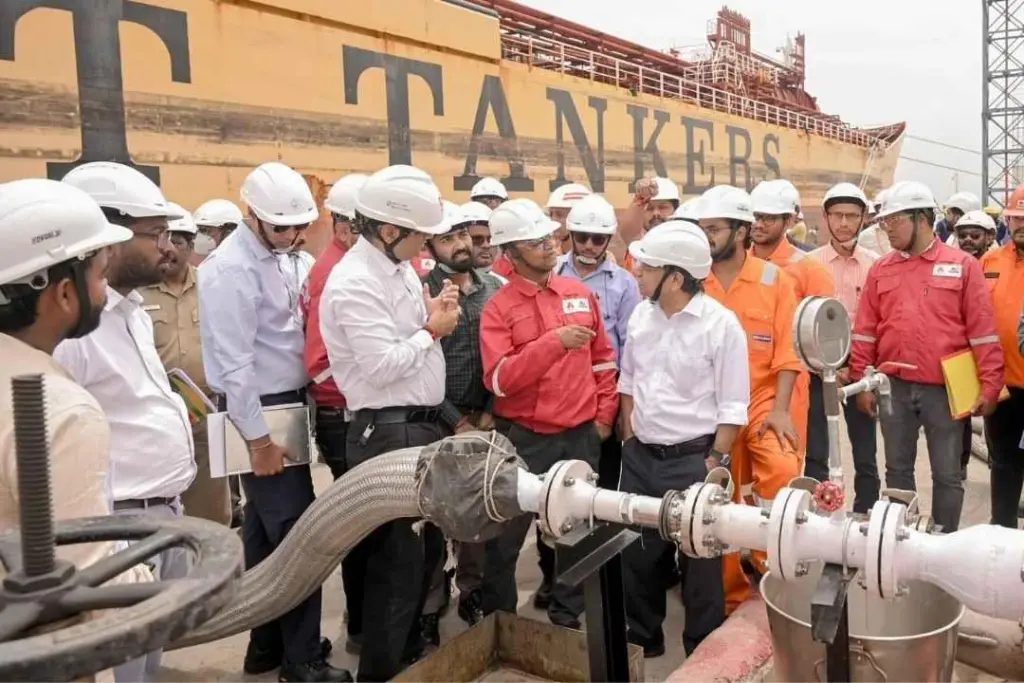
The shore-to-ship methanol transfer marks a milestone for port infrastructure development aligned with maritime decarbonisation goals.
Conducted on 2 April, the trial brought together multiple industry partners to validate operational readiness and safety procedures for handling alternative fuels within a working port environment.
“Shore-to-Ship methanol bunkering’ trial carried out at DPA, Kandla today,” said Sushil Kumar Singh, chairman of Deendayal Port Authority, in a LinkedIn post.
“A big thank-you to M/S Stolt Tankers, JM Baxi, Aegis VOPAK and Indian Oil Corp Ltd, for their participation in the joint exercise.”
Bunkering provision
The initiative forms part of broader efforts to position Kandla port on the Rotterdam–Singapore green shipping corridor while scaling future-facing bunkering solutions.
This demonstration builds on wider investment in port infrastructure to support alternative fuels.
Deendayal Port Authority has initiated site work for a 150 tonnes-per-day e-methanol plant in partnership with Assam Petrochemicals Limited and is progressing tenders for a port-integrated biomethanol production facility.
These developments aim to establish a reliable supply chain for low-carbon fuels linked directly to port bunkering operations.
Back in March, Deendayal Port Authority announced it’s working on a pilot-scale green hydrogen project at Kandla, centred on metal hydrid storage and fuel cell power generation integrated with existing port infrastructure.
The US$350,000 project will establish a hydrogen storage system with a minimum capacity of 3 kg using metal hydride technology, coupled with a fuel cell system capable of generating at least 4 kW of electricity.
Beyond installation, the project includes testing, commissioning and a two-year operational phase. This comprises a defect liability period followed by comprehensive operation and maintenance, allowing performance validation under real-world conditions.
Related Articles
 ALTERNATIVE FUELS GREENPORT
 ALTERNATIVE FUELS GREENPORT
 ALTERNATIVE FUELS GREENPORT