![GreenPort[PortStrategy]](https://www.portstrategy.com/greenport/wp-content/uploads/sites/4/2026/09/GreenPortPortStrategy.svg)



Mediterranean ports map hydrogen potential
Mediterranean port infrastructure could enable hydrogen production from renewable energy, supporting alternative fuels and accelerating maritime decarbonisation, according to new research.
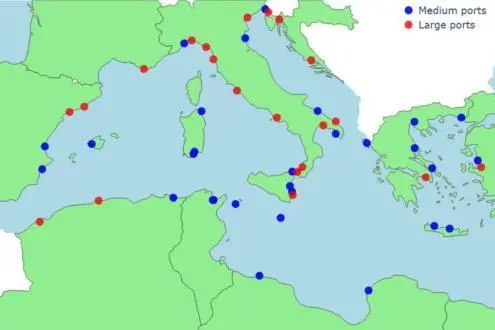
Published in Energy Conversion and Management on ScienceDirect, the paper “The role of Mediterranean ports in the energy transition: assessment of hydrogen production potential” presents a GIS-based model analysing 62 ports across the region.
The research by Italy’s Department of Industrial Engineering, University of Naples Federico II, evaluates how port infrastructure can integrate renewable energy sources, including solar, wind and wave power, alongside storage systems to produce hydrogen via electrolysis, supporting alternative fuels and energy transition strategies.
“Results highlight significant variations in hydrogen production potential across different ports,” the researchers state, emphasising the influence of local renewable energy availability on system performance.
Energy management
The study develops a dynamic simulation framework assessing interactions between renewable energy generation, storage, electrolyser operation and grid supply under different configurations.
It incorporates economic, environmental and energy indicators, including the levelised cost of hydrogen, to support decision-making around renewable energy deployment and port infrastructure planning.
Findings show solar energy provides the most consistent renewable energy source across Mediterranean ports, while wind performance varies by location and wave energy shows limited viability due to low availability.
Hydrogen production costs differ widely, ranging from around €5.7–8.6/kg in fully renewable systems and €2.5–13/kg in hybrid configurations depending on electricity pricing and emissions intensity.
The paper concludes that integrating renewable energy-driven hydrogen production into port infrastructure could position ports as critical hubs for alternative fuels, supporting a broader transition toward a hydrogen-based, low-carbon energy system.
Related Articles
 ALTERNATIVE FUELS GREENPORT
 ALTERNATIVE FUELS GREENPORT
 ALTERNATIVE FUELS GREENPORT