![GreenPort[PortStrategy]](https://www.portstrategy.com/greenport/wp-content/uploads/sites/4/2026/09/GreenPortPortStrategy.svg)
Rotterdam and Duisburg team up on hydrogen
The ports of Duisberg and Rotterdam are cementing their partnership in the development of European hydrogen chains with a new feasibility study.
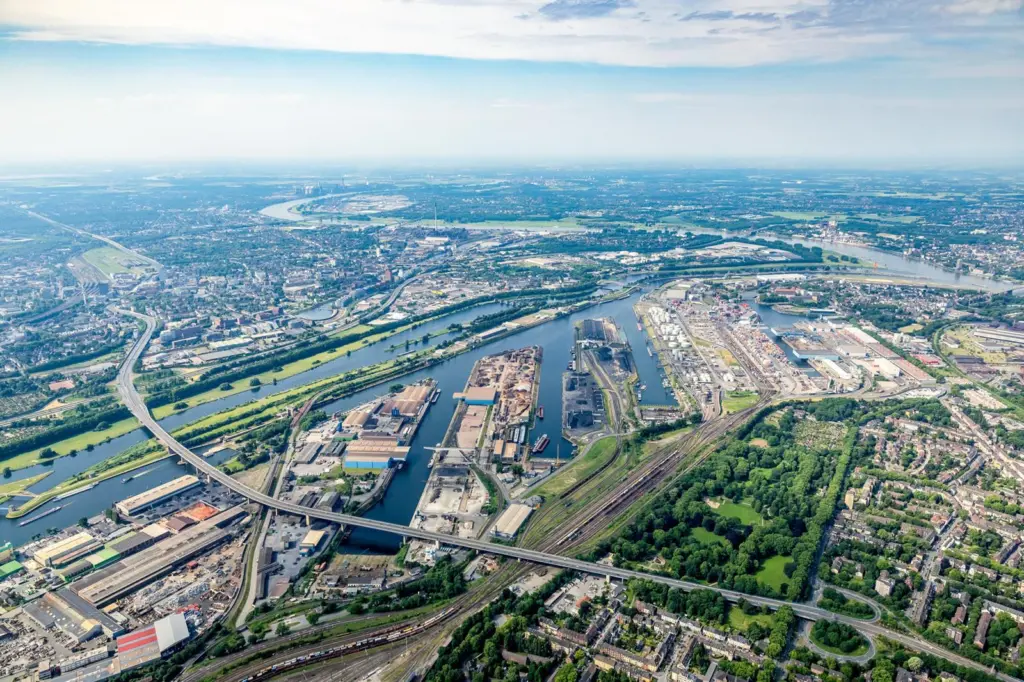
Their study aims to show the combined role the two ports have to play in supporting the growing demand from the industry for hydrogen and its derivatives, by acting as a conduit between the governments, industry and future players in the market.
“This study confirms the important role that both ports play as hubs, matchmakers and drivers of the energy transition. It shows which forward-focussing activities are needed in both ports to build the hydrogen economy of the future,” said Boudewijn Siemons, interim CEO and COO of Port of Rotterdam Authority.
Concrete solutions
Their feasibility study highlights that in North Rhine-Westphalia, a significant increase in the demand for low carbon hydrogen of more than 3 million tonnes per year is expected until 2045.
The demand for methanol is also expected to increase significantly, to more than 2.5 million tonnes per year. Subsequently, duisport and the Port of Rotterdam Authority are mediating between the political and business worlds to match supply and demand and provide the necessary clarity to help speed up the decision-making on investments and subsidies.
The ports are supported by the hydrogen initiative ‘Hy.Region.Rhein.Ruhr e.V.’, co-founded by duisport, which the port of Rotterdam has now also joined.
To meet expected demand, the ports said it will be crucial to scale up relevant infrastructure and provide suitable areas. The study shows that the first hydrogen pipeline between the two ports should be completed by 2027 to meet the growing demand for green hydrogen in North Rhine-Westphalia in the medium term.
Hydrogen derivatives pipelines and pipelines for the export of CO2 should follow. Inland shipping and rail transport will also remain essential elements in getting the hydrogen chains up and running and facilitating the first imports.
According to the study, several hydrogen pipelines will ultimately be needed to meet the demand in North Rhine-Westphalia and beyond.
Joined-up thinking
Rotterdam and duisport have been interconnected for decades by rail, inland shipping, trucks and pipeline connections. The existing collaboration was expanded last year with a MoU on digitalisation and energy transition, to jointly explore the possibilities for green hydrogen, methanol and ammonia.
Both ports are already taking action to develop the necessary infrastructure to support the hydrogen economy. One central building block for a resilient supply to the industry is the expansion of tank storage capacities for hydrogen derivatives in Duisburg.
duisport recently announced its intention of building a storage facility for tank containers with green energy sources and a tank farm for liquid renewable fuels and raw materials, such as ammonia, in the port of Duisburg. The construction of a first hydrogen plant is planned for mid-2025.
Together with the city of Duisburg and the Essen power plant, the first hydrogen training centre in the region is currently being built. From 2025, staff from across the hydrogen value chain will be educated and trained here to meet the growing demand for skilled personnel.
In Rotterdam, several projects have been announced for hydrogen import terminals and local hydrogen production, including the expansion of OCI Global’s ammonia terminal and the building of a 200MW electrolyser by Shell.
Space has been reserved for several electrolysers that will produce green hydrogen from North Sea wind energy. Gasunie recently made the decision to invest in the national hydrogen network, the construction of which will start in Rotterdam.
Related Articles
 ALTERNATIVE FUELS GREENPORT
 ALTERNATIVE FUELS GREENPORT
 ALTERNATIVE FUELS GREENPORT