![GreenPort[PortStrategy]](https://www.portstrategy.com/greenport/wp-content/uploads/sites/4/2026/09/GreenPortPortStrategy.svg)
Spatial safety warning
Ports need to proactively prioritise spatial safety when planning for future fuels.
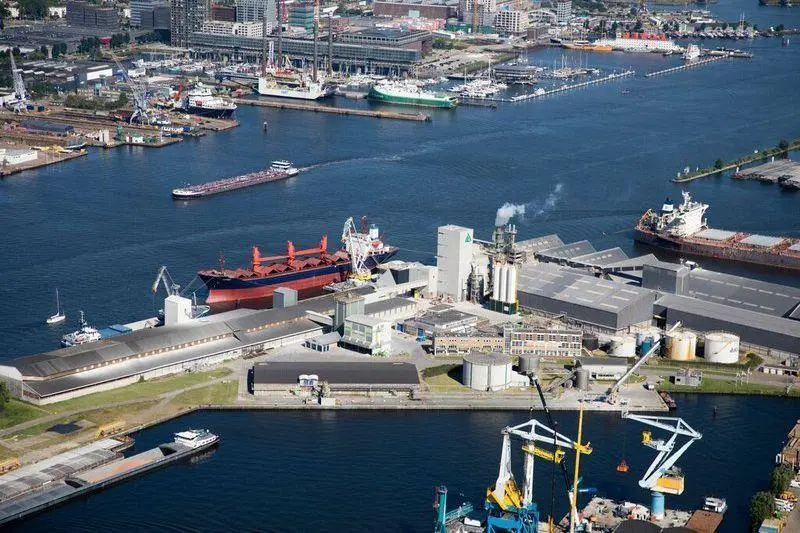
This is the key takeaway from a new report by the Harbour Masters division of the Port of Amsterdam in collaboration with the classification society DNV.
The study “concluded that ports looking to supply new zero or carbon neutral fuels to ships will need to pay special attention to spatial safety when planning ahead for locating and building bunkering infrastructure,” said the IAPH’s World Ports Sustainability Program (WPSP).
Ammonia needs vast space
Considering LNG, methanol, ammonia and hydrogen, the report found the external safety distances (10-6/year) for bunkering of methanol and gaseous hydrogen are much smaller (a factor of 3-5) than those for LNG. For refrigerated ammonia and liquid hydrogen, the safe distances are similar to those for LNG, and for pressurised ammonia, the distances are about three times as large due to the generation of a large toxic cloud in the event of a hose rupture.
The report coincides with COP26 and the increasing focus on future fuels at the upcoming MEPC77 meeting of the IMO. This includes examining short-to-medium term measures to decarbonise and reduce emissions, including market-based measures to fund the acceleration of research into zero carbon fuels.
Henri van der Weide, environmental policy advisor at the Port of Amsterdam, commented: “Current legislation and competing space for urban and industrial use demands that ports look far ahead when considering the location, design and implementation of future bunkering infrastructure for ships.”
The report pointed out that as “much remains unknown as to how the bunkering of these fuels will exactly be performed,” reassessment of requirements will be needed as the future fuels market develops.
Both the ports of Amsterdam and Rotterdam are key contributors to the work of the IAPH Clean Marine Fuels Working Group, which is in the process of digitalizing its cryogenic bunker fuel lists, bunker audit tools for candidate terminal operators and alternative fuel terminal readiness guidance, beginning with LNG and now being adapted for hydrogen, methanol and ammonia.
Related Articles
 ALTERNATIVE FUELS GREENPORT
 ALTERNATIVE FUELS GREENPORT
 ALTERNATIVE FUELS GREENPORT