![GreenPort[PortStrategy]](https://www.portstrategy.com/greenport/wp-content/uploads/sites/4/2026/09/GreenPortPortStrategy.svg)


Training up on hydrogen reachstackers
Port of Valencia stakeholders have been training up on Hyster’s hydrogen reach stacker which is being developed as part of the European H2PORTS project.
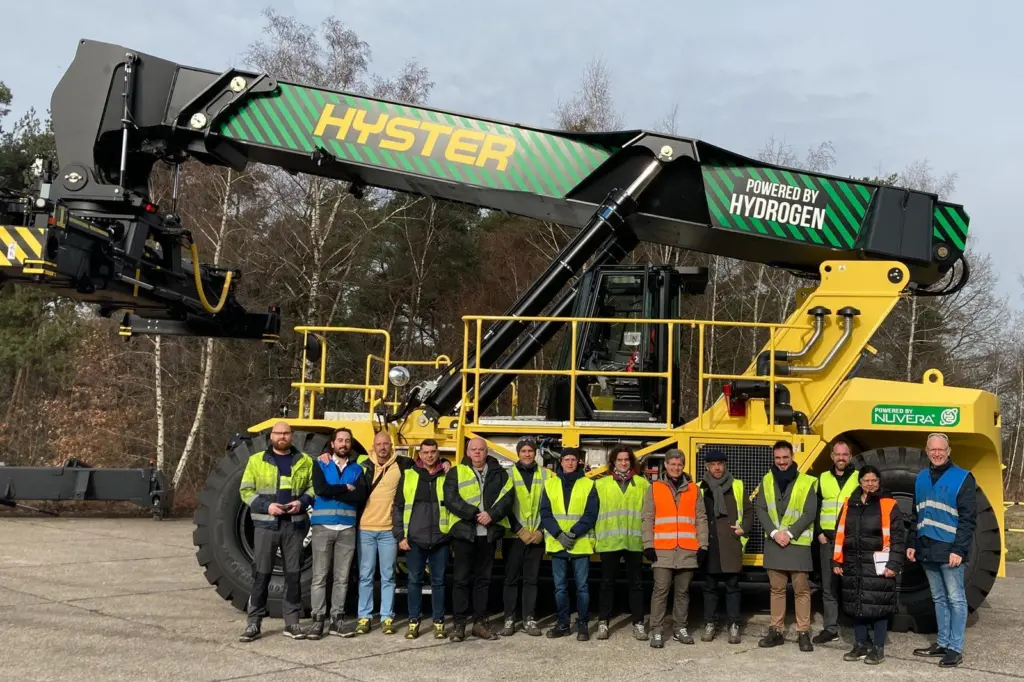
The aim is for Fundación Valenciaport, the MSCTV terminal and Valencia dockers to familiarise themselves with the machine’s operation before it’s sent to the Port of Valencia to begin testing in real life operations.
Training on the reach stacker has been performed both virtually and by a visit to the Hyster-Yale Group facilities in Weeze, Germany.
Test project
When it goes into operation, the hydrogen-powered reach stacker will be tested over a period of two years at the MSCTV terminal.
The mobile Hydrogen Refuelling Station, developed by CNH2 and managed by Carburos Metálicos, will guarantee fuel supply for both for this pilot project and for the 4×4 hydrogen terminal tractor that will be tested at Valencia Terminal Europa, part of Grimaldi Group.
Hyster’s reach stacker is expected to offer comparable performance to a conventional truck in terms of capacity and lift and driving speeds, helping to support similar productivity levels.
It’s expected that the hydrogen powered reach stacker will provide up to one day of operation before refill is required. It’s also being developed to comply with the standard H2 filling station connection (SAE standard), enabling global use.
The European project “H2PORTS – Implementing Fuel Cells and Hydrogen Technologies in Ports” is an initiative coordinated by Fundación Valenciaport in close collaboration with the Port Authority of Valencia and financed by the Clean Hydrogen JU, the successor of Fuel Cells and Hydrogen Joint Undertaking (FCH JU) program.
Its main objective is to test and validate hydrogen technologies on port machinery that allow to have applicable and real solutions without affecting the performance and safety of port operations and producing zero local emissions.
The H2PORTS project will entail a total investment of €4 million and involves, in addition to Fundación Valenciaport and the Port Authority of Valencia, the Centro Nacional del Hidrógeno, and the private companies MSC Terminal Valencia, Grimaldi Group, Hyster-Yale, Atena Distretto Alta Tecnologia Energia Ambiente, Ballard Power Systems Europe, Carburos Metálicos and Enagás.
Related Articles
 ALTERNATIVE FUELS GREENPORT
 ALTERNATIVE FUELS GREENPORT
 ALTERNATIVE FUELS GREENPORT