




Valencia showcases H2 port tech
The Port of Valencia has opened its gates to show what hydrogen-powered port operations look like in real life, hosting the final conference of the EU-funded H2Ports project.
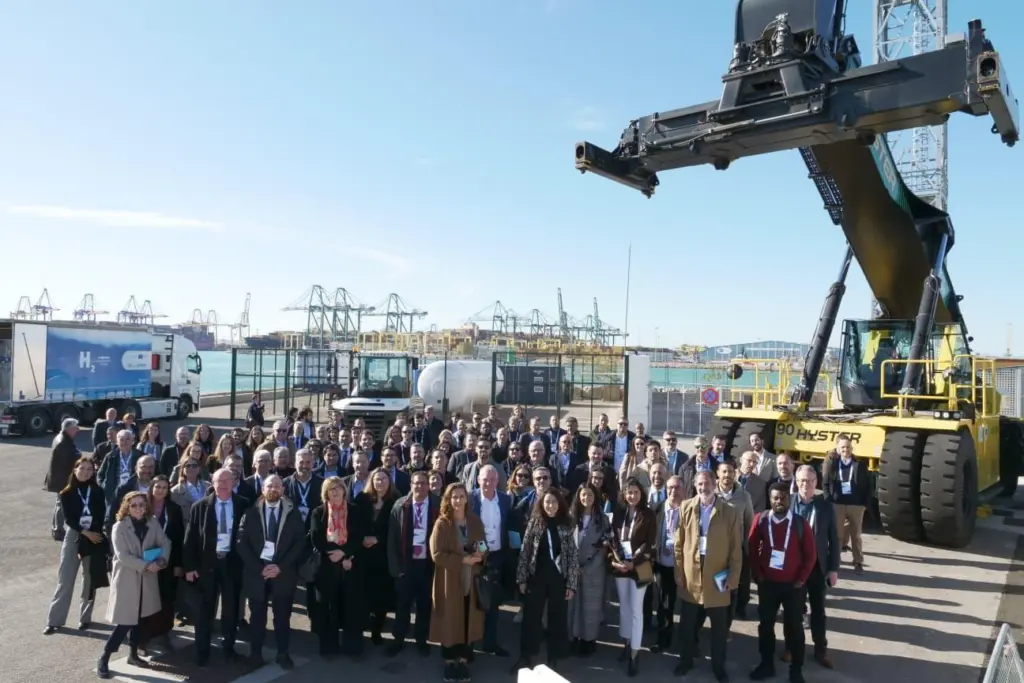
More than 150 attendees moved from auditorium talks to the Xità quay, where the headline prototypes – a hydrogen ReachStacker and a converted 4×4 terminal tractor – were put on display.
“This project reaffirms our commitment to decarbonisation,” said Mar Chao, president of the Port Authority of Valencia. “We envision a port that is a living laboratory where industry and science converge.”
Speakers from the Clean Hydrogen Partnership, Fundación Valenciaport and the European Commission all pointed to the project as a sign that hydrogen is edging closer to commercial viability. Valerie Bouillon-Delporte of the Clean Hydrogen Partnership said that the initiative ‘shows ports can become catalysts for clean mobility and new energy value chains’.
On the quay, workers and visitors assessed the hydrogen fuel-cell ReachStacker developed by Hyster-Yale and tested at the MSC terminal. Operators who used it said the machine felt familiar but noticeably quieter. “It behaves like a diesel but without the noise or fumes,” one dockworker said during the tour.
Nearby, the world’s first hydrogen-powered terminal tractor, converted from diesel by an Italian research consortium, drew equal attention. Engineers explained that the toughest challenge was teaching the machine to balance power between its fuel cell and battery. “Getting the energy management right was the key to making it work for a full shift,” one project researcher said.
A mobile refuelling station, built by Spain’s National Hydrogen Center, rounded out the demonstration. The unit can fuel both prototypes in a single day, an approach project managers said could be replicated in other ports.
Antonio Torregrosa of Fundación Valenciaport said that the day’s demonstrations show momentum. “European funding is making innovation in ports a reality, not a promise,” he said.
Related Articles
 ALTERNATIVE FUELS GREENPORT
 ALTERNATIVE FUELS GREENPORT
 ENERGY & TECHNOLOGY GREENPORT