![GreenPort[PortStrategy]](https://www.portstrategy.com/greenport/wp-content/uploads/sites/4/2026/09/GreenPortPortStrategy.svg)




Cleveland forges ahead with electrification drive
The US Port of Cleveland is accelerating port electrification with new solar power, battery storage and electric port equipment supported by a US$94 million award from the federal Clean Ports Program.
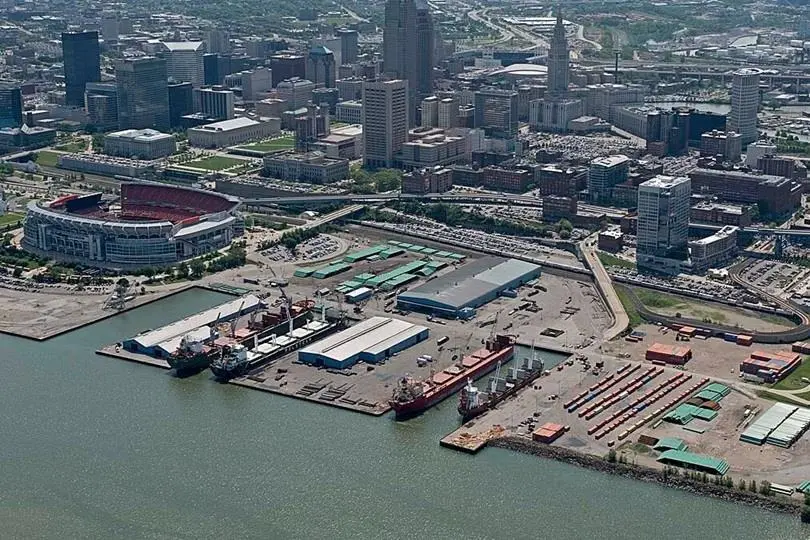
It’s a project which involves transforming the port’s main Lake Erie warehouse into a clean-energy hub with electrification at the centre of activities.
Once complete, Warehouse A will feature roughly 2 megawatts of rooftop solar panels, battery storage and charging stations for zero-emission cargo-handling equipment.
Power in numbers
Cleveland’s clean-energy progress stands out as it continues moving forward despite the Trump administration’s broader rollback of environmental policies and resistance to renewable energy projects.
The Electrification Coalition (EC) is a non-profit organisation in the US that promotes policies and actions to facilitate the widespread adoption of plug-in electric vehicles (EVs) on a mass scale.
It has been instrumental in getting industry movers and shakers together to share strategies and tackle ongoing challenges in advancing port electrification.
Back in January, the U.S. Department of Transportation announced nearly US $5 billion in grant funding for various transportation initiatives, including US $636 million of funding for 49 electric vehicle (EV) charging infrastructure projects.
This funding is anticipated to add more than 11,500 charging ports across 31 states (including four Tribal Nations) and the District of Columbia, representing the single largest charging infrastructure investment in U.S. history.
The EC assisted the City of Cleveland in its successful application for nearly $4 million to install 92 charging ports on city-owned property, helping to propel electrification aims forward.
It’s a project which feats in neatly with Cleveland-Cuyahoga County Port Authority’s goal of achieving net-zero greenhouse gas emissions by 2050.
This commitment covers both the port’s direct Scope 1 emissions and its Scope 2 emissions from energy use, with electrification very much a focus on achieving this target.
Related Articles
 ENERGY & TECHNOLOGY GREENPORT
 PROJECTS & INITIATIVES GREENPORT
 ALTERNATIVE FUELS GREENPORT