![GreenPort[PortStrategy]](https://www.portstrategy.com/greenport/wp-content/uploads/sites/4/2026/09/GreenPortPortStrategy.svg)


San Diego Port advances electrification
The Port of San Diego is seeing measurable environmental and public health benefits thanks to its aggressive push toward electrification, a cornerstone of its Maritime Clean Air Strategy (MCAS).
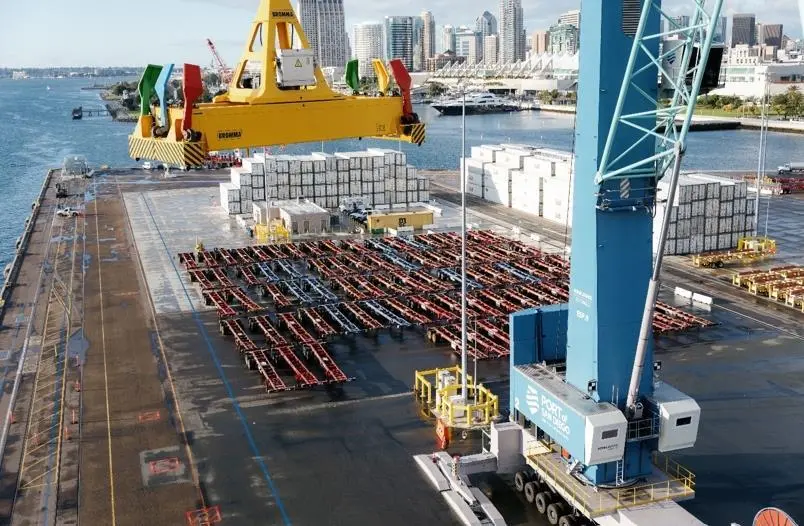
According to the latest MCAS Highlights Report, the port has implemented or made progress on 80% of MCAS objectives, with electrification playing a critical role in driving down maritime-related emissions.
“All of us at the Port of San Diego are excited to see the Maritime Clean Air Strategy delivering results,” said Danielle Moore, chair of the Board of Port Commissioners.
“The investment and deployment of new, zero-emission technologies show we can grow the economy while safeguarding the people we serve.”
Emissions reduction
Since the last emissions inventory in 2019, the port’s maritime operations have achieved a 46% reduction in diesel particulate matter, 32% reduction in nitrogen oxides and a 10% decrease in carbon dioxide emissions. These improvements are largely tied to investments in zero-emission technologies and electric infrastructure.
To date, more than US$227 million has been committed toward maritime electrification and efficiency. This includes electric trucks, equipment, vehicles and major infrastructure upgrades at cargo and cruise terminals. The efforts have been bolstered by a recently awarded US$58.6 million EPA grant, matched by US$27.7 million in additional funding, to expand zero-emission capabilities.
Projects include shorepower systems, electric truck charging stations and the purchase of 77 new pieces of electric equipment, from cargo handlers to shuttle vans. These improvements support both environmental goals and the port’s ‘Health Equity for All’ vision, aiming to reduce pollution in nearby communities.
The port is also investing in education and community engagement, with nearly 150 residents already graduating from its Portside Community Academy since 2023.
Related Articles
 ENERGY & TECHNOLOGY GREENPORT
 PROJECTS & INITIATIVES GREENPORT
 ALTERNATIVE FUELS GREENPORT