![GreenPort[PortStrategy]](https://www.portstrategy.com/greenport/wp-content/uploads/sites/4/2026/09/GreenPortPortStrategy.svg)



Study identifies US ports most needing shorepower
A new study has revealed which US ports would most benefit from installing shorepower.
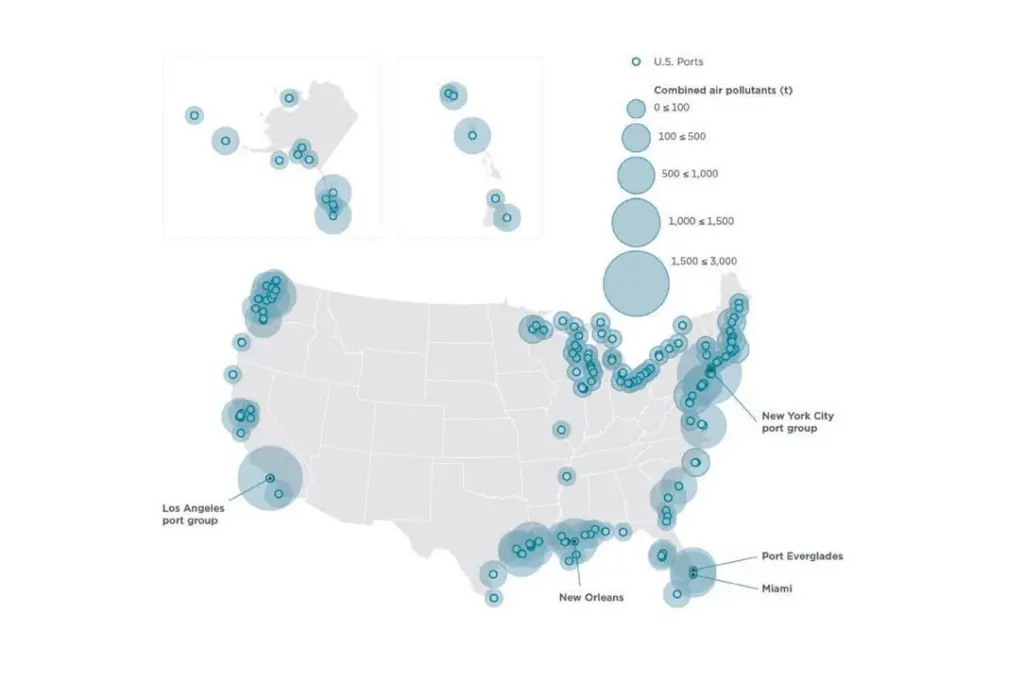
For the first time ever, nationwide missions from at-berth vessels have been assessed to identify where switching to shorepower would most improve air quality, benefitting workers, port users and the local community.
Using the International Council on Clean Transportation’s Systematic Assessment of Vessel Emissions model and automatic identification system data, the study shows that at-berth vessels emitted around 27,000 tonnes of combined air pollutants (NOx, SOx, and PM10) and more than 1.4 million tonnes of CO2 in 2019.
Of the 129 ports studied, 43 high-priority ports overlapped with areas that do not meet US Environmental Protection Agency air quality standards.
The study assigns the 43 ports and port groups a priority level of 1 to 4 based on at-berth vessel air pollutant emissions estimates and the population near each port.
Based on the results, there is potential at priority 1 (New York City port group and Los Angeles port group) and priority 2 (New Orleans, Seattle, Galveston port group, Houston, and Oakland port group) ports to reduce emissions by installing shorepower for use by the highest emitting ship types.
Many of the priority 1 and 2 ports have shorepower currently installed or planned for these high-emitting ship types, which include tanker, container, cargo, cruise, and tug vessels.
US ports can use available federal funding to install zero-emission port equipment, develop air quality monitoring plans, or conduct emission inventories for more tailored emission estimates than this nationwide screening provides.
As more ports complete emission inventories and further data is available, it may become easier to identify additional areas to decarbonise, say the authors.
Related Articles
 ENERGY & TECHNOLOGY GREENPORT
 PROJECTS & INITIATIVES GREENPORT
 ALTERNATIVE FUELS GREENPORT