![GreenPort[PortStrategy]](https://www.portstrategy.com/greenport/wp-content/uploads/sites/4/2026/09/GreenPortPortStrategy.svg)



Eastland Port’s stormwater is clean enough to drink
How a New Zealand port is treating its stormwater runoff to produce clean results, even after heavy rain.
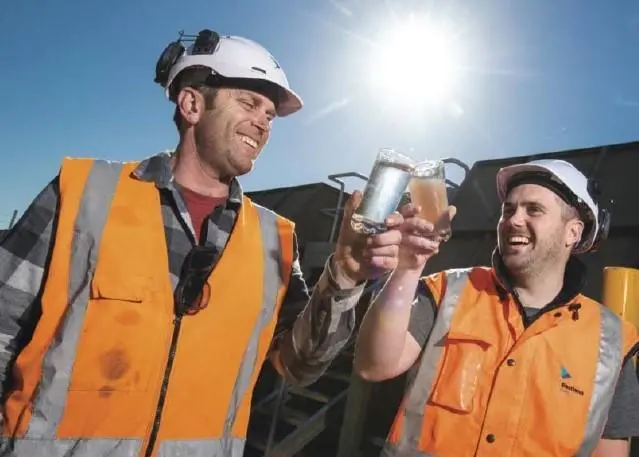
The stormwater treatment process at the North Island port of Eastland, in Gisborne, is believed to be a world leader in ports associated with the export of logs, and has also achieved external recognition by winning the Eastland Wood Council Environmental Management Award.
Contracts project manager Mark Richards and project assistant Matt Schmelz have dedicated the past two years to ensuring the efficiency of the port’s stormwater treatment system upgrade, checking in whenever rain events trigger the plant to treat water, and poring over the nuances of how to make dirty water cleaner.
Eastland Port’s innovative stormwater treatment system was installed in the upper log yard in 2018 and uses technology and processes more commonly found in town drinking water processing to clean its stormwater.
Port staff are pretty sure they’re the only ones worldwide adapting the technology for log-yard stormwater treatment.
“We’re writing the operations manual as we go,” says Mr Schmelz. “But in this day and age, like everyone else, Mark and I worry about the effects of industry on our neighbours. It’s part and parcel of working in the marine environment.”
Twelve hours of steady rain isn’t a problem for the system, but an hour of torrential rain from a thunderstorm adds challenges for the team. “In just one hour you can get a hell of a lot of water rushing along the ground and so we get that pump shifting up to 50,000 litres of water an hour through the plant,” says Mr Schmelz.
“A rain event like that will be smashing into other streets around us, not just the port, and when that happens everyone’s stormwater starts pouring into the stream. All our trials and tests mean we are getting better at what we’re doing and the testing shows there’s much cleaner water from our pipe disappearing into the stream.”
Mr Richards says: “At the start of the project, we discussed quantifiable measures for success and we decided that one of them should be that we would all drink water from the treatment system at some point. We knew stakeholders like Gisborne District Council would ask the question.so we did it!”
Mr Schmelz adds: “I’ve taken a glass with me to the upper log yard and filled up with complete confidence.” The innovative water treatment system is to be replicated in the port’s wharfside log yard currently under construction, and later in the existing southern log yard.
How it works
Turning log yard run-off into cleaner water involves a number of steps. First in are the log yard sweepers – loaders with imported front-end units from Europe. They recover up to 45,000 cubic metres of bark and wood debris a year. The sweepers can’t get everything, so sprinklers used to suppress dust help flush the remaining debris across the yard into gully traps, and a 200-metre-long, two-metre-deep swale (basin) sunk into the ground to one side.
Natural settlement then occurs in the deep, swimming pool-sized swale. Heavier particles fall to the bottom as the water passes through, then the residuals are scooped or sucked out and reused for compost or taken off-site to consented clean landfills. Meanwhile, the chocolate-coloured water from the swale is pumped through two lamella clarifiers at around 24,000 litres per hour.
Angled plates catch floating particles from the incoming water and they accumulate at the bottom of the clarifier as sludge. Flocculant and coagulant agents are added to the stormwater prior to it passing through the clarifiers to help the clumps form up and drop.
The recovered sludge is pumped into reusable geo-bags to dry out. What’s left dries to a soil consistency and is taken to a clean fill. The clarified water exiting the treatment plant at the top goes over a weir, disappears via a pipe under the road, and spills into the nearby stream and eventually into the harbour.
Related Articles
 ENERGY & TECHNOLOGY GREENPORT
 PROJECTS & INITIATIVES GREENPORT
 PRODUCTS & SERVICES GREENPORT