![GreenPort[PortStrategy]](https://www.portstrategy.com/greenport/wp-content/uploads/sites/4/2026/09/GreenPortPortStrategy.svg)
EXCLUSIVE: Sustainability focus in Napier’s cyclone recovery
Napier Port is in the throes of recovery from damage sustained during a 2023 cyclone, but it’s been building back leaner and greener, writes Dave MacIntyre.
In February 2023 Cyclone Gabrielle lashed the New Zealand province of Hawke’s Bay with gale-force winds, a large easterly swell and record rainfall causing rivers to burst their banks, devastating the region.
Napier Port was seriously affected by a Category 3 Severe Tropical Cyclone. Road and rail links feeding the port were cut. Major exporters were faced by catastrophic flood damage.
Two years later, Napier is in the throes of a recovery. Half-year results published in May show net profit after tax increased 40.8% including a payout of an insurance claim worth NZ$7.5 million.
Green transformation
The recovery is being driven by a Transformation Project in which sustainability is a key feature.
Transformation initiatives are focused on the port’s container terminal to modernise the way containers are moved.
Investment will introduce battery-electric autonomous trucks and trailers for moving containers between the yard and the wharf, replacing diesel-powered equipment and supporting the port’s commitment to delivering more efficient, sustainable operations.
There are plenty of opportunities to reduce fuel use and emissions, congestion within the terminal, reduce equipment wear and maintenance costs, thereby further removing limitations on productivity and capacity.
To this end, a secure private 5G network will be set up to support the autonomous trucks and trailers, with full integration into Napier’s terminal operating system for real-time task management. An automated battery swap station will keep the fleet operating continuously.
Napier chief executive Todd Dawson says the commercial drivers of the Transformation Project need to align with sustainability goals.
“This transformation is part of Napier Port’s long-term strategy to operate as a sustainable business – operationally, economically, environmentally, and socially. It positions the port to support future growth while meeting the evolving needs of cargo customers, shipping lines and the wider supply chain.”
The company is pouring between NZ$20 to $25 million into the Transformation Project and has gone to considerable lengths before making its choices.
“We have done extensive research, global benchmarking, and operational modelling and trials,” says Mr Dawson.
“Napier Port has selected a preferred option that is globally-proven, commercially-available technology to shift to battery-electric trucks for horizontal container transport, while existing reachstackers will continue to perform vertical lifting, optimising their role without the inefficiency of long-distance travel.”
Napier is progressing a due diligence and business case with an anticipated investment sign off in the second half of this year.
In its general fleet upgrades, Napier has been following a policy of investing in lower-emission cargo-handling equipment. The acquisition of two Kalmar Eco Reachstackers in 2023 has already achieved a 32% fuel reduction compared to older models. In early 2025, five additional Eco Reachstackers were received, expected to deliver up to 40% lower fuel consumption than the legacy machines they replace.
The rollout of LED lighting upgrades is continuing across the port, reducing energy consumption.
Sustainability in action
This Transformation Project is one of a number of “Sustainability in Action” initiatives under way. Since launching its formal sustainability programme in 2021, Napier has identified over 100 sustainability initiatives, with 79% now fully integrated into business-as-usual activities.
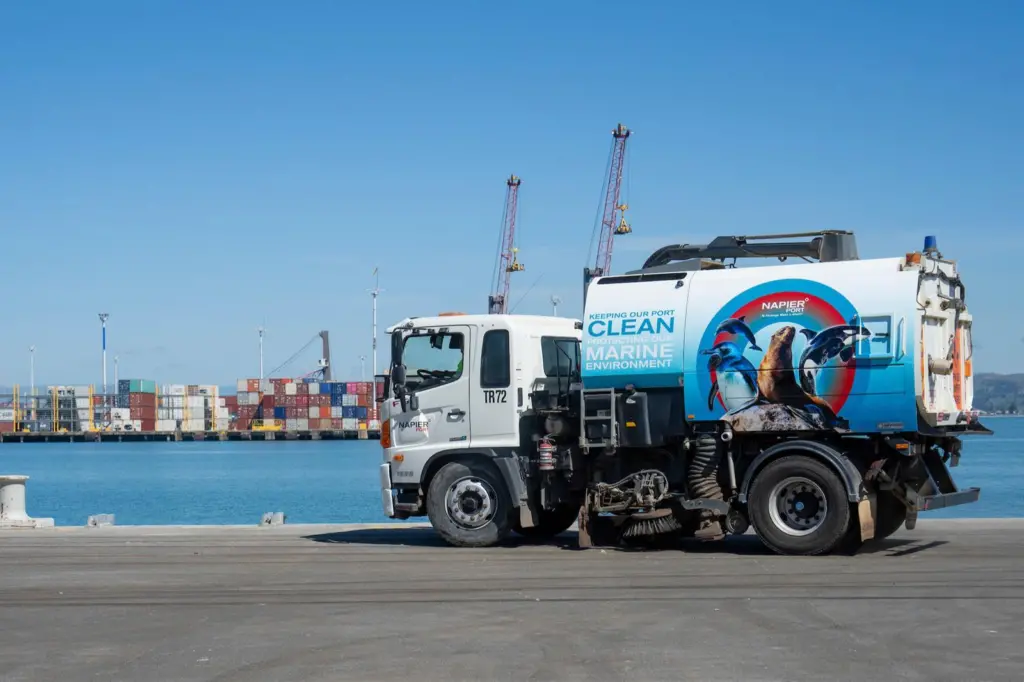
The company has embedded sustainability criteria into its procurement practices, a recent example being the purchase of a new sweeper truck to help manage dust emissions, improve air quality, and meet environmental compliance requirements. The port ran an internal competition to name the truck, and “Sweeping Beauty” was selected.
Another initiative is the placement of turbidity buoys in the harbour. Before applying for consents to build its new wharf, Napier installed monitoring buoys in the harbour to understand the natural variations in water quality (turbidity), waves, currents and winds.
This long-term data allowed the development of trigger levels for turbidity rates. Adaptive dredge management (ADM) was then used throughout the operational phases of the project to ensure that water quality – in particular turbidity related to the dredging and disposal – met predicted environmental effects.
These buoys mean that the port is alerted immediately if turbidity levels at Pania Reef are above trigger levels to allow management measures to be implemented as soon as practicable. This ensures that turbidity created by dredging will not threaten the existing ecology of the reef, which has deep cultural significance locally.
The port’s website has an environmental monitoring dashboard that provides live information on water quality at Pania Reef every 15 minutes.
It also operates a certified Environmental Management System (EMS), externally audited to ISO standards. It also publicly discloses climate-related risks and opportunities, aligned with the NZ Climate Standards and completes an annual audit of its greenhouse gas emissions inventory, helping track and manage the port’s carbon footprint.
Community
Napier has also been active in the community, supporting conservation and biodiversity projects, including work to protect native seabirds and the kororā (little penguin).
Fisheries monitoring and stakeholder engagement is undertaken as part of the port’s commitment to marine environmental stewardship, with active collaboration with stakeholders.
In 2023, it conducted comprehensive surveys to assess the health and sustainability of local fish populations. The port maintains an active Fisheries Liaison Group, fostering communication and collaboration with the fishing community.
The port works alongside mana whenua (local Māori), and community stakeholders to support the long-term success of the artificial reef established during the building of the new 6 Wharf. Protected under a two-year rāhui (tribal ban) until July 2025, the reef has provided an opportunity to support marine biodiversity.
Engagement with a tribal advisory group and fishing representatives is progressing toward establishing a reserve to safeguard customary and recreational fisheries.
This work is further supported by the Te Kōhanga Project, an initiative using woven cabbage tree ropes to enhance kelp and mussel growth, demonstrating shared responsibility for marine sustainability and cultural values.
Related Articles
 ENERGY & TECHNOLOGY GREENPORT
 PROJECTS & INITIATIVES GREENPORT
 PRODUCTS & SERVICES GREENPORT