![GreenPort[PortStrategy]](https://www.portstrategy.com/greenport/wp-content/uploads/sites/4/2026/09/GreenPortPortStrategy.svg)

Antwerps plan: consolidate and communicate
New barge consolidation hubs are part of a unique action plan to improve efficiency at the Port of Antwerp. Felicity Landon reports.
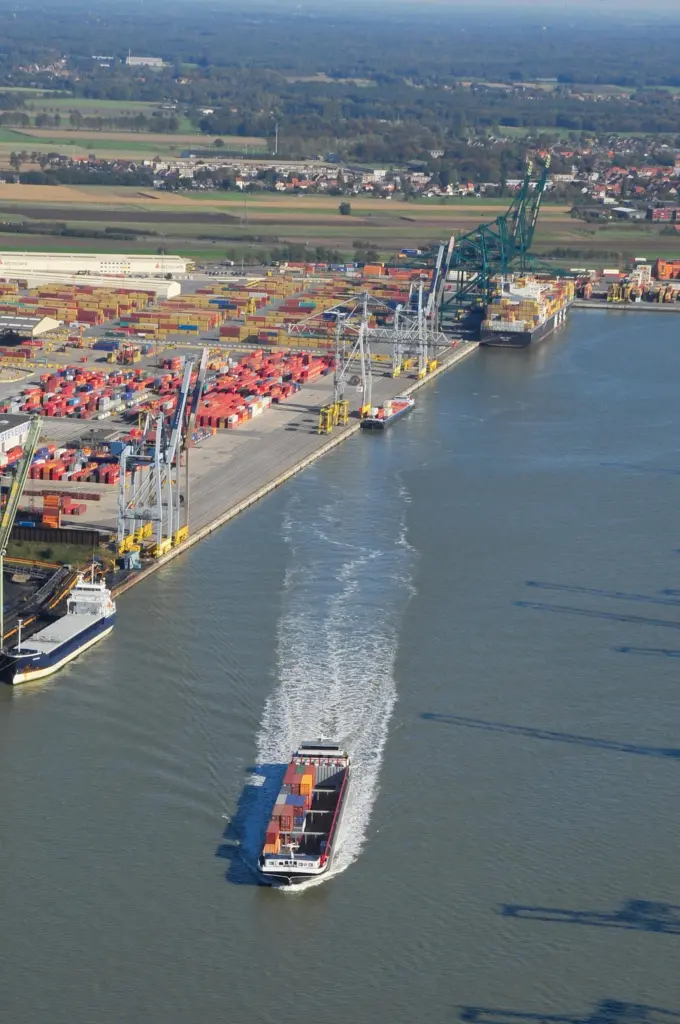
Multiple barges dropping tiny numbers of containers at different terminals, cranes standing idle waiting for barges to moor, individual planning systems leading to scheduling conflicts… when members of the Antwerp port community met last year to discuss problems of congestion and delays associated with inland navigation and barge calls at maritime container terminals, it was clear that something had to be done.
The result? In November a new system of consolidating container barge volumes came into operation. The pilot project will run for two or three months, and Antwerp Port Authority is expecting some significant improvements.
The project incorporates some financial support from the Flemish government and the port authority — but this is not a case of ‘when push comes to shove’, as Pascale Pasmans, the port authority’s senior project leader, inland navigation, emphasises. “In July last year, when we had long waiting times for inland navigation at the maritime container terminals, all parties agreed we had to look at what we could do to improve the whole process in Antwerp in a structural way,” she says.
“In September 2017, we started working group discussions in which the whole chain was present – including shipping lines, barge operators, freight forwarders, shippers, barge and marine terminals, and others. Between September and April, we had 40 working groups, and about 30 people participated in each working group — it was a very intense process. With everyone sitting down together, they started to understand each other’s problems better. This led to an understanding that we should do something together, and the role of the port authority has been to work with that community feeling. It isn’t just the port authority imposing something.”
Piecemeal loads
Early analysis illustrated some of the issues. Nearly 60% of the barge calls at maritime terminals were making fewer than 30 moves per call, that is to say, 15 containers on, 15 off. This 60% accounted for only 20% of total barge volumes. About 37% of total barge calls were actually only making between one and 15 moves per call, and bringing just 7% of total moves.
“The problem was that all the barges with very small volumes also had to be moored and unmoored at the quay, and cranes were waiting idle until they were moored,” says Ms Pasmans. “So there was a lot of potential to increase efficiency and use existing capacity better.”
It was also noted that one barge coming into the port would usually have made only one hinterland terminal call, but would then call at an average eight terminals in the port. “That is the process which we really would like to change,” she said. “We would like barge operators to co-operate in the hinterland — for example, four inland terminals only deploying one barge instead of all having their own and navigating to Antwerp on their own.”
The new system is designed to encourage bundling of volumes in the hinterland but on the understanding that operators could not be expected to suddenly start working and co-operating together overnight. Hence the project is based around seven hinterland consolidation hubs, located on the different navigation corridors towards the port, and two consolidation hubs within the port.
From November 5, barges with a total of 30 or more containers to be loaded/unloaded could still call directly at the maritime container terminals in the port. Fewer than 30, and the barges must now collaborate to consolidate their loads. This means, of course, two extra moves per container. In the first phase, the Flemish government and port authority are supporting the barge operators, so that the transhipment fees at the hubs are limited to €5 in the hinterland and €10 in the port.
The hubs’ role is to ensure that the consolidated loads are delivered in good time to the maritime terminals, with the barge operators still paying for the transport costs towards the sea port. Eventually the charge at the hubs will increase — the financial support is temporary, says Ms Pasmans, to support barge operators while they adapt their processes.
Matchmaking
Success will depend on match loading and unloading. Barge A might arrive at a hub with 15 containers for Terminal A; these will likely be unloaded in readiness for consolidation on another barge. However, Barge A might also have 23 containers for Terminal B; here it will likely load an additional seven for the final destination.
“The hubs should try to have a balance at the end of the month between the loads and unloads per barge operator,” says Ms Pasmans. “We will be monitoring how it works in practice; we have key performance indicators (KPIs) to measure the whole process, and the working group will discuss the KPIs each month. We will evaluate the process and modify and adjust as required. It is for sure our intent that this will continue after the pilot.”
Some barge operators were already co-operating and bundling without needing a project to stimulate this, she added — “but obviously not enough. We really want to change the system in a structural way, beyond the actual barges.”
The hinterland consolidation hubs are at BCTN Meerhout and Haven Genk on the Albert Canal; TCT Willebroek on the Brussels–Scheldt corridor; Combined Cargo Terminals on the South and Middle Netherlands and Rhine–Maas corridor; and Stukwerkers Gent on the Terneuzen–Ghent–Northern France corridor.
“We chose inland terminals with a lot of experience,” says Ms Pasmans. “We launched the project in May and asked all inland terminals to submit proposals. It was important that they made clear how they were going to handle and organise transport – the frequency of the barge from that hub to the port is very important.”
Overall, the port authority and all those involved have to be pragmatic, she adds. “We start with the concept and see how it works. We will not stick to principles if they are not working — we will adjust.”
She is unaware of any other port community putting such a comprehensive system in place. Some terminals in Rotterdam have imposed a rule on barge calls, requiring a minimum of 30 moves per call, “but this isn’t a common exercise — each terminal is doing it individually. The way we are doing it is really unique.”
BARGES READY FOR SCHEDULING OVERHAUL
Barge consolidation hubs are part of a wider set of actions drawn up by the Antwerp port community, based around planning and co-operation, bundling and digitisation.
A new central barge planning tool, launched in October, will be used for slot requests and registration. “It is a system which is obligatory for all the terminals and it will enable us to measure and monitor barge movements closely,” says the port’s Pascale Pasmans.
Previously, barge scheduling was all done individually, so that a barge could end up being due at two different terminals at the same time. “The large maritime terminals will start to co-operate with the scheduling and monitoring of barges,” she explains. “If there is a delay at one terminal, they can react quickly and proactively port-wide to re-plan and reschedule.”
This system is being piloted at the PSA and DP World terminals, and is due to be rolled out to others. “It will simplify the whole cycle and make it more efficient.”
As part of this, the maritime container terminals will strive towards 24/7 barge scheduling. “At the moment, they are doing it alone and only doing it in the first and second shift on weekdays. It will extend to 24/7 and also include nights and weekends. We aim to be at 24/7 barge scheduling and monitoring by January.”
From October, the maritime terminals have also guaranteed minimum handling capacity for barges. The action plan is also aiming to create more dedicated barge berths, to avoid conflict with seagoing vessels, while barges will be able to remain in port for 48 hours before incurring higher rate charges — up 12 hours from the previous 36-hour limit. This recognises that barges would not stay overlong in port out of choice, but because of waiting times.
Digitisation is another important pillar in the port’s action plan. “We want to share all information earlier,” says Ms Pasmans. “It is often shared too late and hence doesn’t allow proactive behaviour.”
Other areas of focus include labour capacity. “Last year we had a shortage of labour in the port. However, the employers’ organisation has been organising large-scale training and we expect supply and demand to be in balance in November.”
Related Articles
 CONTAINER & CARGO HANDLING
 CONTAINER & CARGO HANDLING