![GreenPort[PortStrategy]](https://www.portstrategy.com/greenport/wp-content/uploads/sites/4/2026/09/GreenPortPortStrategy.svg)


Auto class
Take up of automation is picking up, albeit from a very low base. John Bensalhia reports
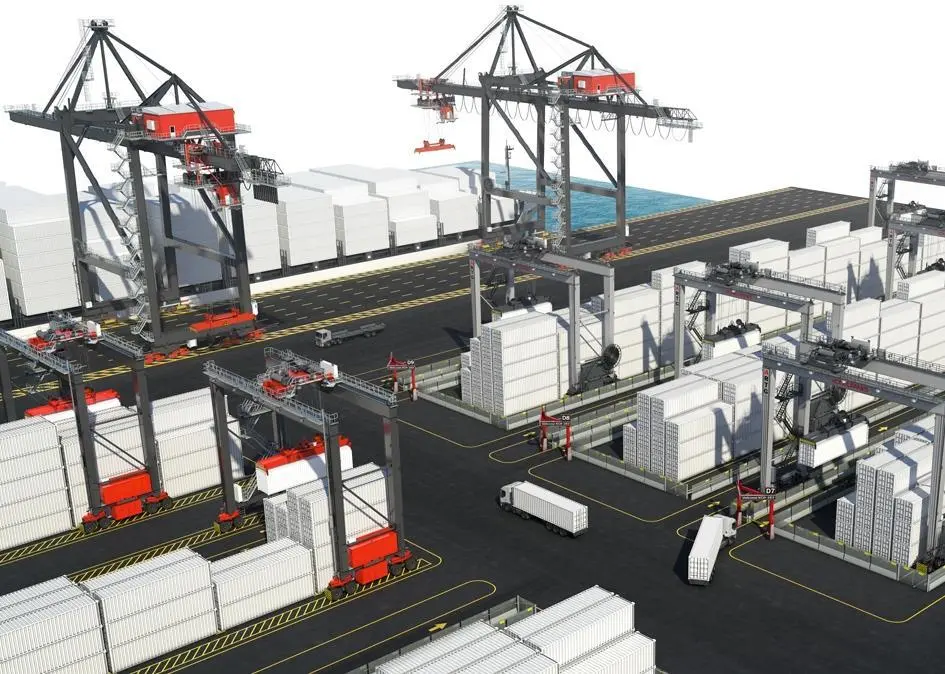
Once upon a time, the thought of machines and robotics doing the work that humans do was the stuff of comic books, B-movies and cult science fiction TV. However, in the 21st century, automation is no longer a science fiction idea. Ports and harbours have found that automation is a notable boon.
But automation technology is not something that has been introduced in the past couple of years. Neil Davidson, senior analyst of ports and terminals, reminds us that automation technology has been around for many years: the pioneers, ECT Rotterdam started way back in 1993. But while automation started back in the 1990s, technology developed at a slow pace.
However, as Mr Davidson explains, recent advancements have meant greater technological breakthroughs. “In recent years, the technology has been advancing much more rapidly, especially in terms of yard automation. This is making it significantly more viable and attractive than in the past, especially for greenfield terminals. The pace at which yard automation in particular is being taken up, is accelerating markedly.”
Ranjan O Bose, containership industry consultant, comments: “While the newest terminals now under construction are designed to employ the latest in automated and remote-controlled operations, this is not an entirely novel concept; Australia’s Port of Sydney began using fully automated straddle carriers eight years ago. At present, physical and design constraints which limit the number of cranes which can simultaneously work a vessel, automation offers the best, (or only) option for port operations to try to keep up with ever increasing operational requirements.”
Mr Bose says that over the past two decades, container terminal productivity has not kept pace with the dramatic growth of vessel capacity and the overall growth of global containerised trade. “The largest vessels now in service are of 18,000 teu capacity, and combined container traffic through the world’s ports last year rose to 620m teu handled.
“With larger vessels now cascading down to African and Latin American service, it is clear that productivity solutions are urgently required not just on the main line Far East/Europe container port calls, but throughout the industry.”
Cost base
There are a number of reasons for using automation at ports. Neil Davidson offers some examples: “The primary reason for deploying automation is to reduce wage costs in high labour cost environments, replacing manpower costs with (lower) capital costs. There are also other reasons for automation including safety and also resilience (wear and tear of equipment is more controlled for example).”
“Automation leads to better controllable, more consistent, safer, and more cost-efficient operations,” adds Dr Yvo Saanen, managing director/chief operating officer of TBA. “Safety becomes of increasing importance, and automation takes people away from the hazards.”
Tuomas Saastamoinen, sales and marketing director of port cranes, Konecranes, comments: “Cost savings is a notable benefit, because due to more controlled functions the crane gets ‘less damaged’, reliability increases and operation gets more predictable. Typically automated cranes are electrically fed and that eliminates the local emissions from the cranes. Safety increases dramatically, because there is no uncontrolled human access to the yard.”
Mr Bose expands on the benefits afforded by automation: “Automated operations are more efficient, reducing both fuel or power consumption, and along with it, the concurrent emissions associated with local diesel engine operations or more distant electricity generation at conventional power stations. The reduction of personnel in the yard in favour of automated and robotic operations automatically reduces the risk for accidents associated with the movement of containers and vehicular mishaps in terminals coping with increasing vessel load and discharge movements.”
Despite these benefits, port automation is still in infancy stages. Neil Davidson says that while automation gets high profile press coverage, only a small proportion of the world’s container terminals can be described as automated – “less than 20 out of something like 800 container terminals worldwide”.
“Of these, only a handful can be described as fully automated, meaning full landside automation where the operation is unmanned from the point where the gantry crane drops the box on the quay through to the yard stack and then delivery to trucks. Most are semi-automated, for example where only the yard stack operations are automated.”
Advance payment
Upfront costs continue to be prohibitive for smaller terminals: “At present, automation is mainly focused on large terminals,” says Mr Davidson. “The up front investment level is very high, and operationally it’s not something you can do on a small scale. So it needs large volumes to make it viable.”
However, Konecranes’ recently-launched ARTG system does offer a solution for smaller terminals. As Mr Saastamoinen says, the system can lower the automation barrier. “Konecranes ARTGs don’t require major civil works investments; they can operate at normal RTG yard. We can also propose the overall process around the equipment covering the job handling, traffic control and so on.”
Mr Saastamoinen says that so far, the majority of automation efforts have been in greenfield terminals, meaning serious investments to yard infrastructure, equipment and software. However, another financial issue is that of cash flow. “The terminal manager is constantly thinking: Can I generate revenue soon enough? Can I open my terminal as planned?
“When building a new terminal, there are naturally many stakeholders and suppliers dealing around it. Suppliers need to be reliable and they need to seamlessly work together, when needed. When dealing with bigger items, like with cranes, the supplier needs to have enough size, knowledge, expertise and required technology to keep their commitments with delivery time, quality and support during the lifetime of the equipment. If any of the key suppliers fail, customer suffers and typically much more than the supplier itself.”
Pay attention
A successfully automated operation requires a great deal of preparation and care. Dr Saanen says that the main points of attention for port operators are the lengthy planning and implementation process and an emphasis on educated staff. Mr Saastamoinen adds that there are various factors that ports should consider before deciding whether automation is worth investment: “Local cost structure, customer mix, competition, owner’s KPI’s, terminal’s business model and approach, local specialties all enter in to the equation when deciding whether automation add value in the big picture or not.”
While port automation may still be in the early stages, the future looks set to include more automated solutions. “We will see more automation in new, large terminals especially, and in particular yard automation,” says Neil Davidson. “Automation of the horizontal transport between quay and yard is more challenging and is seeing a slower take up. What will also be seen more is other forms of ‘automation’, for example, moving crane drivers out of gantry crane cabs and into offices where they will remotely drive the cranes using a monitor and joysticks.”
“The future looks bright: automation is a clear megatrend,” says Mr Saastamoinen. “We believe that automation will rapidly gain ground in the future, it will cover smaller terminals and it will be more and more popular in the emerging markets, especially for ‘better operational predictability’ reasons – operations are not that much depending on the individuals skills.”
“Ports are essential engines of economic growth with evolving manpower needs,” concludes Mr Bose. “While some traditional yard positions may no longer be required, new employment opportunities will be created by increased cargo movements and economic growth. The challenge will be for ports and port labour to be able to accept these changes and work collaboratively to assure that obsolete labour models are updated and adapted so that the inevitable automation of some or all of the port operations results in greater opportunities, rather than fewer, for the local workforce.”
Related Articles
 CONTAINER & CARGO HANDLING
 CONTAINER & CARGO HANDLING