![GreenPort[PortStrategy]](https://www.portstrategy.com/greenport/wp-content/uploads/sites/4/2026/09/GreenPortPortStrategy.svg)



Avoiding slips, trips and weather dips
With health and safety standards at their peak, ports need to keep up with changing rules and regulations. John Bensalhia investigates.
As this article was being written, the so-called ‘Beast from the East’ was crashing into Europe, bringing forbidding and challenging weather conditions. For ports, though, adverse weather is only one of many areas to consider when approaching health and safety in the working environment.
In addition to making sure that operations are as safe as possible during freezing, gusty or rainy weather, port managers must consider other vital factors such as safe equipment, chemical handling, and potential diseases.
Just as importantly, ports must also keep up with changes in health and safety regulations. Factors such as technological advances necessitate such changes. For example, last year saw the release of the ILO’s (International Labour Organization) Revised Code of Practice on Safety and Health in Ports.
As Paul Mackay, manager of employment relations policy for Business New Zealand, told Port Strategy in March 2017, “occupational health and safety is in constant evolution”.
Climate change
Even the weather has changed within the last 10 years. “We live in a world of more and more extreme weather conditions,” says Barry Eagle, director, GripClad (which supplies retro-fit and structural anti-slip flooring surfaces for industrial, commercial and public-access areas). “Climate change in the last 10 years has caused a gradual worsening of weather throughout the world, but particularly along our coastlines.”
Mr Eagle says that ports and dockside facilities are more vulnerable than ever to the direct and indirect impacts of climate change. “A combination of climate change and port infrastructure development can affect local water levels and alter coast geomorphology, which can lead to health and safety risks. In addition, a higher mean sea level and more violent storms present huge challenges to port operations.”
To withstand such risks, Mr Eagle says that structures should be designed with consideration given to a changeable environment that is subject to extreme changes in weather. “Both the port and its supply infrastructure should look to increase and maintain effective drainage against flash floods and storm surges. Also, ensure that policies and procedures are in place for the safe stowing of cranes and lift apparatus in the event of high winds and storms, and keep your handling equipment in the best condition.”
Weather planning
Prior preparation for adverse weather will hold ports in good stead and ensure both minimal disruption and high safety levels. Following on from its previous weather plans for tackling cold weather, the Port of Virginia’s latest one for the 2017/2018 season was hailed as a success.
The three-phase plan counted down from two days before the cold weather took hold through to the advance of the snow. Forty-eight hours before the big freeze, the port ensured that its equipment at the terminals was staged and loaded for use. Twenty-four hours before, salt and brine solutions were pre-prepared at the terminals. Once the snow arrived, the port carefully and regularly monitored the situation to ensure the right allocation of resources, with snow removal taking place at key locations such as berth/pier areas, thoroughfares/rail areas, container stacks, transfer zones and roadways. Terminals were constantly salted in order to prevent freezing or refreezing. Until the terminals were cleared and made completely operational again, the port continued to monitor the state of play of conditions.
Even when the ground isn’t an ice rink, slips and trips are a common cause of workplace injury. GripClad’s Mr Eagle says that this is particularly true of the ports and docks sector. “They can be reduced by installing effective drainage to prevent water pooling, installing anti-slip flooring in high traffic areas, and providing adequate signage throughout.”
From the outset, health and safety measures should be outlined to everyone arriving at a port. Warrenpoint Port, for example, provides an online health and safety induction for employees, contractors and visitors to ensure that everyone coming to the port fully understands the minimum safety requirements.
Mr Eagle adds that regular training classes and H&S handouts are vital to promoting health and safety. But ports must ensure that everyone remembers health and safety standards all the time. “It’s important that the lessons aren’t forgotten as soon as the training is over. The key is encouraging mindfulness. Keep health and safety at the front of employees’ minds and they will be more proactive in maintaining a safe workplace. Adequate signage, safety paint and railings all promote safety and keeps staff aware of the hazards.”
Ports should also prepare for sudden deteriorations in an employee’s health. What if someone gets injured or falls ill? A good method is to run a worst-case scenario situation to sufficiently prepare for such an event.
Trial runs
Identifying areas that need attention in health and safety are just as crucial. Research and studies can pinpoint such areas, with a notable example being the 2016 independent study commissioned by the Institution of Occupational Safety and Health (IOSH) and the International Transport Workers’ Federation (ITF), carried out by Cardiff University.
The research was carried out at six key port/global network terminal operators. The results found that attention was required in seven principal areas which included under-reporting of health and safety outcomes; concentration on immediate safety risks at the expense of longer-term health effects; and limitations of behavioural management systems.
David Walters, Professor of Work Environment at Cardiff University, said that this was the first major study to provide a detailed examination of health and safety arrangements in major container terminals globally. “While its findings indicate a shared commitment among major global terminal operators to address the management of safety in these terminals around the world, they also reveal some significant gaps between the operators’ expectations of the effectiveness of these arrangements and the reported experiences and impressions of workers in the study.
“It shows in particular that there remain very different levels of protection of workers in different jobs, under different employment arrangements and in different terminals in different countries. Unsurprisingly, it shows that the national regulatory and labour relations contexts in which the terminals are situated also play a significant role in determining workers’ experiences of occupational safety and health.”
Richard Jones, head of policy and public affairs at IOSH, adds that the results of the research should be carefully considered by all container terminal operators. “Key messages include the need for operators to regularly review their health and safety systems, particularly how their contractor-workforce is managed, how health and wellbeing are assured and how worker involvement is fostered. As well as helping to prevent injury and illness, effective supply chain management makes really good business sense. We know from other research that positive feelings about work have been linked with higher productivity, profitability and customer and worker loyalty.”
Updated rules
The importance of maintaining high health and safety standards is seen in changing rules and standards, such as the recently revised Code of Practice prepared by the ILO. A number of aspects are addressed, including safeguarding against the risk of disease contact between port workers and the ship’s crew who may have come from areas where the risk of contagious virus is greater.
The revised ILO Code also acknowledges recent advances in technology. Consultations must take place on health and safety aspects between employers and workers and their representatives in order to reach an agreement on the introduction of innovations. In addition, workers and employers should also carefully monitor the usage of new technology.
Meanwhile, with the rise in automated container terminals, a clear health and safety policy should be devised, introduced and regularly reviewed by the relevant national authority in conjunction with employers and workers. In the event of any accidents, dangerous events or disease, the authority should also ensure that a strong system is in place to investigate the occurrence of such incidents.
While the rules may change in health and safety, the core message remains the same. As Mr Jones summarises: “Good health and safety not only helps save lives, it also sustains businesses and is an investment, not a cost.”
BEING PREPARED FOR EVERY EVENTUALITY
How can ports prepare for a sudden, unexpected event that could potentially prove to be life-threatening for an employee? The UK’s Peel Ports came up with a solution to this problem.
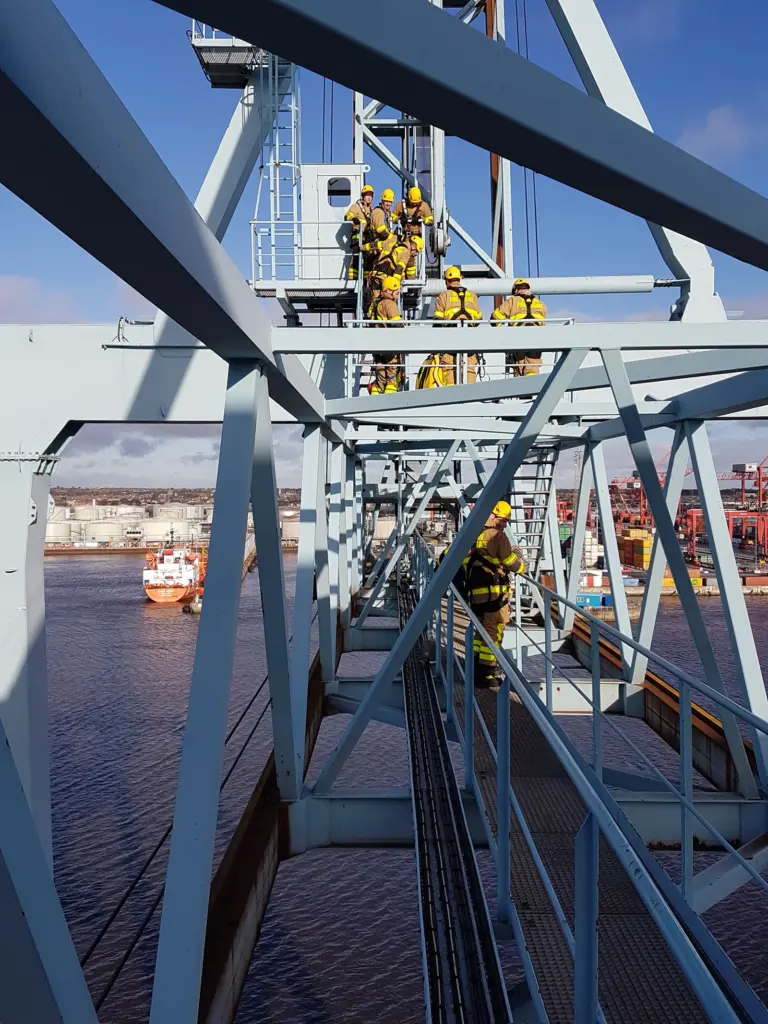
Peel’s Dublin Port invited the Dublin Fire Brigade to its facilities to act out a couple of worst case scenarios involving 110-foot cranes used for container handling.
The first of these involved the re-creation of a fictional situation in which a crane driver suffers a heart attack. Responding to this, the fire brigade scaled the crane, treated the crane driver and returned him to the ground in 28 minutes. A second drill saw the firefighters respond to the fictional crisis of a maintenance engineer suffering spinal injuries, rescuing and helping the man to the ground – who was then subsequently ‘treated’ by paramedics – in a timespan of 40 minutes.
Stephen O’Gara, Peel Ports’ operations manager, said that working closely with the emergency services and preparing for worst case scenarios ahead of time is beneficial for everyone involved and could be crucial when it comes to resolving a potentially life-threatening situation. “Health and safety is absolutely crucial to everything we do at Peel Ports, with our central aim that each member of staff returns home safely every day,” he says.
Related Articles
 CONTAINER & CARGO HANDLING
 CONTAINER & CARGO HANDLING