![GreenPort[PortStrategy]](https://www.portstrategy.com/greenport/wp-content/uploads/sites/4/2026/09/GreenPortPortStrategy.svg)

Back to the drawing board
A reversal in terminal planning priorities has complicated designs, as Iain MacIntyre discovers
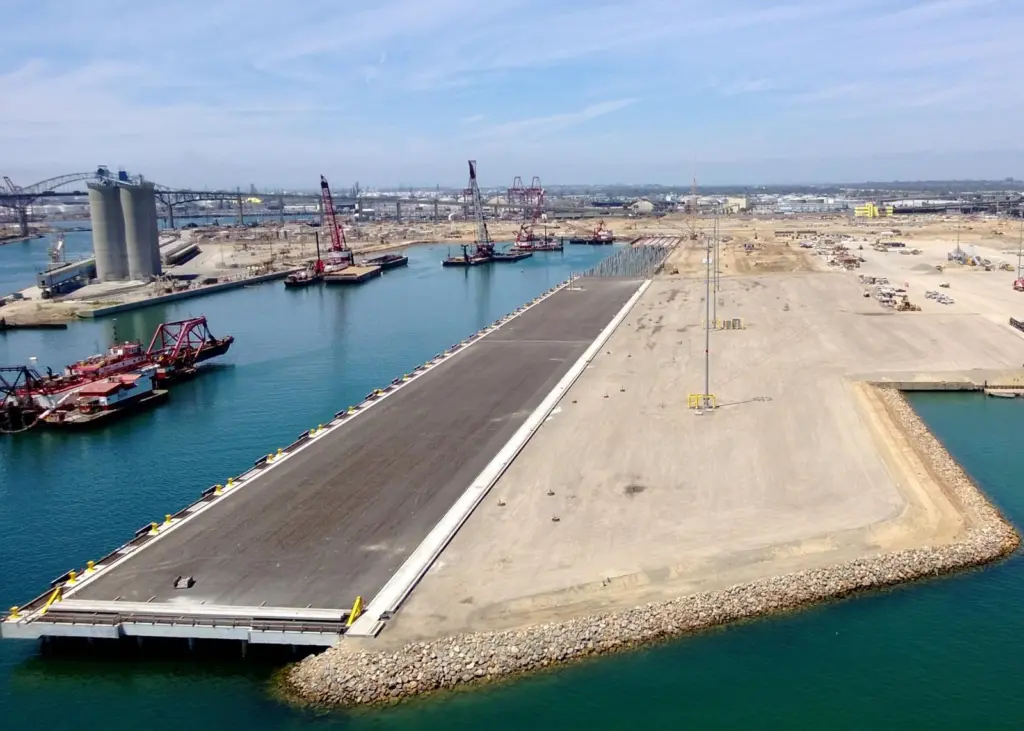
Accommodating ever-increasing vessel dimensions and capacities alongside ports’ mounting service, IT, security and environmental requirements are among the significant challenges before today’s terminal planners.
Whereas at one time terminals were designed with minimal above-ground infrastructure to provide flexibility to adapt with the mode of operation, modern ports are predicated on automated equipment with inherently fixed infrastructure.
Furthermore, planners need to be cognisant of increasing fuel, infrastructure and labour costs, fluctuating container volumes and the impact of the global economy on the investment climate.
To begin tackling such a plethora of challenges, modern planners must first have clearly defined goals for the business case over the required economic life of a terminal, according to Moffatt & Nichol vice-president and senior port engineer Ashebir Jacob.
He cites the following scenarios:
- capacity goals for terminal X might be 4m teu per year with 35% of the containers moved using an on-terminal rail yard
- productivity goals for vessels could be of 150/200 moves per hour, a gate facility that can facilitate a 30-minute or less turn time and an on-terminal rail yard that supports a 24-hour turn time for rail cars
- cost constraints such as infrastructure $700m, equipment $400m and labour $75/box
- emission of the equipment needs to be reduced by half compared with a previous year of footprint
“The goals of the business case should include the required performance and other social-aspect parameters such as capacity, productivity, cost and emissions,” he says.
“The business case then drives the development and selection of fit-for-purpose terminal layout, appropriate infrastructure, container handling equipment and a reliable and scalable terminal operating system and other applications.”
Plan ahead
Mr Jacob says one of the most important aspects of the process is a well-developed integration plan for infrastructure, equipment and IT hardware and software.
“This is achieved by a core team consisting of highly experienced planners, designers and operational engineers using tools such as FlexTerm simulation and emulation software to support owners and operators to make critical decisions throughout the terminal development process – from developing the business case to the terminal go-live.
“The core team at a minimum includes a project executive, project manager, lead planner, lead modeller, infrastructure team leader, equipment team leader, IT hardware and software team leader, representative of the financing team, operations team leader and a maintenance and repair team leader.
“Project realisation also requires close co-operation with selected suppliers in the manufacturing, commissioning and testing phases. New technical solutions are required to solve new challenges in the development of brownfield terminal projects.”
Given the current portfolio offering from suppliers, a terminal conversion is “an even more challenging undertaking than developing a greenfield terminal”, says Mr Jacob.
“In developing brownfield terminals, the planning of phased development will become more challenging as existing terminal and operation needs to be continuously supported.”
Technology aid
Nonetheless, BMT JFA Consultants senior principal engineer Mike Chambers says the evolution of technological aids means it is now possible to design more economic terminal structures with greater confidence.
“In the past more empirical methods were used and a large safety factor applied due to the uncertainty of the evaluation methods,” he says.
A recent case in point was the James Point Port Project (Perth, Western Australia), which saw BMT develop the concept design for the port layout to facilitate three multi-use bulk berths; produce a cost estimate to build the port and include bulk handling equipment and infrastructure; undertake a geotechnical survey to establish the subsea ground conditions; obtain directional metocean data to enable detailed design and vessel operability to be assessed; assess navigability of vessels coming into the port using BMT’s navigation software, REMBRANDT; and develop the design of the port to reference design stage sufficient to take to the next stage.
“The project had environmental approval and a designated development boundary when BMT JFA Consultants was asked to develop the concept further.
“The project involved dredging and reclamation of 14 hectares of land, construction of 820 metres of land-backed berth and development of the port infrastructure.”
Mr Chambers says the programme constraints were very tight and design of the breakwater and coastal protection structures were initially required before investigation work could be completed.
“Complex models were developed to adapt known information and establish a credible design wave so that the concept design could be progressed.
“BMT’s REMBRANDT was used to simulate shipping movements and prove navigability of the approach channels. REMBRANDT can simulate vessel approaches taking into account meteorological and current conditions on a desk top computer. This enables operability limits for vessel movements in the port and can provide early indications of issues with the layout of the port and berths.”
Cruise constraints
Noting the increasing trend to optimise existing port facilities to cater for larger ships, Arup senior associate Ross Newcombe says this is particularly the situation with cruise vessels which have experienced a “spectacular increase in size and numbers over the past decade”.
“Arup has recently assisted Sydney Ports Corporation to upgrade their facility at Sydney’s Overseas Passenger Terminal to receive large cruise vessels such as the Queen Mary 2, and Ports North to undertake a Cruise Shipping Strategy Development to determine upgrading works to the existing facilities to also cater for larger cruise vessels,” he says.
“At the Sydney Overseas Passenger Terminal, Sydney Ports with Arup’s design assistance, implemented an innovative temporary mooring drag anchor system at one end of the quay to enable the larger vessels to moor at the facility until more permanent extension works are constructed.
“Ports today recognise the need to future proof existing and new development for climate change impacts and shipping trends.”
He lists the main challenges in these projects as determining the optimum design vessel size that would call at the ports, managing impacts on the nearby communities (visual, traffic and noise), rehabilitating existing facilities to upgrade to current standards and extending design life and minimising disruptions to existing operations.
Addressing such aspects saw Arup undertake a market study including consultation with the major cruise ships operators, complete detailed condition inspections, conduct a back-calculation of the structural capacity of the existing facilities and use of independent mooring and berthing facilities, and seek consultation with asset managers, operators and harbour masters.
Looking to the future, Moffatt & Nichol’s Ashebir Jacob believes the use of simulation to select the best layout alternative and the use of emulation to debug and optimise the terminal operating system will become standard in the sector.
“One challenge still remains in developing reliable terminal operating systems for automated terminals. Few organisations may be able to provide equipment, a terminal operating system and other IT systems in one package. However, the development of proven layouts and infrastructure design will continue to be independently developed.
“Another challenge is the integration of terminal operating systems and other sub-systems such as equipment control systems and gate management systems, as different types and different vendors of equipment will have different features and requirements. The industry has very little standardised interfaces between systems, which increases integration efforts for the actual integrator. Innovations on wireless communication technology and battery technology may allow the industry to provide more reliable and greener automated equipment.”
Related Articles
 CONTAINER & CARGO HANDLING
 CONTAINER & CARGO HANDLING