![GreenPort[PortStrategy]](https://www.portstrategy.com/greenport/wp-content/uploads/sites/4/2026/09/GreenPortPortStrategy.svg)





Bag for life
On dock bagging services offer value-added services for port customers. John Bensalhia reports
To coin a phrase: “It’s in the bag”. The phrase has been said many a time when the mission’s practically been accomplished or the job’s been done. For ports and harbours, the bagging sector brings a whole new meaning to this saying.
Ports across the globe have realised the potential of bagging facilities. At Jeddah Islamic Port, AJWA boasts a bagging facility which includes seven bagging lines that can accommodate weights from 20kg to 1,000kg. The Victoria Group’s Port of Boston can repackage, split packs or unitise thanks to bagging facilities that allow for greater ease and flexibility.
Recently, it was announced that Helm Fertilizer signed a 10-year deal with PD Ports to run a blending and bagging facility for its fertiliser imports at the Port of Howden. The machine is said to be one of the first of its kind in the country and can bring value and greater efficiency to its supply chain.
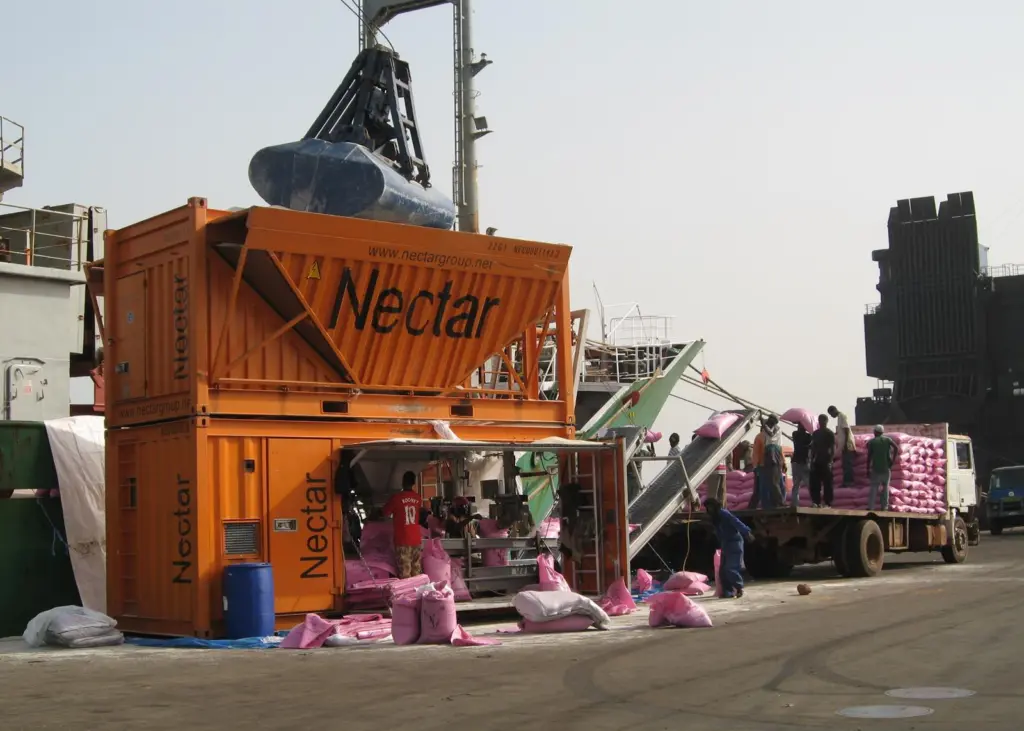
As Han Ozturk, director of Nectar Group explains though, there are various factors that ports must consider when dealing with bagging operations. “A major factor is the number of quays and berths available to handle bulk shipments in any particular port. The bagging operation requires enough space on the quayside for both the bagging machines and enough space for trucks to serve those machines. Nectar operates a fleet of mobile bagging equipment which need very little space to operate, something which is important when operating in smaller ports or where there is limited access space.
“It is also important to consider the volume of other bulk commodities passing through the port. Increased delays at port weighbridges or port entrance/exit gates can hinder the operations and result in an insufficient supply of trucks at the quayside to serve the operation.”
Making money
Financially, bagging facilities can provide considerable benefits. “A vessel carrying pre-bagged cargo may be discharged with the vessel’s gear and slings at a rate of 1,000 mts per day on average,” says Mr Ozturk. “A similar operation involving a bulk shipment may see speeds of up to 4,000-5,000 mts discharged and bagged per day. This difference of over 400% increase results in highly reduced laytime and less congestion at the port in question. This in turn improves cargo throughput and berth utilisation and promotes economical efficiencies and ultimately higher revenues for the port. Once the higher discharge speeds are witnessed the clients will also be happier to bring return business to the port.”
Mr Ozturk adds that quayside bagging allows the client to receive their consignment in a form that is easier to store, handle and move for onward distribution. “Where a terminal has storage facilities within its facility, discharging bulk and then bagging in the port/terminal warehouse allows the port/terminal operator to offer value added services to its clients.”
“In handling bulk ships regularly, ports see a substantial financial gain in offering bagging services,” says Omran Alikhan, chief executive of IMGS. “With mobile bagging systems like the Rapidpack system, ports can services bulk ships at numerous berths. Bagging at a speed of up to 140mt per hour, a single Rapidpack machine can discharge up to 3,300mt per 24 hour day – across two bagging lines. With discharge speeds like this, the port can turn around ships faster thus accommodating more ships. Additionally ports increase revenue streams through offering bagging services to bulk ships charging on a rate per ton basis. The second point can be very lucrative depending on the throughput of cargo at the port.”
Outsourcing bagging operations to third party contractors is becoming more popular for ports: “IMGS handles the entire cycle from initial survey to discharging bulk cargo with related machinery – bagging on to trucks or into warehouse and finally delivery to inland destinations,” explains Mr Alikhan. “Above all, this is an economical model for ports as they simply outsource the entire operation for bulk cargoes, ensuring that the operation is being run effectively to global best standards – all the while offering financial gain to the port.”
“Third party contractors can offer peace of mind in ensuring that the port can deliver its commitments to their clients,” adds Mr Ozturk. “For example, Nectar guarantees various aspects of the operation including bag weight accuracy and speed of bagging combined with international best practice based on years of experience. To achieve success and to bring all these elements together requires close co-ordination with port authorities, local agents, and third party contractors such as transport providers as well as client representatives.”
Come together
It is vital that third party contractors work in partnership with the port. “Only in working together is it possible to provide the right guidance, support and assistance when looking at the development of cargo handling capability within a specific port and to meet the challenges in terms of increasing cargo volumes and variety. Such a partnership can be a winning formula both for the port and the third party contractor working hand in hand in a long term relationship.”
A key element of the bagging industry is training. To enable smooth running operations and meeting the relevant KPIs and guarantees, Nectar continuously trains junior technicians with on-the-job experience in tandem with senior technical staff who run operations. “In doing this, all of the field technicians have years of experience and are able to maintain the equipment as well as provide trouble shooting under high pressure,” explains Mr Ozturk. “It is important to remember that bagging does not take place in isolation: in a typical port environment, technical and supervisory staff need to be trained and fully aware of all aspects of a safe quayside operation. They also need to take into account all the risks including safety of others around them and indeed the suitability of ship’s equipment.”
Mr Alikhan says that because cargo volumes through ports are increasing across the globe, this has led to ports reconsidering their existing infrastructure and modernising capabilities to meet tonnage demands of importers and exporters. “Ports will always act as vital gateway for trade. However, the future will dictate how well the ports adapt to the changing requirements of its customers and it is this that will dictate which ports will lead where others follow.”
Because each port has different cargo handling requirements, there will be various outcomes in the bagging services sector. “There are still a large number of ports with potential to develop bulk cargo trade as a result of changes in trade patterns or developments within a particular country,” says Mr Ozturk. “Such ports will provide an opportunity to utilise quayside bagging services during the development stages of their entry into bulk cargo trade.
“Some of the ports will continue to have pressure to utilise a limited number of berths to handle growing volume and variety of commodities. In such ports, mobile bagging will continue to play a significant role in improving efficiency of cargo handling capacity of the port.
“Other ports with sufficient opportunity to grow in terms of available land and good hinterland connections to support fixed cargo handling facilities will evolve towards dedicated facilities where fixed bagging facilities could be incorporated as a part of cargo handling facilities. In all scenarios, flexible bagging services will continue to play a vital role in progress and development of ports and terminals in the future.”
Related Articles
 CONTAINER & CARGO HANDLING
 CONTAINER & CARGO HANDLING