![GreenPort[PortStrategy]](https://www.portstrategy.com/greenport/wp-content/uploads/sites/4/2026/09/GreenPortPortStrategy.svg)



Breaking box boundaries
The next big jump in containership design is imminent, so what are the implications for containerports, asks Mike Mundy 19No its not going to stop – the 10,000 teu barrier will well and truly be broken in the near future, containerships will continue to get bigger and ports will have to react accordingly.
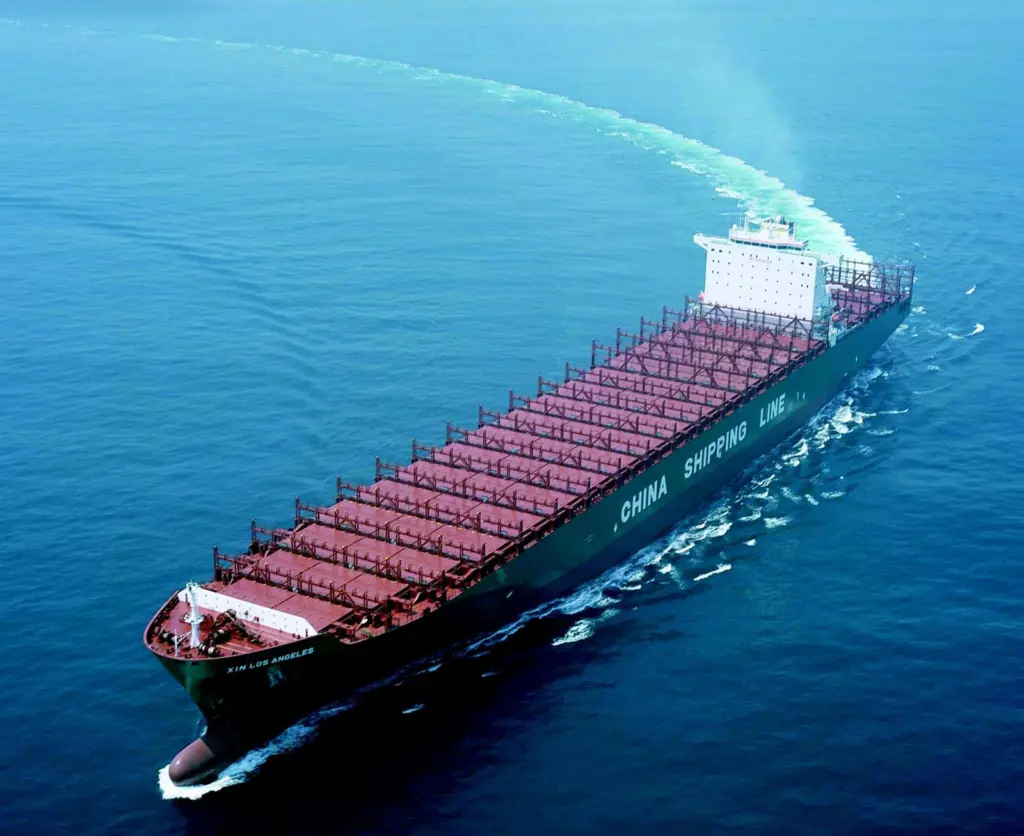
The biggest size of ship in service today is around the 10,000 teu mark. The next step up in size, pioneered by Maersk Line, promises to be much higher: 12,000 teu at least and some analysts say possibly as high 13,000 teu. This ship type is now under construction and can be expected to be introduced into service in the near future.
Previously, it was thought that the 10,000 teu capacity mark would effectively signal the end of big increases in containership capacity as it would prove too difficult to maintain the standard service speed of 25 knots with just one engine, and that a two engine configuration would be too expensive.
The one engine ship design formerly envisaged for a vessel with a capacity in excess of 10,000 teu, with a draught of 14.8m, basically resulted in a square type of vessel configuration really only capable of a 23 knot service speed, hence it was ruled out.
Maersk Line, however, appears to have overcome these limitations through a combination of new ship design and the fact that such a design can operate in a system where Maersk has strong control over the resources that support the ship, especially terminal assets.
The design envisaged – of which no details have been officially released – is, according to informed sources, understood to be a single engine configuration with a much “finer” style of ship type possessing a 15.5m draught. For terminals, the notable implications are that while it will work with current top-of-the-range container crane design, serving 22 rows of containers, the impact of actual draught on crane air draught could become important. It may even present a crane height that is beyond the expectations of a number of terminals now in the planning stage.
THE ACCESS ISSUE Looked at, however, purely from the point of view of port access an interesting question arises, now being studied in certain ports. That is, whether another increase in ship size will bar or reduce entry.
A number of European ports are now known to be looking at this issue utilising historical data to analyse the load characteristics of ships engaged in the Asia-Europe trade, inbound and outbound. The thrust of the analysis is to identify average load patterns and, following on from this, to calculate the real windows of access for various size vessels based on used draught.
Such an approach is based on factors such as identifying in real terms what the average container load weight is. Practically speaking, this is known to be lower than the rated container capacity on inbound vessel calls from Asia. Conversely, on the return leg of vessel deployments there is a significant volume of empty containers alongside a relatively small volume of loaded containers, albeit that some of them possess very heavy cargoes such as tiles.
The aim, therefore, is to predict load factors and following on from this to more accurately identify port access parameters.
Is size everything?
The most striking feature of the Maersk initiative to realise the next major jump in containership capacity is that it is facilitated by what can be described as a closed Maersk system.
The company’s control of landside terminal assets via its sister division APM Terminals, has effectively allowed it to develop terminals in tune with the requirements of this forthcoming new generation of containership.
Indeed, it is debatable as to whether other major operators, such as MSC and CMA CGM, will be able to match this capacity given that they are not in a position to deploy terminal assets in line with the size of ship development, at least not imminently.
Related Articles
 CONTAINER & CARGO HANDLING
 CONTAINER & CARGO HANDLING